
6 Month Milestones: Sitting, Solids and the 6 Month Check (Australia)
The 6 month milestones most babies show: sitting with support, passing toys hand to hand and babbling, plus solids, teething and the 6 month check.

The 6 month milestones most babies show are pushing up on straight arms, rolling, sitting with a hand down for balance, passing a toy from hand to hand, babbling in repeated sounds and turning to their name. Around the same age, solids begin, first teeth may appear, and the 6 month check and vaccines fall due.
The birth-to-24-month picture is in our guide to baby milestones by age; the ages either side are 4 month milestones and 8 month milestones.
What most babies do at 6 months
The checklist below is the 4 to 8 month band of the ACECQA developmental milestones(opens in a new window), the reference used by early childhood educators across Australia. It is the same checklist BabyLog records, in the same areas, so what you tick off at home lines up with what an educator or nurse looks for.
| Area | What many babies do between 4 and 8 months |
|---|---|
| Physical | Rolls from back to stomach; raises head and chest on the stomach; makes an effort to sit alone but needs hand support; reaches for and grasps objects with one hand; plays with feet and toes; makes crawling movements; takes weight on the feet when held standing |
| Social and emotional | Responds to own name; recognises familiar people and stretches arms to be picked up; laughs in social play; begins to show wariness of strangers; may fret when a parent leaves the room; more settled eating and sleeping patterns |
| Communication | Babbles and repeats sounds; copies sounds; makes talking sounds in response to others; smiles and babbles at own image in a mirror; enjoys peek-a-boo |
| Cognitive | Explores objects by looking and mouthing; shakes and stares at a toy placed in the hand; searches for a partly hidden object; repeats interesting accidental actions; enjoys banging objects and scrunching paper; develops food preferences |
A 6 month old sits in the middle of that band, so some skills arrived weeks ago and some will not show until closer to 8 months. As healthdirect(opens in a new window) puts it, all children reach milestones at different times.
Sitting, rolling and passing toys: what is typical
At 6 months, many babies sit with support, roll both ways and pass a toy from hand to hand. Pregnancy, Birth and Baby(opens in a new window) describes a 6 month old pushing up on straight arms, sitting with support, taking some weight on the legs when held standing, often rolling over and sometimes making early crawling movements.
The Raising Children Network's 6 to 7 month page(opens in a new window) places unsupported sitting a little later: a baby who can probably sit up without help, sometimes using their hands for balance, and may start commando crawling. Both pictures are normal.
Babbling and knowing their name
Most 6 month olds babble, squeal and turn towards their name. Squeals, growls and blown raspberries come first, then repeated syllables. A 6 to 7 month old might also pause at a firm "no" and raise their arms to be picked up.
Socially, this is the age of clear preferences. Your baby knows familiar people and may look unsure around strangers or cry when you leave the room. The Raising Children Network(opens in a new window) calls separation anxiety and fear of strangers typical at 6 to 7 months.
Starting solids around 6 months
Australian guidance is to offer first foods at around 6 months, not before 4, while breast milk or formula stays the main food. The NHMRC Infant Feeding Guidelines(opens in a new window), quoted in the NSW Blue Book(opens in a new window), recommend only breast milk until about 6 months, then solids alongside breastfeeding to 12 months or beyond. Iron-rich foods come first, once a day, small and smooth.
ASCIA(opens in a new window), the peak allergy body for Australia and New Zealand, adds the allergy side: introduce the common allergy-causing foods, including well-cooked egg and smooth peanut butter, in the first year, one new food per meal.
ASCIA · How to introduce solid foods to babiesSolid food should be introduced to your baby when they show signs that they are ready to start eating. This is usually around 6 months of age and not before 4 months of age.
Readiness signs and first foods: starting solids in Australia.
Teething at 6 months
First teeth commonly appear from around 6 months, and the timing varies a lot. Pregnancy, Birth and Baby(opens in a new window) lists the usual signs: red swollen gums, dribbling, crankiness, a slight fever and chewing on fingers and fists. A cooled (not frozen) teething ring, a clean finger rubbed on the gums or a cold compress can help.
Teething is not usually linked with illness: a fever of 38°C or more, coughing, a rash, diarrhoea or vomiting are reasons to see a doctor. Anaesthetic teething gels and amber necklaces are best avoided.
Sleep and night feeds at 6 months
A 6 month old typically sleeps 12 to 15 hours in 24, with 2 to 3 daytime naps, and most still wake at least once a night. The Raising Children Network(opens in a new window) notes some babies manage stretches of about 6 hours by 6 months, while many still wake and need settling, some three or four times a night. Rolling, crawling and separation anxiety can all unsettle sleep for a while.
On night feeds, Pregnancy, Birth and Baby(opens in a new window) says breastfed babies often need overnight feeds until around 12 months, while bottle-fed babies may stop from around 6 months. The Raising Children Network adds that from around 6 months, if your baby is growing well, it is fine to think about phasing them out, and fine not to hurry. The by-age picture is in our guide to when babies drop night feeds.
The 6 month check and immunisations
The 6 month visit is a scheduled child health check in most states, and the 6 month vaccines are usually given around the same time. In NSW the check is recorded in the Blue Book(opens in a new window): the nurse or GP plots weight, length and head circumference on centiles, checks the eyes, gums and hips, and reviews hearing, vision, feeding, sleep and immunisations. Other states run a similar check under their own book; the state-by-state schedule is in our guide to baby health checks in Australia.
On the National Immunisation Program(opens in a new window), the 6 month vaccines cover diphtheria, tetanus, whooping cough, hepatitis B, polio and Hib, free of charge. Yearly influenza vaccination is also free from 6 months to under 5 years, and Aboriginal and Torres Strait Islander babies may be offered an additional vaccine.
Questions to ask at the 6 month check
Beyond the Blue Book's own prompts (what your baby likes, anything that concerns you, any lost skill), parents often ask:
- Is my baby ready for solids, and how do I introduce egg and peanut safely?
- How many night feeds are typical now, and is it reasonable to phase them out?
- My baby rolls in the cot. Does anything change about safe sleep?
- What is safe to give for teething discomfort?
- Which vaccines are due today, and when is the next check?
When to talk to your child health nurse
Variation is normal; a persistent absence of skills is what health professionals want to hear about. healthdirect(opens in a new window) and the Raising Children Network(opens in a new window) suggest a chat with your child health nurse or GP if by around 6 to 7 months your baby:
- doesn't make babbling sounds such as "aah" or "ooh"
- doesn't reach for or hold toys, or doesn't pass objects between hands
- doesn't roll, or doesn't lift their head and shoulders on their tummy
- doesn't smile or show interest in people
- doesn't respond to sounds or follow things with their eyes
- uses one hand much more than the other
At any age, a baby who loses a skill they had is a reason to see someone promptly.
Keeping track
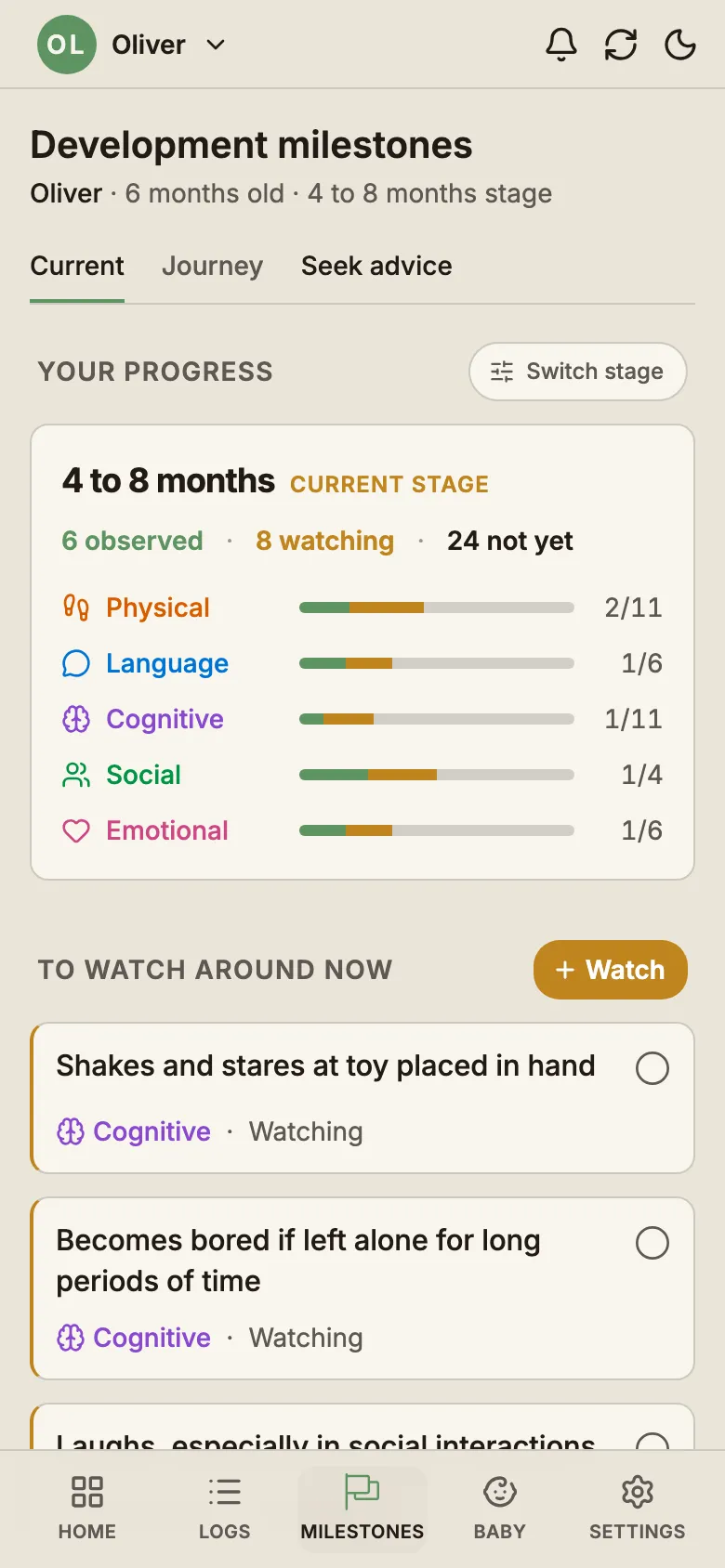
BabyLog's milestone checklist, part of Pro, holds the same ACECQA list as the table above. Mark a skill as one to watch, tap it observed the day it happens, and the date and your baby's exact age sit alongside the feeds, sleeps and nappies you log with a tap and a swipe. Before a check, a checkup report on Pro turns the period into one summary of feeding, sleep, growth and milestones, shareable with a nurse as a private link or PDF. Milestones are built on Australian standards, a guide and not a diagnosis.
Watch these skills arrive in their own time, and track your baby's development with BabyLog. Next up: 8 month milestones.
Common questions
Ready to start tracking?
BabyLog works on any device — iPhone, Android, tablet, or desktop. Setup takes two minutes.
Keep reading
Baby Milestones by Age: Australian Checklist, 0–24 Months
Baby milestones by age for parents in Australia: a 0–24 month checklist of motor, social and language skills, plus the red flags that mean a GP visit.

8 Month Milestones: Crawling, Babbling and Separation Anxiety (Australia)
8 month milestones for parents in Australia: crawling, pulling to stand, pincer grip, babbling and separation anxiety, plus when to see the nurse.