
Formula Feeding Guide (Australia): How Much, How Often, and What the Tin Leaves Out
Formula feeding guide Australia: around 150 mL per kg a day to 6 months, feeds and mL by age, safe preparation, and why the tin's table is a guide.
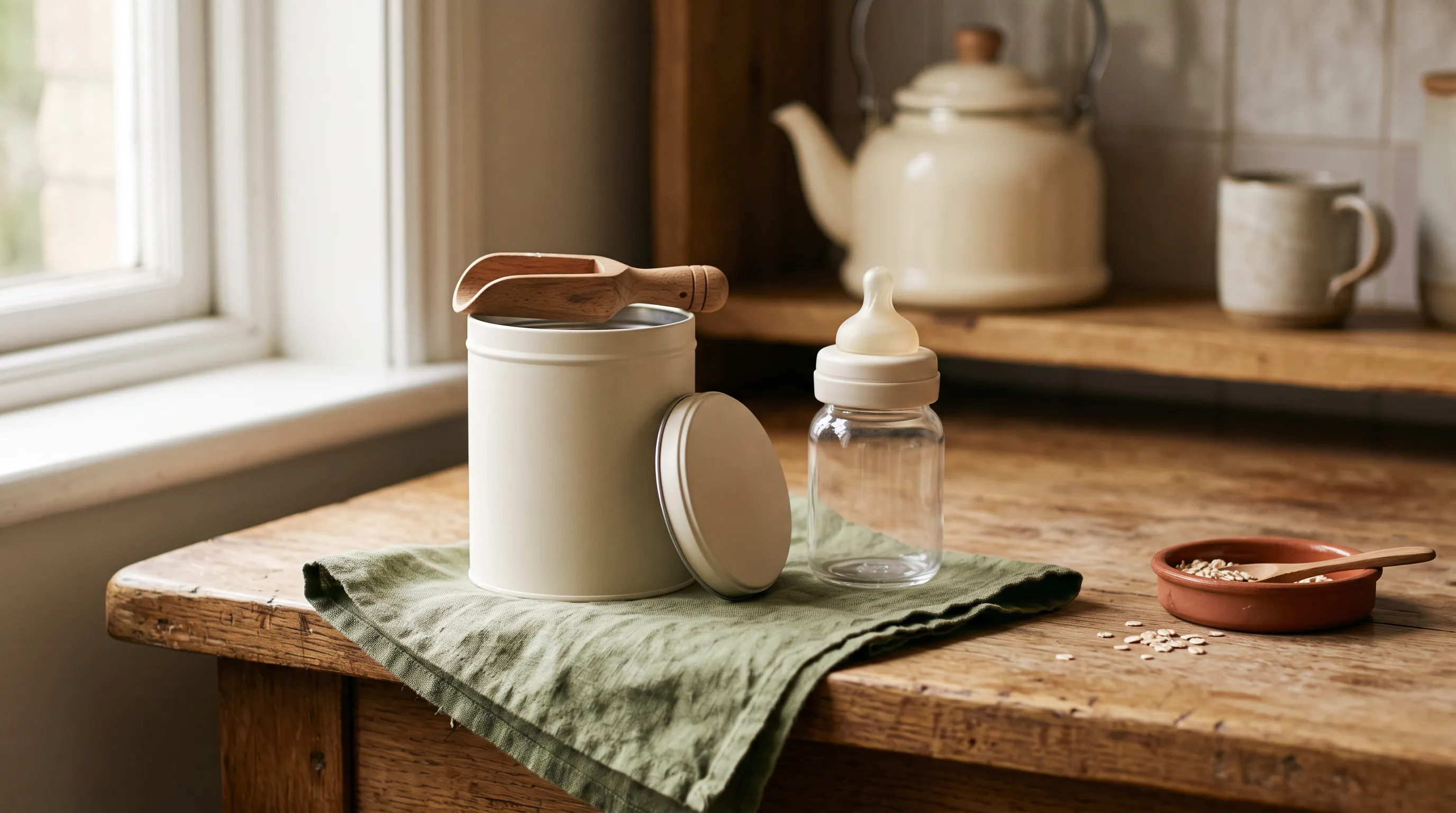
This formula feeding guide (Australia) starts with the number parents search for: around 150 mL per kilogram of body weight a day until 6 months, then about 100 mL per kg from 6 to 12 months. A 5 kg baby takes around 750 mL across 6 to 8 bottles. The tin's feeding table is a guide, not a target.
Those figures come from the NHMRC Infant Feeding Guidelines(opens in a new window) and Pregnancy, Birth and Baby(opens in a new window). Below they become a by-age table, a look at what the tin does and does not tell you, the safe-preparation rules, the signs a baby is getting enough, and one typical day at 4 months. Breastfeeding is a different question; our guide to how much milk a baby drinks covers breast, bottle and mixed feeding together.
How much formula does a baby need?
A formula-fed baby usually takes around 150 mL per kilogram of body weight each day until 6 months, and about 100 mL per kg from 6 to 12 months. The guide is set per kilogram per day rather than per bottle, because a 3.5 kg newborn and a 5 kg newborn of the same age do not drink the same amount. Weight is the anchor; age only changes the rate.
NHMRC · Infant Feeding GuidelinesBottle-fed infants up to 6 months require about 150 ml/kg body weight each day to meet their nutrient needs. Some will require more (up to 200 ml/kg), others less.
The NHMRC adds a step in the middle that the tin often skips: from 3 to 6 months the guide eases to 120 mL per kg, and some babies from 6 months settle closer to 90 mL per kg once solids are on the menu. The Queensland Government(opens in a new window) is clear on the other end of the timeline: babies have formula or breastmilk until 12 months old, with solids building up alongside rather than replacing milk.
Formula feeding amounts by age
The per-kilogram figures below are the NHMRC's; the worked totals follow the examples on Pregnancy, Birth and Baby(opens in a new window). The per-feed column is the daily total at a typical weight divided by the number of feeds in the same row, so a heavier baby or a baby who feeds less often lands at the top of each range.
| Age | Typical feeds in 24 hours | Typical mL per feed | Typical total per day |
|---|---|---|---|
| Days 1 to 4 | 8 to 12 | Around 10 to 25 mL, rising each day | 30 to 60 mL per kg (around 100 to 200 mL at 3.5 kg) |
| Day 5 to 3 months | 8 to 12 (about 12 in the first month, about 8 by 2 months) | Around 50 to 110 mL | 150 mL per kg (around 600 mL at 4 kg, 900 mL at 6 kg) |
| 3 to 6 months | 6 to 8, spaced 3 to 4 hours | Around 120 to 160 mL | 120 mL per kg (around 840 mL at 7 kg, 960 mL at 8 kg) |
| 6 to 12 months | Fewer milk feeds, solids alongside | Around 170 to 200 mL (1,000 mL at 10 kg over 5 to 6 bottles) | 100 mL per kg (around 1,000 mL at 10 kg), some babies closer to 90 mL per kg |
Three things about reading the table. The first-week row is small on purpose: a newborn's stomach is tiny and the amount rises day by day, so 20 mL on day two is ordinary. The feed counts come from NSW Health(opens in a new window), which puts newborns at about 12 feeds a day in the first month and about 8 by 2 months, and from Tresillian(opens in a new window), which has a 3 to 5 month old feeding every 3 to 4 hours. And the NHMRC labels its own table "a guide only", which is the spirit to read every row in.
Weight sets the amount, age sets the rate, and the baby sets the pace. A bottle left half full is information, not a failure.
How often do formula-fed babies feed?
Newborns often feed about 12 times a day in the first month, every 1.5 to 3 hours, and by around 2 months many babies settle at about 8 feeds a day. Those are the NSW Health(opens in a new window) figures for newborns generally, and formula-fed babies sit inside them.
Tresillian(opens in a new window) describes the shape of the change: young babies may want to feed more often, and older babies usually drink more formula at one time. So the day moves from many small bottles to fewer, larger ones. The same page recommends demand feeding, where the baby signals hunger and the parent responds, rather than a clock-driven schedule.
Hunger cues arrive before crying. Pregnancy, Birth and Baby(opens in a new window) suggests feeding on demand when a baby shows those cues, and describes the end of a feed the same way: the baby pulls away from the teat, sucks more slowly, and pauses for longer. Because you hold the bottle, you control the flow more than a breastfeeding parent does, which is exactly why watching the baby matters more than watching the level in the bottle.
What the tin covers, and what it leaves out
The tin tells you how to mix one bottle correctly. It does not tell you how much your baby wants today. Two different jobs, and the second one is the one parents worry about.
The scoop instructions are the part to follow to the letter. Scoop sizes differ between brands, so the NHMRC(opens in a new window) advises using only the scoop from that tin, levelling it, and never adding half scoops or extra scoops. Pregnancy, Birth and Baby(opens in a new window) spells out why: formula made too weak can leave a baby hungry and growing poorly, and formula made too strong can cause constipation and excess weight gain.
The feeding table on the back of the tin is a different kind of information. In the NHMRC's words, the amounts formula packages recommend for various ages are "a guide only and does not necessarily suit every infant". Pregnancy, Birth and Baby says the same thing to parents: use the label as a guide, and expect your baby to need more or less than it says.
NHMRC · Infant Feeding GuidelinesFormula is designed to remain at a constant strength and as an infant grows it is the amount of formula that should increase, not the strength.
That line answers a question a lot of parents ask around the 3 month mark. Formula strength never changes with age. A bigger baby gets more water and more scoops in the same ratio, never a stronger mix. The Raising Children Network(opens in a new window) adds that a stage 1 formula suits babies from birth to 12 months, and moving to a stage 2 or follow-on formula at 6 months is optional rather than better.
How to prepare formula safely
Boil fresh tap water, let it cool to lukewarm, add the water to the bottle first, then the levelled scoops, and throw away anything left in the bottle an hour after the feed starts. The steps below follow the Raising Children Network(opens in a new window) and the NHMRC's preparation table.
- Wash your hands and work on a clean surface, with a sterilised bottle and teat.
- Boil fresh tap water and let it cool to body temperature. Raising Children Network says that takes at least 30 minutes. Cooled boiled water can sit sealed in the fridge for up to 24 hours.
- Read the tin for the water and scoop numbers for the feed size you want, then pour the water in first.
- Fill the scoop loosely from the centre of the tin and level it off. Do not press the powder down, and do not add extra scoops.
- Seal, shake until dissolved, then test a few drops on the inside of your wrist. Just warm is right.
The time limits matter as much as the mixing. Raising Children Network and Pregnancy, Birth and Baby both put the same numbers on them.
| Situation | Time limit |
|---|---|
| A bottle the baby has started | Throw away what is left within 1 hour, because bacteria from the baby's mouth are now in the milk |
| Prepared formula at room temperature, untouched | Discard after 1 hour if it cannot go in the fridge |
| Prepared formula in the fridge (below 5°C, at the back) | Use within 24 hours |
| Made-up formula carried icy cold in a cool bag | Use within 2 hours |
| Cooled boiled water, sealed in the fridge | Use within 24 hours |
| An opened tin of powder | Raising Children Network suggests discarding after one month |
Warm a fridge-cold bottle by standing it in a jug of warm water rather than a microwave, which heats unevenly and can burn a baby's mouth. Many babies are happy with formula cold, and there is no need to warm it at all if yours is.
Signs your baby is getting enough formula
Plenty of wet nappies, steady weight gain, and a baby who is alert and content between feeds are the signs Australian guidance relies on. Pregnancy, Birth and Baby and the NHMRC both count six or more wet nappies a day as the everyday check; Tresillian sets its floor at five or more, with poos that are not hard or dry. Our by-age guide to how many wet nappies a day explains what a heavy nappy feels like.
Weight is the slower signal. Your child health nurse plots it at each visit, and consistent gain along your baby's own centile line matters far more than any single bottle. A baby who finishes 90 mL one feed and 150 mL the next is behaving like a baby, not missing a target.
What changes when solids start
Around 6 months, solids begin as tastes alongside milk, and the formula guide eases from 120 to 100 mL per kg a day. Formula stays the main food until 12 months. The NHMRC notes that some babies drift closer to 90 mL per kg as meals grow, which is the guide adjusting to the baby rather than the other way around.
Two practical shifts come with the stage. From 6 months you can start offering cooled boiled water in a cup, and Raising Children Network suggests aiming to move off the bottle by 12 months. After 12 months a healthy toddler does not need formula, including toddler or stage 3 formulas, and cow's milk can become the drink. If you are choosing first foods, our guide to starting solids in Australia walks through the NHMRC timeline.
One typical day at 4 months
A 4 month old on formula often feeds every 3 to 4 hours through the day, with 1 or 2 milk feeds overnight, in a feed, play, sleep rhythm. That pattern comes from Tresillian's guide to routines at 3 to 5 months(opens in a new window), which also puts the daytime naps at 2 to 3, totalling 3 to 4 hours. The day below is one way it can look for a baby around 7 kg, where 120 mL per kg is about 840 mL. It is an illustration of the rhythm, not a plan to follow.
| Time | Feed | Then |
|---|---|---|
| 6:30 am | Around 140 mL | Play, then the first nap |
| 10:00 am | Around 140 mL | Play, then nap |
| 1:30 pm | Around 140 mL | Play, then nap |
| 5:00 pm | Around 140 mL | Quiet play, bath |
| 8:00 pm | Around 140 mL | Bed |
| Overnight | 1 feed of around 140 mL | Straight back to sleep |
Six feeds of 140 mL come to 840 mL. On a real day one bottle is left half done and another is finished with a hungry look, the naps land at different times, and the total still comes out somewhere near the guide across the week. That week-level view is the useful one. A single bottle is too small a sample to read anything from.
Keeping the amounts straight without doing the maths
Formula feeding gives you something breastfeeding never does: a number on every bottle. The catch is remembering them. Was the 3 am feed 120 or 150? Did your partner do the 6 pm one? By the time the child health nurse asks how much bub is taking a day, the honest answer from memory is a guess.
That is the gap the BabyLog bottle log closes. Open a feed and the time and your baby's usual amount are already there, so a routine bottle is a tap to open and a tap to save, one-handed, half awake. Every caregiver's bottles land on the same timeline, and the day's total sits on the home screen without anyone adding it up. Bottle logging is free.
Log a bottle feed in one tap and let the week tell you how your baby is really feeding.
Common questions
Ready to start tracking?
BabyLog works on any device — iPhone, Android, tablet, or desktop. Setup takes two minutes.
Keep reading
How Much Milk Should a Baby Drink? Amounts by Age (Australia)
Around 150 mL per kg a day to 6 months, about 100 mL per kg to 12 months. Feeds and mL by age from Australian guidance, and the signs of enough.
Starting Solids in Australia: What the NHMRC Guidelines Actually Say
When to start solids, what to introduce first, and how to handle allergies — based on the Australian NHMRC guidelines, not internet opinions.