
Sick Baby Log: What to Write Down for the GP, from Temperatures to Medicine Times
A baby medicine log records each medicine, amount, time and who gave it, beside temperatures, feeds and nappies. What to write, and when to go now.

A baby medicine log is a written record of every medicine your baby is given: the name, the active ingredient, the amount, the time and who gave it. Keep it on one page with each temperature reading, feed, wet nappy and new symptom. When you call the nurse line or see the GP, their first questions are already answered.
One rule comes before any record. A baby under 3 months with a temperature of 38°C or higher needs the nearest hospital emergency department straight away, says Pregnancy, Birth and Baby(opens in a new window). Don't wait to finish a log first.
This guide starts with the red flags, then covers what to write down, a sick-day record you can copy, how two carers avoid giving the same medicine twice, and which thermometer suits a newborn.
When should you see a doctor straight away?
Go to the nearest emergency department straight away if a baby under 3 months has a temperature of 38°C or higher. Call triple zero (000) if your baby is struggling to breathe, can't be woken or has a seizure. Pregnancy, Birth and Baby(opens in a new window) says the age rule applies even if your baby shows no other sign of being sick.
Australian health services set these thresholds. Where they differ, the list gives the stricter one.
- Nearest hospital emergency department, immediately: Under 3 months with a temperature of 38°C or higher (Pregnancy, Birth and Baby; healthdirect).
- Call 000: Struggling to breathe, blue or very pale, or you can't wake your baby (RCH; healthdirect).
- Call 000: A first seizure, a seizure longer than 5 minutes, or not waking after one (RCH).
- Call 000: Drowsy, or a stiff neck (healthdirect).
- Call 000 or go to the emergency department: Signs of severe dehydration, such as sunken eyes, cold hands, low energy or mottled skin (RCH).
- Go to hospital: A rash that doesn't fade when you press on it (RCH).
- See a doctor straight away: Any other rash, or a temperature above 40°C (healthdirect).
- See a doctor right away or go to emergency: No wet nappy for 4 to 6 hours (Pregnancy, Birth and Baby).
- See a doctor: Under 6 months with any sign of dehydration (RCH).
- See a doctor straight away: Vomiting and not keeping fluids or medicine down, a bulging fontanelle, or getting more unwell (healthdirect; RCH).
- See a doctor: A fever that lasts more than 2 days (healthdirect; RCH).
Early signs of dehydration include a dry mouth, dark yellow wee and fewer or less-wet nappies than usual, says Pregnancy, Birth and Baby(opens in a new window).
- Call 000: If your baby has been given too much medicine, or the wrong one, and is having trouble breathing, won't wake or has a seizure.
- Call the Poisons Information Centre on 13 11 26: If you think your baby has been given too much medicine, or the wrong one.
- Ask a nurse: If you're not sure how serious it is, call the healthdirect helpline on 1800 022 222. A registered nurse answers 24 hours a day, 7 days a week (in Victoria it's called NURSE-ON-CALL). Pregnancy, Birth and Baby's maternal child health nurses answer on 1800 882 436 from 7am to midnight (AET).
Trust your instincts. healthdirect(opens in a new window) says to see your doctor straight away if you're concerned.
What should you write down when your baby is sick?
Write down the time of every temperature reading and how you took it, every medicine with its active ingredient, amount and who gave it, every feed, every wet and dirty nappy, and any new symptom. Add when the illness started. Those entries cover most of what a GP or nurse asks first.
Each item has a reason behind it:
- When it started. The doctor will ask how long your baby has been unwell, and a fever lasting more than 2 days is a reason to see a doctor in its own right.
- Temperatures, with the method. The Royal Children's Hospital(opens in a new window) (RCH) notes that readings vary with the type of thermometer, so an underarm reading and an ear reading aren't directly comparable.
- Medicines. healthdirect(opens in a new window) lists four things to write down, quoted below. Add who gave it.
- Feeds. Drinking matters more than eating when a baby is unwell. Note each breastfeed or bottle, and whether it was shorter or smaller than usual.
- Wet and dirty nappies. Fewer wet nappies than usual is one of the signs Pregnancy, Birth and Baby(opens in a new window) lists alongside a fever. Our guide to how many wet nappies a day gives the usual count by age.
- Symptoms, in your own words. A rash, fast or noisy breathing, vomiting, a weak or high-pitched cry, or being more sleepy than usual. Write what you saw and when, not a diagnosis.
The RCH makes one point worth keeping in mind here. Doctors usually focus on the cause of a fever, not the exact number. Watching your baby's breathing, feeding and alertness matters more than checking the temperature again and again, so the record is most useful when it captures those.
A sick-day record you can copy
A sick-day record is one line per event, in time order, with a column for each thing a GP asks about. Copy these columns onto paper, a note on the fridge or a shared phone note:
- Time: Clock time, with the date after midnight.
- Temperature and method: The reading and how it was taken, such as underarm digital.
- Medicine, active ingredient, amount, given by: The name on the pack, the active ingredient, the amount from the label, the carer's initials.
- Feed: Breast: side and minutes. Bottle: mL taken, and if it was less than usual.
- Nappy: Wet, dirty or both.
- Symptoms and notes: Rash, breathing, vomiting, sleepiness, a changed cry, and anything that worried you.
A few habits make the record easier to use:
- Write it as it happens. Two hours later, at 3am, nobody reliably remembers whether the last dose was at 1 or 2.
- Use one record, not two. If each carer keeps their own list, neither list is complete.
- Leave the medicine column empty unless something was given. An empty cell is useful information too.
- Keep the medicine packet with the record. The GP or pharmacist may want the exact product and strength.
healthdirect · Medicines for babies and childrenWrite down the name of the medicine, the time you gave it, the amount and the active ingredient.
Two carers, one medicine: how to avoid a double dose
Keep one written record of every dose where both carers can see it, check the active ingredient on every pack, and ask the other adult to check the dose before it's given.
In Australia, giving the wrong dose of medicine is the most common cause of accidental poisoning in children under one year of age, says healthdirect(opens in a new window). A double dose can happen when each carer thinks the other hasn't given it, or when two products hold the same ingredient.
The label, your pharmacist and your GP set the dose. This guide gives no doses. What Australian health services say about giving medicine safely:
- Follow the pack. healthdirect(opens in a new window) says to check the strength is right for your child's age and weight and follow the instructions on the pack, and to ask your pharmacist if you're not sure how much your child needs.
- Check the active ingredient. Don't give two medicines with the same active ingredient. A combination product can contain paracetamol alongside other ingredients, says healthdirect.
- Have another adult check. healthdirect suggests asking another adult to double-check the dose before you give it, and checking decimal points carefully: 0.5 mL is not 5 mL.
- Use the syringe or cup in the box. Don't mix medicine into a bottle of formula, because your baby may not finish it and then won't get the full dose.
- Put the record where everyone looks. The RCH(opens in a new window) suggests keeping track of doses and leaving a note somewhere visible, like the fridge, to avoid double-dosing.
Some medicines aren't for young babies at all. healthdirect describes paracetamol for babies over 1 month and ibuprofen for babies over 3 months. For a newborn, speak to your GP or pharmacist before giving any medicine, and remember that a fever under 3 months means going straight to emergency.
If your baby has needed paracetamol for more than 48 hours, healthdirect says to see a doctor.
When carers swap over in the night, hand over out loud: the last medicine, the time and the amount. Then check the written record together.
Taking a temperature: which method for which age?
For a baby under 3 months, use a digital thermometer under the arm. Ear thermometers suit older babies. Forehead thermometers and fever strips can be unreliable, so confirm with a digital thermometer. Whatever you use, write the method beside the reading.
Each method, for a baby from newborn to 3 months:
- Digital thermometer under the arm: Yes, the recommended method. Pregnancy, Birth and Baby recommends it for babies younger than 3 months.
- Digital ear thermometer: No. Pregnancy, Birth and Baby recommends ear thermometers from 3 months; the RCH says not under 6 months.
- Forehead (infrared) thermometer: No. Easy to use but not always accurate (Pregnancy, Birth and Baby; SCHN).
- Fever strips and dummy thermometers: No. Not accurate enough, says Pregnancy, Birth and Baby.
- In the bottom (rectal): No. Not recommended because of the risk of injury, says the Sydney Children's Hospitals Network.
- Mercury thermometer: No. No longer recommended because they can break (Pregnancy, Birth and Baby).
Feeling your baby's forehead is a quick first check, but confirm with a thermometer before you act on it. Follow your thermometer's own instructions, and ask your pharmacist or child health nurse to show you how if you haven't used one on a baby before.
What will the GP or nurse line ask?
Expect questions about how long your baby has been unwell, whether they're feeding and drinking as usual, what medicines they've had, and their vaccinations. healthdirect(opens in a new window) lists these as the things a doctor will want to know about a child with a fever.
The full list from healthdirect, with where the answer sits in your record:
- Symptoms, and how long your baby has been unwell: The start time and the symptoms column.
- Whether your baby has been eating or drinking as usual: The feed column, compared with a normal day.
- Your baby's general health: Anything ongoing, written at the top.
- Recent travel: A line at the top.
- Contact with someone who has an infection: A line at the top: a sick sibling, daycare, a visitor.
- Any medicines your baby takes: The medicine column, with times, amounts and the pack.
- Whether your baby has had their childhood vaccinations: The record book; note a vaccination in the last few days, since a fever can follow one.
Wet nappies often come up as well, because fewer wet nappies can signal dehydration(opens in a new window). Read the count straight off the nappy column.
If your baby is due for a routine check soon, our guide to baby health checks in Australia covers what to bring to those visits.
Keeping the record on your phone
BabyLog logs temperature, symptoms and medication free, beside feeds and nappies. Once you add the Medication tile to the home screen, it shows the last medicine, the amount and how long ago, with a carer label such as Mum or Dad when you've set one. It keeps the record only, so the label and your pharmacist still set the dose.
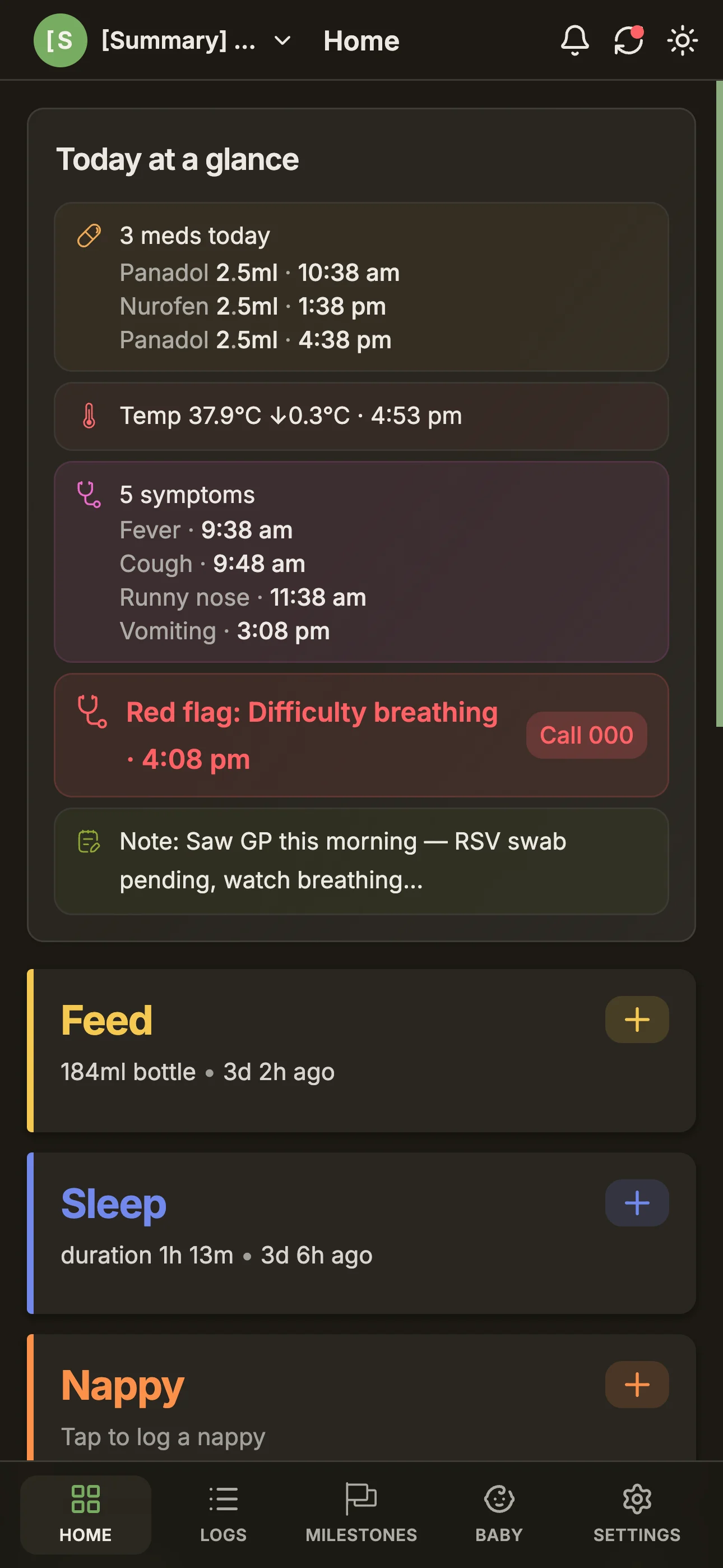
Logging each one takes a few taps, and the time is filled in for you:
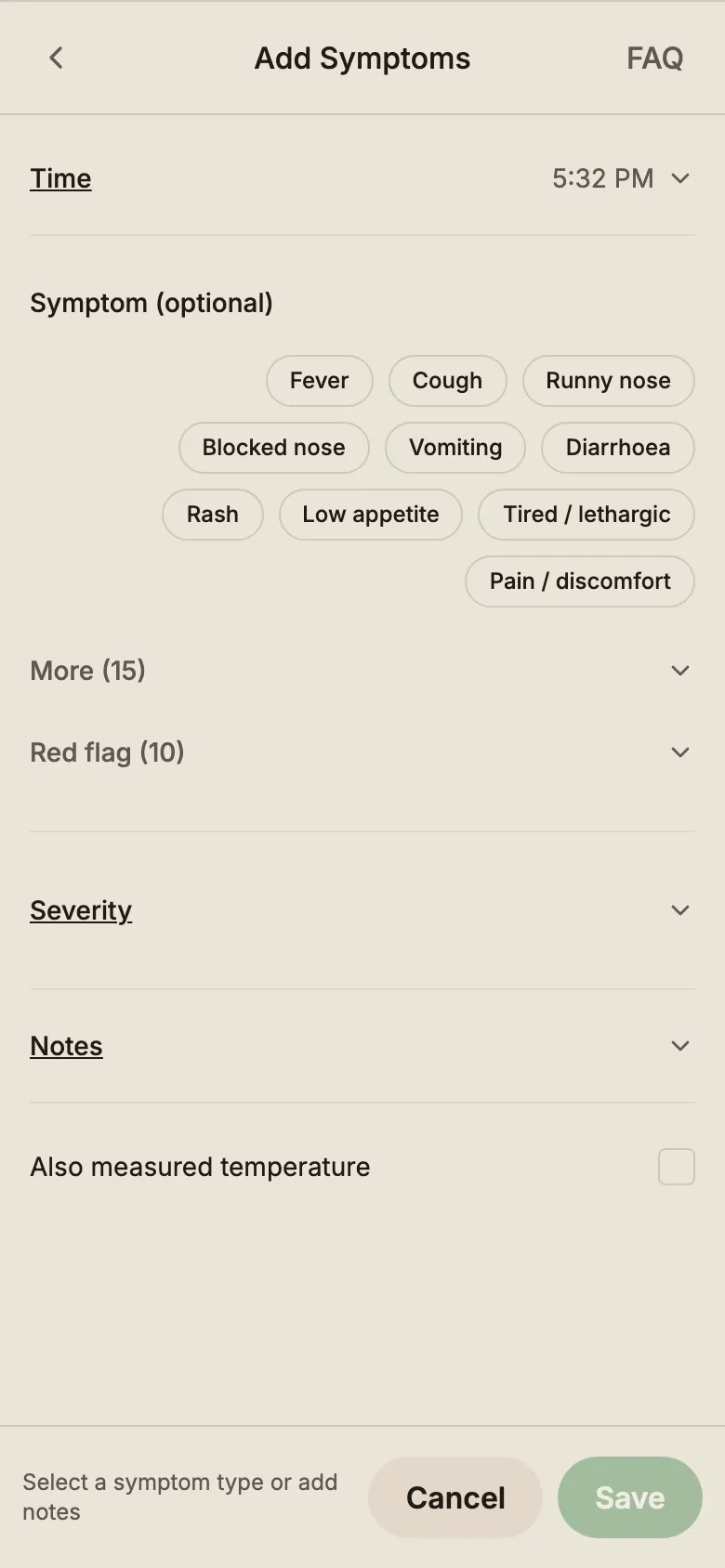
Tap the symptoms you see, open the red-flag list if one applies, and add a note or a temperature.
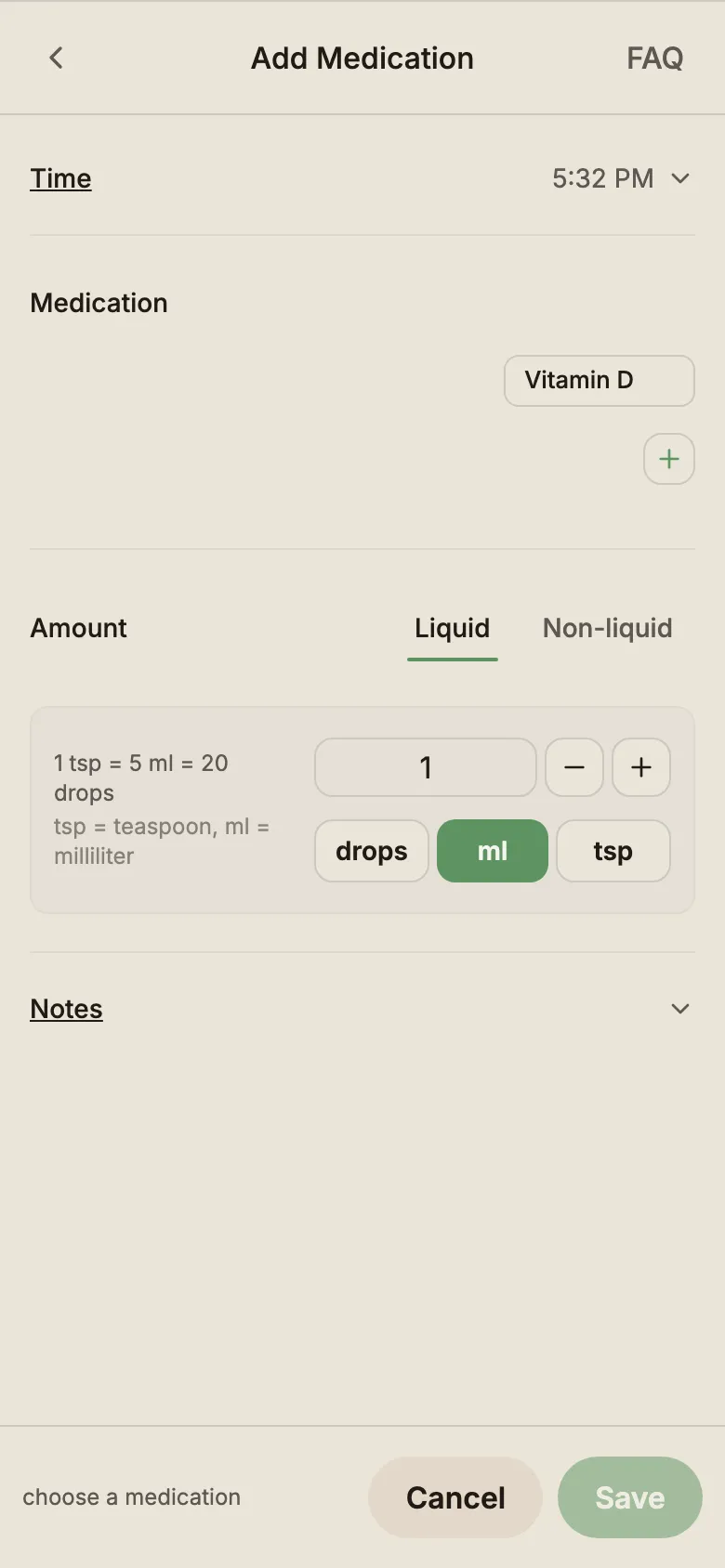
Pick the medicine and the amount in mL, drops or teaspoons, exactly as the label or your pharmacist set it.
If a shared record would help on the next sick night, you can start free in the browser on your phone.
Common questions
Ready to start tracking?
BabyLog works on any device — iPhone, Android, tablet, or desktop. Setup takes two minutes.
Keep reading

How Many Wet Nappies a Day? A By-Age Guide for Parenting in Australia
At least five heavy wet nappies a day once feeding is established. The by-age counts, what a heavy nappy feels like, and the dehydration red flags.
Baby Health Checks in Australia: The Schedule by State and What Happens at Each Visit
Baby health checks Australia: the free child health nurse visits in the first two years, state by state, what each visit covers and what to bring.