
Pumping Schedule for Working Mums: How Many Sessions You Need, With Sample Days by Age
A pumping schedule for working mums: one session per missed feed under 6 months, one or two from 6 months, plus sample days, storage and your rights.
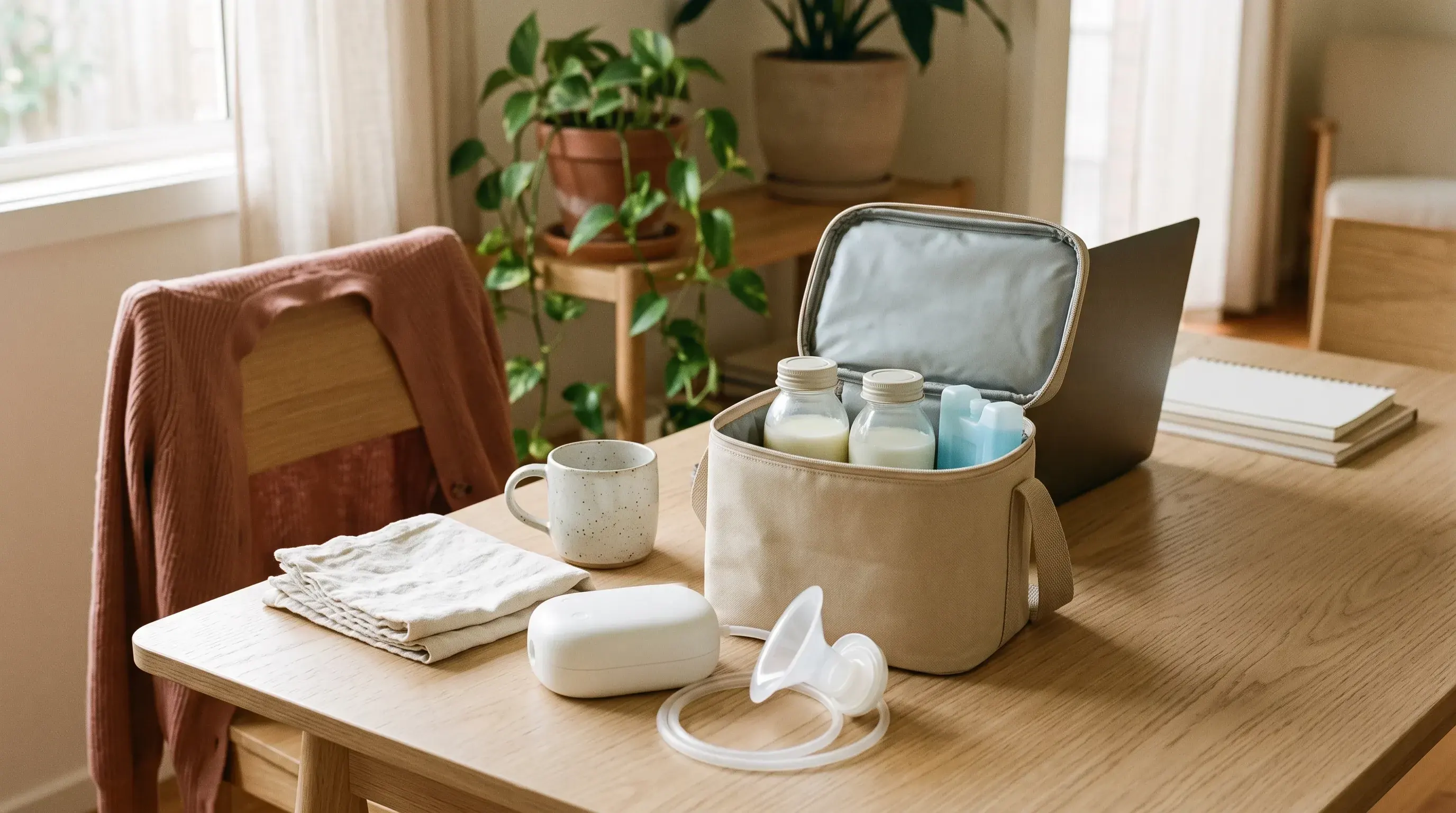
What's a good pumping schedule for working mums? If your baby is under about 6 months, express once for each feed your baby has while you're apart. For a baby who feeds about every 3 hours, that's three sessions in an 8-hour workday. From about 6 months, the ABA suggests two sessions at work, dropping to one as your baby grows.
Either way, breastfeed just before you leave and again as soon as you're back together. Those two feeds carry a lot of the load. Most babies breastfeed more often when you're together, and some feed more overnight.
This guide turns Australian Breastfeeding Association (ABA) and Better Health Channel guidance into sample days by baby age and hours away. It also covers how much milk to leave, storing milk at work, your rights under Australian law and what to pack.
How often should you pump at work?
Express about as often as your baby would feed while you're apart. The Better Health Channel's rule is simple: express as often as you would breastfeed to keep up your supply. How often that is depends mostly on your baby's age.
The ABA's guide to whether you need a milk stash(opens in a new window) sets out what usually works at each stage:
- 0 to 6 weeks: your supply is still being established. Breastfeeding or expressing at least 8 times in 24 hours helps build and protect it.
- 6 weeks to 6 months: many working mums feed just before and after work and express a few times during the day.
- 6 to 12 months: gaps between feeds get longer and solids start. You might begin with two expressing sessions at work and reduce to one as your baby grows.
- Over 12 months: babies can have food and water while you're apart. You might express for comfort and leave whatever milk you have.
If you're going back before your baby is 6 weeks old, the session counts are higher. Our guide to how much breast milk to pump covers the newborn weeks.
Sample pumping schedules by baby age and workday length
Count the feeds your baby will have while you're away, and plan one session for each. The table applies that rule to common shift lengths. The under-6-months column assumes a baby who feeds about every 3 hours in the day. If yours feeds more or less often, adjust the count to match.
| Time away | Under 6 months | 6 to 12 months |
|---|---|---|
| 4 to 5 hours | 1 session | 0 or 1 |
| 8 to 10 hours | 3 sessions | 2, then 1 |
| 11 to 13 hours | 4 sessions | 2 |
At 6 to 12 months, 8 to 10 hours away starts at 2 sessions and drops to 1. Over 12 months, expressing at work is optional, for comfort, whatever the time away.
"Time away" includes the commute. An 8-hour day with 45 minutes' travel each way keeps you apart for close to 10 hours.
These counts are a starting point built from the ABA and Better Health rules. The ABA adds that every mum is different, so you may need to experiment to find a pattern that suits you.
Sample day: a 5 month old, 8-hour workday
Say you work 8:45am to 5pm and your baby is at childcare. Your baby usually has about 8 feeds in 24 hours.
- 7:00am: Breastfeed at home before leaving.
- 8:15am: Childcare drop-off.
- 10:00am: Express at work, 15 to 20 minutes.
- 12:45pm: Express at lunch.
- 3:15pm: Express.
- 5:30pm: Breastfeed at pick-up or at home.
- Evening: Breastfeed on cue, including overnight.
How much milk to leave: the ABA suggests dividing 750 mL, the average daily intake at 1 to 6 months, by your baby's feeds in 24 hours. Here that's 750 ÷ 8, or about 95 mL a feed. Your baby misses three feeds, so you leave about 280 mL, split into small bottles.
Sample day: a 9 month old, same workday
At 9 months, your baby eats solids at childcare and has longer gaps between milk feeds. You start with two sessions and plan to drop the afternoon one first.
- 7:00am: Breastfeed before leaving.
- 11:00am: Express at work.
- 2:30pm: Express (the first to drop).
- 5:30pm: Breastfeed at pick-up or at home.
How much milk to leave: the ABA gives an average of about 600 mL a day at 6 to 12 months. If your baby has 5 milk feeds a day, that's about 120 mL a feed. Two missed feeds means leaving about 240 mL.
Plan one expressing session for each feed your baby has while you're apart, and breastfeed just before you leave and as soon as you're back.
Before you go back: build a small supply
Most mums who express at work don't need a large frozen stash. The ABA says the milk you express one workday is often enough for the next.
The ABA's tips for building that first supply:
- Express a little each day rather than full feeds. Even 20 mL a day adds up.
- Store milk in small amounts of 50 to 100 mL, so carers can offer what your baby needs without wasting any.
- Practise the bottle early. Some breastfed babies take time to accept a bottle. The ABA suggests having someone else offer it, since babies often expect the breast when you're nearby.
The ABA's breastfeeding and work plan(opens in a new window) suggests starting several months ahead. Talk to your manager or HR about your return, decide on a pump, and discuss your baby's feeds with the childcare centre. A few practice runs of the morning routine help too.
A good quality electric pump is usually the most effective for frequent expressing, says the ABA. If your baby is older and eating solids, a personal electric pump may be all you need. The ABA also hires out pumps if you want to try one first.
Keeping your supply steady
Frequent sessions matter more than long ones. The ABA's expressing basics(opens in a new window) says most sessions last about 15 to 20 minutes, or until the milk slows to a drip. Pumping for more than 30 minutes is too long for most mums.
- Keep to your session count. The Better Health Channel says to express as often as you would breastfeed to maintain your supply. Pregnancy, Birth and Baby also lists avoiding missed feeds, and expressing when you need to, as a way to prevent mastitis.
- Feed often when you're together. The ABA notes that most babies breastfeed more often when you're together, and some feed more overnight.
- Help your let-down. Looking at a photo or video of your baby, a warm drink, or slow breathing in a quiet room can all help the milk flow.
- If your supply dips, express more often for a short time. The Better Health Channel suggests expressing every 2 hours during the day for one to two days.
How much you pump doesn't show how much your baby gets:
Australian Breastfeeding Association · Expressing, the basicsDon't judge your milk supply by how much you can express. Pumping and hand expressing are skills that can take time to learn. Babies are usually better at getting milk than pumps.
Storing milk at work and on the way home
At work, keep expressed milk in the fridge, or in a cooler bag with ice bricks if there's no fridge. The ABA says a workplace fridge is often the easiest option. Freshly expressed milk keeps for 6 to 8 hours at 26°C or lower, and up to 72 hours in a fridge.
- Room, 26°C or lower: 6 to 8 hours. Use a fridge if you can.
- Fridge, 5°C or lower: Up to 72 hours, at the back.
- Cooler bag with ice bricks: For the trip home. Then put the milk into the fridge or freezer.
The figures come from the ABA's storage guide(opens in a new window) and healthdirect(opens in a new window), both based on the NHMRC Infant Feeding Guidelines. Freezer times, thawing and warming are in our breast milk storage guide.
Label each container with your name and the date and time you expressed, especially in a shared fridge. Seal the milk and keep it at the back of the fridge, away from the door.
Handing milk over to childcare or a carer
- Label bottles clearly with your baby's name and the date and time you expressed.
- Send small portions. Any milk left after a feed is thrown away, so 50 to 100 mL bottles waste less.
- Agree on a plan for running out. The ABA's guide for carers(opens in a new window) asks them to contact you before offering anything else, even water.
The ABA also has a free "Carer's guide to the breastfed baby" leaflet you can hand to your childcare centre or nanny. For keeping the whole care team on the same page, see our guide to a shared log for nannies and carers.
Your rights at work in Australia
You're entitled to reasonable breaks to breastfeed or express, and a private, safe space to do it. The ABA's guide to workplace support(opens in a new window) says not providing this may be discrimination under the Sex Discrimination Act 1984 and the Fair Work Act 2009.
Whether those breaks are paid is a separate question. The ABA states that no specific Australian law requires paid breastfeeding breaks. Ask your workplace whether its lactation breaks are paid or unpaid.
What the law covers:
- Breastfeeding is a protected attribute. The Fair Work Ombudsman lists it alongside pregnancy and family responsibilities. An employer can't take adverse action against you, such as changing your job to your disadvantage, because you breastfeed.
- No time limit on breastfeeding. The ABA says an employer can't set a date for you to stop, or say support ends after, for example, 3 months.
- Night shifts. Being forced onto night shifts when other shifts are available may be indirect discrimination, the ABA says.
- Flexible work requests. After 12 months with the same employer (casuals have extra conditions), a parent of a child school-aged or younger can request changes to hours, patterns or location of work. The Fair Work Ombudsman(opens in a new window) says the employer must reply in writing within 21 days, and can refuse only on reasonable business grounds.
Each state and territory also has its own anti-discrimination law. For advice on a workplace problem, the Fair Work Ombudsman is on 13 13 94. The Australian Human Rights Commission handles discrimination complaints under federal law.
Breastfeeding Friendly Workplaces
The ABA runs a Breastfeeding Friendly Workplace(opens in a new window) accreditation built on three elements: time to feed or express, a private space, and a supportive culture. If your workplace hasn't supported a breastfeeding employee before, pointing your manager or HR to those pages gives them a ready-made checklist.
What to pack for expressing at work
A pump, a way to keep milk cold, and clothes that open easily cover most of it. The ABA's pumping at work checklist(opens in a new window) is the basis for this list:
- Your breast pump, with its charger or batteries. If you drive between sites, a pump that doesn't need a power point helps.
- The collection kit and sealed bags or containers for the pump parts.
- Storage bottles or bags, plus a marker for labels.
- A cooler bag with ice bricks for the trip home.
- Work clothes that make expressing easy, and a patterned or spare top in case of leaks.
- A photo or video of your baby to help your let-down.
Allow more time than the pumping itself. The ABA's list includes walking to the room, setting up, labelling the milk, cleaning and packing the kit, and getting back to your desk.
When to call the ABA helpline, a lactation consultant or your GP
Get help early if your supply keeps falling, your baby won't take expressed milk, or your breasts become sore and red. An ABA counsellor or lactation consultant can look at your sessions, your pump and your baby's feeds together.
- Call triple zero (000): If you need urgent medical help.
- See a doctor about mastitis: Mastitis can cause a sore, red or swollen area of the breast with fever, shivers or body aches. Pregnancy, Birth and Baby says to see a doctor as early as possible if you think you have mastitis, and to see your doctor if a blocked area doesn't start to improve within 12 to 24 hours.
Talk to an ABA breastfeeding counsellor, a lactation consultant or your child and family health nurse if:
- your output keeps dropping for several days even with extra sessions
- your baby still won't take expressed milk after you've tried different teats, cups and carers
- pumping hurts or damages your nipples.
Helplines: The ABA Breastfeeding Helpline is open 24 hours a day on 1800 686 268. Pregnancy, Birth and Baby connects you with a maternal child health nurse on 1800 882 436. For medical advice after hours, call healthdirect on 1800 022 222.
Keeping track between work and home
On workdays, the milk you pumped and the bottles the carer gave happen in different places. A notebook in the pump bag works: jot the time and mL after each session, and ask the carer to note what each bottle held.
BabyLog's free pumping log records each session's total mL, with an optional left and right split. A partner, grandparent or nanny you invite can log the bottles they give in the same shared log, and you see their entries on your own phone. On Pro, optional reminders can nudge you when a session is likely due.
If a phone suits you better than a notebook, you can start free.
Common questions
Ready to start tracking?
BabyLog works on any device — iPhone, Android, tablet, or desktop. Setup takes two minutes.
Keep reading

A Nanny Log That Actually Works: One Shared Log for Every Carer
A nanny tracker and shared nanny log for families with multiple carers: mum, dad, nanny and grandparents log and see the same day in real time.
How Much Milk Should a Baby Drink? Amounts by Age (Australia)
Around 150 mL per kg a day to 6 months, about 100 mL per kg to 12 months. Feeds and mL by age from Australian guidance, and the signs of enough.