
How Much Breast Milk Should You Pump for a Newborn? Amounts by Day, How Often and How Long
How much breast milk should you pump? Drops at first, 50 to 70 mL a session by day 5, 500 to 800 mL a day by 2 weeks, plus how often and how long.
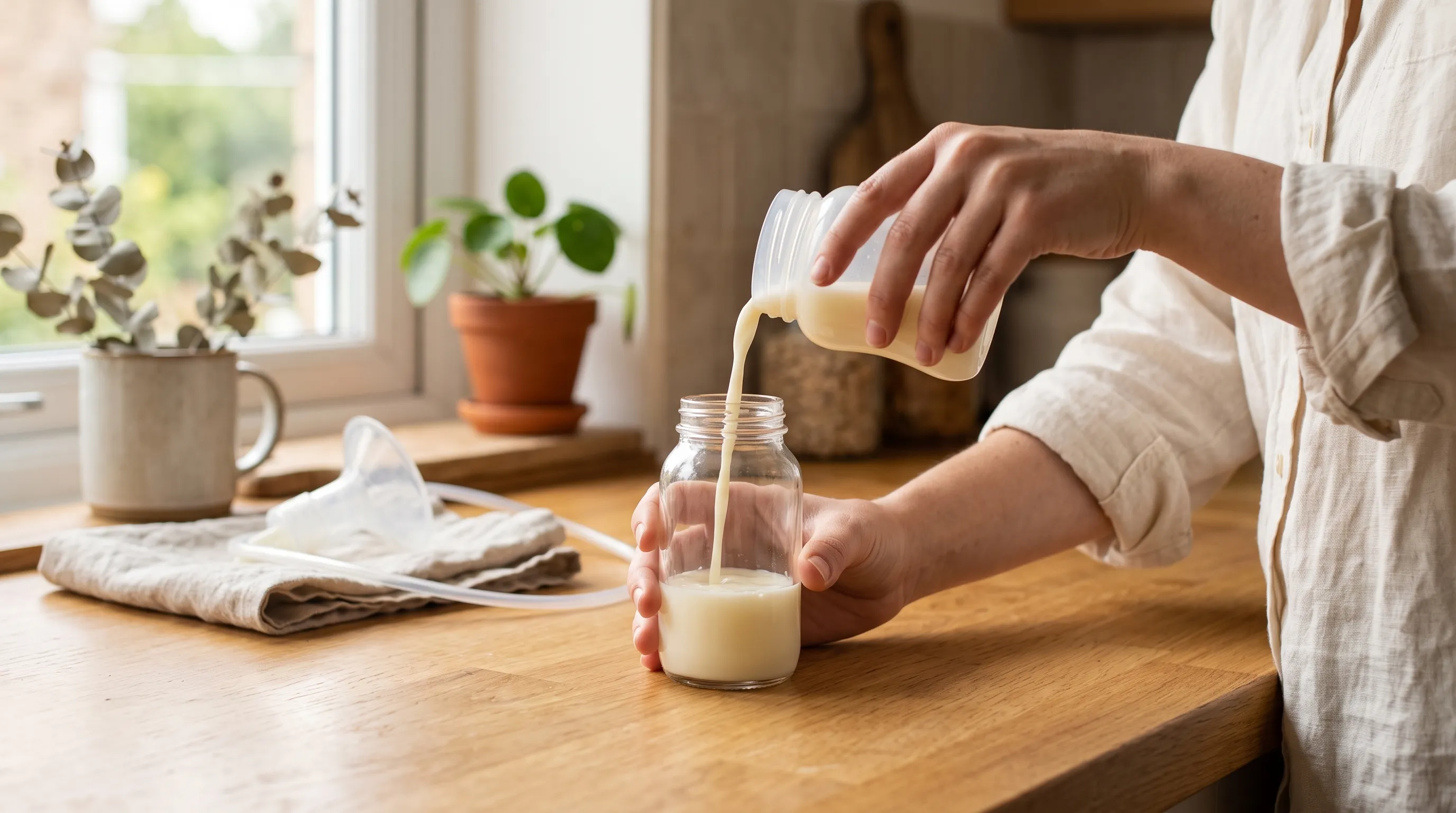
How much breast milk should I pump for a newborn? In the first two or three days, expect drops to a few mL of colostrum each session. By day four or five, around 50 to 70 mL a session is common. By about two weeks, expressing for every feed can give around 500 to 800 mL over 24 hours.
Those figures are for a mum expressing for all of her baby's feeds. If you breastfeed and pump extras for a partner's bottle, expect smaller amounts. The ABA says not to judge your supply by how much you can express.
This guide sets Australian hospital and Australian Breastfeeding Association (ABA) guidance side by side. It covers how often to pump, how long on each side, a sample exclusive-expressing day and when to get help.
How much breast milk should you be pumping?
If you express for all of a newborn's feeds, aim for your output to reach about 500 to 800 mL in 24 hours by around two weeks. It builds in steps:
- Days 1 to 3: a few drops to a few mL of colostrum each time, usually by hand.
- Days 4 to 5: around 50 to 70 mL each session as colostrum changes to mature milk.
- By about 2 weeks: 500 to 700 mL a day, says the ABA(opens in a new window). The Royal Women's Hospital gives 600 to 800 mL, and a WA neonatal guideline gives 500 to 800 mL.
The numbers vary from mum to mum and from session to session. The Royal Women's Hospital in Melbourne says so in its guide to expressing for a premature baby(opens in a new window). The trend over several days tells you more than any single bottle.
How much to expect in the first five days
In the first days, a newborn needs only a few mL a feed, and colostrum comes in drops. The ABA lists what a healthy term baby tends to take at each feed in the first week. The Royal Women's Hospital describes what expressing gives over the same days.
| Baby's age | Baby takes a feed | Pumped a session |
|---|---|---|
| Day 1 | 2 to 10 mL | A few drops to a few mL |
| Days 1 to 2 | 5 to 15 mL | A few drops to a few mL |
| Days 2 to 3 | 15 to 30 mL | Rising |
| Days 3 to 4 | 30 to 60 mL | Rising |
| Days 4 to 5 | Not listed | Around 50 to 70 mL |
The first pumped amounts are colostrum. From days 2 to 4, they rise as colostrum turns to mature milk.
The two columns measure different things, so they won't match exactly. A few mL of colostrum is a normal early session, even though it looks tiny in a bottle.
Colostrum is thick and small in volume, so the ABA suggests hand expressing it and collecting the drops with a small syringe or teaspoon. Between about days two and six, as your milk increases, a breast pump often becomes easier.
If your baby can't breastfeed, start expressing as soon as you can after the birth. The Royal Women's Hospital says ideally within the first six hours.
How much milk in 24 hours, from week 2
By about the second week, expressing for every feed can give around 500 to 800 mL a day. Three Australian sources give overlapping ranges and very similar session counts. Reading them side by side is the quickest way to see what's normal.
| Guidance | Sessions a day | Overnight | By about 2 weeks |
|---|---|---|---|
| ABA | At least 8 | 1 or 2 sessions | 500 to 700 mL a day |
| The Women's (Vic) | At least 8 to 10 | At least 1 session | 600 to 800 mL a day |
| WA (KEMH + CAHS) | About 8 | Included | 500 to 800 mL a day |
The ABA's overnight sessions are at least every 4 hours. For twins, The Women's says 10 sessions a day and about 1,000 mL a day. In WA, the count rises to 8 to 10 sessions if your baby can't attach.
The WA row combines two guidelines. The session counts come from King Edward Memorial Hospital's newborn feeding guideline(opens in a new window). The volume comes from the Child and Adolescent Health Service neonatal breastfeeding guideline(opens in a new window), which refers mums with a low supply to a lactation consultant.
What about weeks 3 to 6?
No Australian source opened for this guide gives a separate pumping figure for each week from week three to week six. What they give is the amount a baby drinks once feeding settles.
The ABA's exclusive expressing guide(opens in a new window) says exclusively breastfed babies aged 1 to 6 months drink an average of 750 to 800 mL in 24 hours. Some need 500 mL, and others more than 1,000 mL. When you express for every feed, your baby's bottles come from your sessions. So once your supply settles, those intake figures are the yardstick for your daily total.
For the amounts a bottle-fed newborn drinks by weight, see how much milk a newborn drinks.
Expressing for every feed, the usual target is about 500 to 800 mL a day by two weeks, from at least eight sessions including overnight.
How often and how long to pump
Pump at least eight times in 24 hours, with one or two sessions overnight. Frequent sessions tell your breasts to make milk. The ABA and The Royal Women's Hospital both say expressing often works better than expressing for longer.
How often
- Every 2 to 3 hours in the day. The ABA says most hospitals recommend this, with at least every 4 hours at night.
- At least 8 sessions a day. The Royal Women's Hospital suggests 8 to 10, or at least 10 for twins.
- No long gaps. The ABA's expressing basics(opens in a new window) says to avoid gaps of more than 6 hours while you build your supply.
Going back to work later on? The pumping schedule for working mums covers how the session count changes once your baby is older.
How long
The ABA says most sessions last about 15 to 20 minutes, or until milk slows to a drip. Pumping for more than 30 minutes is usually unnecessary.
Keep going for a few minutes after the milk stops flowing. That can trigger another let-down.
Each side
- With a double pump: both breasts at once takes about 15 minutes, says The Royal Women's Hospital. The ABA adds that you end up with more milk overall than pumping one side at a time.
- With a single pump: express one breast until the flow slows to drips, then switch. The whole session takes about 25 to 30 minutes.
- If your supply is low: switch back and forth, expressing each breast two or three times. The Royal Women's Hospital calls this switch pumping.
One breast often makes more milk than the other. The ABA says that is normal.
The KEMH guideline suggests double pumping until the flow slows, then each breast on its own with breast compression. Compression means gently squeezing your breast while you express.
Pumping shouldn't hurt. The ABA's guide to using a breast pump(opens in a new window) says to centre your nipple in the flange and start on the lowest suction. Only turn it up as far as feels comfortable.
A sample exclusive-expressing day
Eight sessions, about three hours apart in the day and no gap longer than four hours overnight, meets every Australian source above. The example below is for an imaginary mum expressing for all of her 2 week old's feeds with a double pump. The amounts show the layout only. Your own numbers will differ.
| Time | Left (mL) | Right (mL) | Total (mL) |
|---|---|---|---|
| 6:00am | 40 | 35 | 75 |
| 9:00am | 42 | 36 | 78 |
| 12:00pm | 38 | 33 | 71 |
| 3:00pm | 40 | 34 | 74 |
| 6:00pm | 36 | 32 | 68 |
| 9:00pm | 41 | 35 | 76 |
| 11:30pm | 43 | 37 | 80 |
| 3:30am | 44 | 38 | 82 |
| 24 hours | 324 | 280 | 604 |
How to read it:
- The day total is the number to watch. Here it lands at 604 mL, inside every range above.
- The left side makes more at every session. That difference between breasts is normal.
- The longest gap is four hours, from 11:30pm to 3:30am. That matches the ABA's advice to express at least every 4 hours at night.
Milk from a day like this keeps up to 72 hours at the back of the fridge. Our breast milk storage guide has the freezer, thawing and warming times.
If a partner or grandparent gives the bottles, they can also wash the pump parts. That frees you to sleep between sessions.
What if you're only getting 30 mL?
Whether 30 mL is a problem depends on why you're pumping. If you also breastfeed, a small amount after or between feeds is common, and the ABA is clear about what it does and doesn't tell you.
Australian Breastfeeding Association · Expressing, the basicsDon't judge your milk supply by how much you can express. Pumping and hand expressing are skills that can take time to learn. Babies are usually better at getting milk than pumps.
The ABA also notes that some mums find it easier to express small amounts more often, such as up to 30 mL every 1 to 2 hours.
If you also give formula top-ups, our guide to mixed feeding and top-ups covers how to protect your supply.
If you are expressing for every feed and still get about 30 mL a session at two weeks, your day total is well below the ranges above. These steps come from the ABA and The Royal Women's Hospital:
- Add sessions before adding minutes. More frequent sessions build supply better than longer ones.
- Try short, repeated sessions. The ABA suggests pumping for 5 to 10 minutes at a time, several times over an hour or two.
- Finish by hand. Hand expressing after the pump can bring more milk.
- Use breast compression and switch pumping. The Royal Women's Hospital says both can increase the milk you get.
- Check the flange fit. The ABA says your nipple should sit in the centre of the flange, and the flange should fit well all around.
- Hold your baby skin to skin before or during a session. The Royal Women's Hospital says this helps increase supply.
If low supply doesn't lift, see a lactation consultant.
When to call a lactation consultant, the ABA or your GP
Get help early if your output stays well below these ranges, pumping hurts, or your baby shows signs of not getting enough. A lactation consultant can look at your pump, your sessions and your baby's feeding together.
Talk to a lactation consultant, your midwife or your nurse if:
- your daily total stays well below 500 mL at two weeks while you express for every feed
- pumping hurts, damages your nipples or leaves lumps
- your baby isn't back to birth weight by about two weeks, or has fewer wet nappies than usual.
Helplines: The ABA Breastfeeding Helpline is open 24 hours a day on 1800 686 268. Pregnancy, Birth and Baby connects you with a maternal child health nurse on 1800 882 436.
Mastitis can make part of your breast hot, painful or swollen, with a fever or chills. The ABA says to see a doctor if you don't start to feel better within 12 to 24 hours, or if you feel very unwell.
See a doctor right away, or go to the nearest emergency department, if your baby hasn't had a wet nappy for 4 to 6 hours.
Call 000 if your baby shows signs of severe dehydration, such as being less active than usual, sleepy or confused, sunken eyes, cold hands and feet, or no tears when crying.
The wet nappies guide covers the nappy count and dehydration signs in more detail.
Keeping count across eight sessions
By the second night of eight sessions, the numbers on the bottles start to blur. A notebook by the pump works: one line per session, with the time and the mL from each side, added up once a day.
BabyLog's free pumping log keeps the same record on your phone: the session's total mL, split between left and right if you want, and your partner sees each session on their own phone. On Pro, optional reminders can nudge you when a session is likely due.
If a phone suits you better than a notebook at 3am, you can start free.
Common questions
Ready to start tracking?
BabyLog works on any device — iPhone, Android, tablet, or desktop. Setup takes two minutes.
Keep reading
How Much Milk Should a Baby Drink? Amounts by Age (Australia)
Around 150 mL per kg a day to 6 months, about 100 mL per kg to 12 months. Feeds and mL by age from Australian guidance, and the signs of enough.
How Many Wet Nappies a Day? A By-Age Guide for Parenting in Australia
At least five heavy wet nappies a day once feeding is established. The by-age counts, what a heavy nappy feels like, and the dehydration red flags.