
6 Week Milestones: What Most Babies Do at 5 to 7 Weeks in Australia
6 week milestones: eye contact, first smiles and short head lifts, what changes from week 5 to 7, the 6 week vaccines and when to see your nurse.
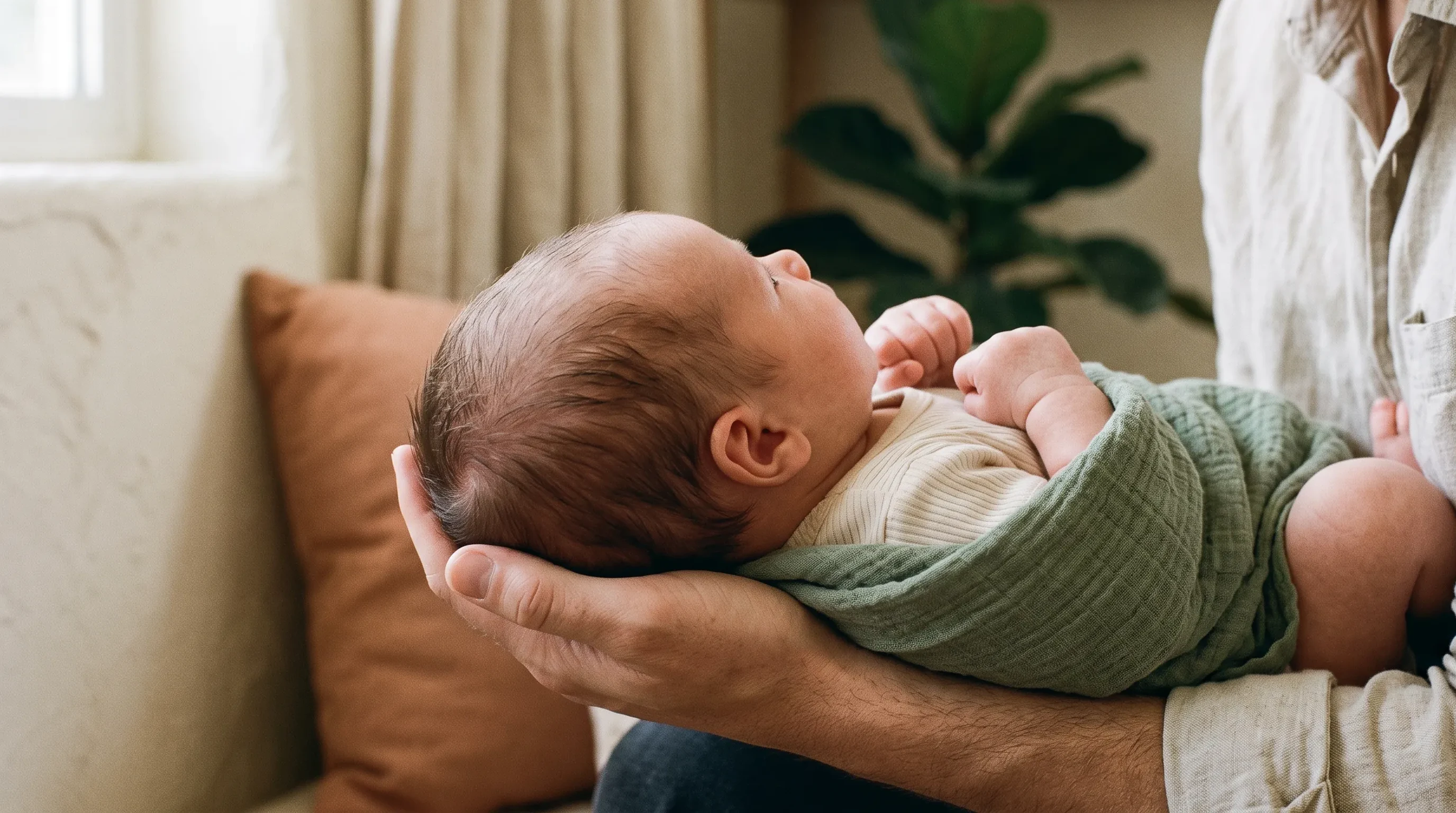
6 week milestones are mostly social. At 6 weeks most babies look at faces, hold eye contact for a moment, turn towards a familiar voice and lift their head briefly on their tummy. Most smile back at you by about 8 weeks.
Around 6 weeks crying often peaks, a growth spurt is common, and the first scheduled vaccines can be given.
Few Australian sources describe week 6 on its own. Pregnancy, Birth and Baby writes about 1 month and 2 months, and the NSW and Victorian child health books list skills at 8 weeks. This page lines those sources up for weeks 5, 6 and 7.
It sits between 1 month milestones and 2 month milestones, inside the wider guide to baby milestones by age.
What does a 6 week old do?
A 6 week old spends most awake time looking at faces, listening for familiar voices and practising short head lifts on their tummy, and crying is often at its loudest.
The list groups these skills by area. Each item draws on the birth to 4 months band of ACECQA's developmental milestones(opens in a new window), narrowed to 6 weeks with the 1 month(opens in a new window) and 2 month(opens in a new window) pages at Pregnancy, Birth and Baby.
What many 6 week olds do:
- Social: Look at faces and make eye contact when held about 20 cm from your face; turn towards voices; some are starting to smile back.
- Movement: Squirm, wave their arms and kick their legs; lift their head briefly and turn it to the side on their tummy; hands start to relax out of fists.
- Seeing and hearing: Prefer faces to objects; look at edges and high-contrast patterns; follow a slow-moving object briefly; startle at a loud noise.
- Sounds: Cry to show a need; make small throaty noises when content; cooing and gurgling begin for many by 2 months.
- Crying and settling: Crying builds towards a peak at 6 to 8 weeks. Crying from hunger or discomfort usually settles when held, but peak-time crying can go on even when you are doing everything right.
- Feeding and growth: A growth spurt is common at about 6 weeks, with a fussier, hungrier baby for a few days.
healthdirect(opens in a new window) notes that most children learn skills in the same order, but not always at the same time. Read each item as a set, not a score.
5, 6 and 7 weeks: what changes week to week?
Week 5 carries on the 1 month skills, week 6 brings the crying peak, a common growth spurt and the first vaccines, and week 7 is the run-up to the 8 week lists your nurse checks against. No Australian source splits these weeks, so the list places each item at the earliest week a source names for it.
- Week 5: Brief head lifts and a turn to the side on the tummy; a preference for faces over objects; turning towards your voice; crying that may keep increasing (Pregnancy, Birth and Baby, 1 month; RCH, crying and unsettled babies).
- Week 6: Eye contact and focusing on toys; a growth spurt; the start of the 6 to 8 week crying peak; the first scheduled vaccines, which can be given from 6 weeks; the NSW 6 to 8 week check window opens (RCH, tummy time; Pregnancy, Birth and Baby, 2 months; SCHN; National Immunisation Program; NSW Blue Book).
- Week 7: Still inside the crying peak and the check window; tummy time getting easier with practice (SCHN; RCH, tummy time).
- Week 8, next: Smiles when you talk or smile; makes sounds other than crying; holds head up on the tummy; watches you move; looks at a toy for several seconds (NSW Blue Book; Better Health Channel, 8 week visit).
The week 8 item matters in week 7 because it is what the next check uses. The NSW Blue Book(opens in a new window) lists those skills on its 8 week page. Victoria's 8 week visit(opens in a new window) lists smiling, bringing hands together, making sounds like they are "talking", looking at you when you talk, and copying your facial expressions.
Each 8 week skill is covered in our 2 month milestones guide.
The NSW list is adapted from the US CDC Learn the Signs. Act Early.(opens in a new window) programme, used here as supporting evidence. The CDC counts a milestone as something 75% or more of children can do by that age. So a skill on the 8 week list is one most babies have by 8 weeks, and many have earlier.
When do babies first smile?
Most babies smile back at a familiar face by about 8 weeks, so a first social smile in weeks 5 to 8 sits inside the usual range. Pregnancy, Birth and Baby lists smiling back when you smile as a 2 month skill. The NSW Blue Book's 8 week list and Victoria's 8 week visit both include smiling.
No Australian seek-advice list names a missing smile at 6 weeks. Eye contact comes first. The Royal Children's Hospital(opens in a new window) suggests medical advice if a baby is six weeks old and not making eye contact or focusing on toys. The smile is flagged later: the Blue Book's act-early list at 8 weeks includes a baby who doesn't smile at people.
The Blue Book asks parents two questions before the 6 to 8 week check: does your baby smile at you, and does your baby look at your face and make eye contact? If the answer to either is no, the book asks you to tell your nurse or doctor.
Eye contact first, then the smile. Most babies have both by 8 weeks.
Head control and tummy time at 6 weeks
At 6 weeks most babies can lift their head briefly and turn it to the side on their tummy, and by 8 weeks most can hold it up for short moments.
Pregnancy, Birth and Baby places the first brief lift at the end of the first month. The NSW Blue Book lists holding the head up on the tummy at 8 weeks.
Head control is built during tummy time, and it grows with practice. The Royal Children's Hospital(opens in a new window) says tummy time can start from birth. Begin with one to two minutes and build towards 10 to 15 minutes at least three times a day by around four months.
Pregnancy, Birth and Baby's 2 month page suggests a few minutes at a time, adding up to at least 30 minutes across the day.
Protests are normal. The RCH explains that a young baby's head is heavy, so tummy time is hard work. It works best when your baby is awake, not too tired and not straight after a feed. Always stay with your baby during tummy time, and always put them on their back to sleep.
Our guide to tummy time: when to start has positions to try when the floor is a battle.
Feeding and sleep at 6 weeks
Feeding at 6 weeks often ramps up for a few days. Pregnancy, Birth and Baby notes that babies often have a growth spurt at about 6 weeks, which can make them fussier because they want to eat more than usual.
If feeds are bunching into the evening, the guide to cluster feeding and the witching hour covers what is normal. Bottle amounts by age are in how much milk a baby drinks.
At 6 weeks many babies still sleep most of the time, but awake stretches in the day start to lengthen. ACECQA notes a baby in the birth to 4 months band may sleep most of the time. Pregnancy, Birth and Baby describes a 2 month old settling into a daily rhythm and staying awake more during the day.
Sleep on the back, every time. The newborn sleep guide covers wake windows and safe sleep.
Crying is often worst at 6 to 8 weeks and better by 3 to 4 months, according to the Sydney Children's Hospitals Network(opens in a new window). Our 2 month guide covers why, and what helps.
Which immunisations happen at 6 weeks?
The first scheduled vaccines on the National Immunisation Program are listed at 2 months and can be given from 6 weeks of age. The National Immunisation Program schedule(opens in a new window) (June 2026 edition) lists four at this point.
- 6-in-1 combined: Protects against diphtheria, tetanus, whooping cough (pertussis), hepatitis B, polio and Haemophilus influenzae type b (Hib). Given to all babies. One injection covers all six.
- Rotavirus: Protects against rotavirus gastro. Given to all babies. The first dose must be given by 14 weeks of age.
- Pneumococcal: Protects against pneumococcal disease. Given to all babies.
- Meningococcal B: Protects against meningococcal B disease. Given to Aboriginal and Torres Strait Islander children. The schedule carries an aftercare note for this vaccine; ask your immunisation provider about it.
NSW Health · My Personal Health Record (Blue Book), 6 to 8 week visitThe first scheduled vaccinations start at 6 weeks of age to protect against serious preventable diseases, including whooping cough (pertussis) and pneumococcal.
Some states fund extra vaccines on top of the national schedule, so check your state's schedule or ask your immunisation provider.
The rotavirus age limit is one reason not to leave this appointment late. The Blue Book notes that the 4 month vaccines repeat the 6 week ones. Ask the immunisation provider which reactions are common and what to watch for afterwards.
The 6 to 8 week visit
The 6 to 8 week check is the first full child health check after the newborn visits, booked at 6 to 8 weeks in NSW and at 8 weeks in Victoria. Our baby health checks guide covers what the nurse checks there, state by state, and what to ask.
When to talk to your child health nurse or GP
Variation is normal at 6 weeks. A skill that stays missing, or one your baby had and lost, is what nurses want to hear about. Drawing on the Royal Children's Hospital(opens in a new window), the ACECQA seek-advice list, Pregnancy, Birth and Baby(opens in a new window) and the NSW Blue Book, talk to your nurse or GP if your baby:
- is six weeks old and not making eye contact or focusing on toys
- is not responding to familiar faces or showing interest when you play with them
- by about 8 weeks, is not smiling at people
- is not improving at tummy time after six to eight weeks
- is not moving their arms or legs
- feels very stiff or very floppy
- is not moving both sides of their body the same
- is developing a misshapen head or strongly prefers turning their head to one side
- does not react to loud sounds
- cries a lot, arches their back or is hard to settle
- is not feeding as expected
- has stopped doing something they had already learned
Pregnancy, Birth and Baby's maternal child health nurses answer calls on 1800 882 436, 7am to midnight AET, 7 days a week.
healthdirect also lists these as signs a baby may need urgent and immediate medical care:
- floppy, irritable or less responsive, or a weak cry
- breathing fast, noisily or with difficulty
- very pale skin, or a purple rash that does not fade when pressed
- drinking less than half the usual amount, fewer wees than usual, or no wee in 6 hours
- vomiting green fluid or blood, or blood in the poo
- a possible seizure
Crying at this age can wear anyone down. The Royal Children's Hospital(opens in a new window) says it is okay to put your baby in a safe place, such as their cot, and take a few moments to calm down.
If you are worried you might hurt your baby, place them in the cot and get support from another adult straight away, or call PANDA on 1300 726 306 or Lifeline on 13 11 14. Never shake a baby.
Keeping a record of the firsts
BabyLog's milestone checklist is built on the same ACECQA framework as the first list on this page, as a guide rather than a diagnosis.
Mark a milestone as observed and BabyLog saves the date with a note, so when the nurse asks about smiling and eye contact at the 6 to 8 week check, you have the dates to hand. Milestone tracking is part of BabyLog Pro, and the developmental milestones page shows how it works.
Weeks 5 to 7 are loud and tiring, so watch for the eye contact and let the smile arrive in its own time.
Common questions
Ready to start tracking?
BabyLog works on any device — iPhone, Android, tablet, or desktop. Setup takes two minutes.
Keep reading

2 Month Milestones: What Most Babies Do at 8 Weeks in Australia
2 month milestones: the social smile, head lifting and cooing most babies show around 8 weeks, plus the 6 to 8 week check and the first immunisations.

Newborn Development Week by Week: Milestones From Birth to 8 Weeks
Newborn development week by week: reflexes in week 1, head lifts by 4 weeks, smiles and cooing by 8 weeks, plus the newborn and 6 to 8 week checks.