
1 Month Milestones: What Most Babies Do at 3 to 4 Weeks, and When to Ask Your Nurse
One month milestones: the brief head lift, the interest in faces and the startle most babies show at 3 to 4 weeks, and when to call your nurse.
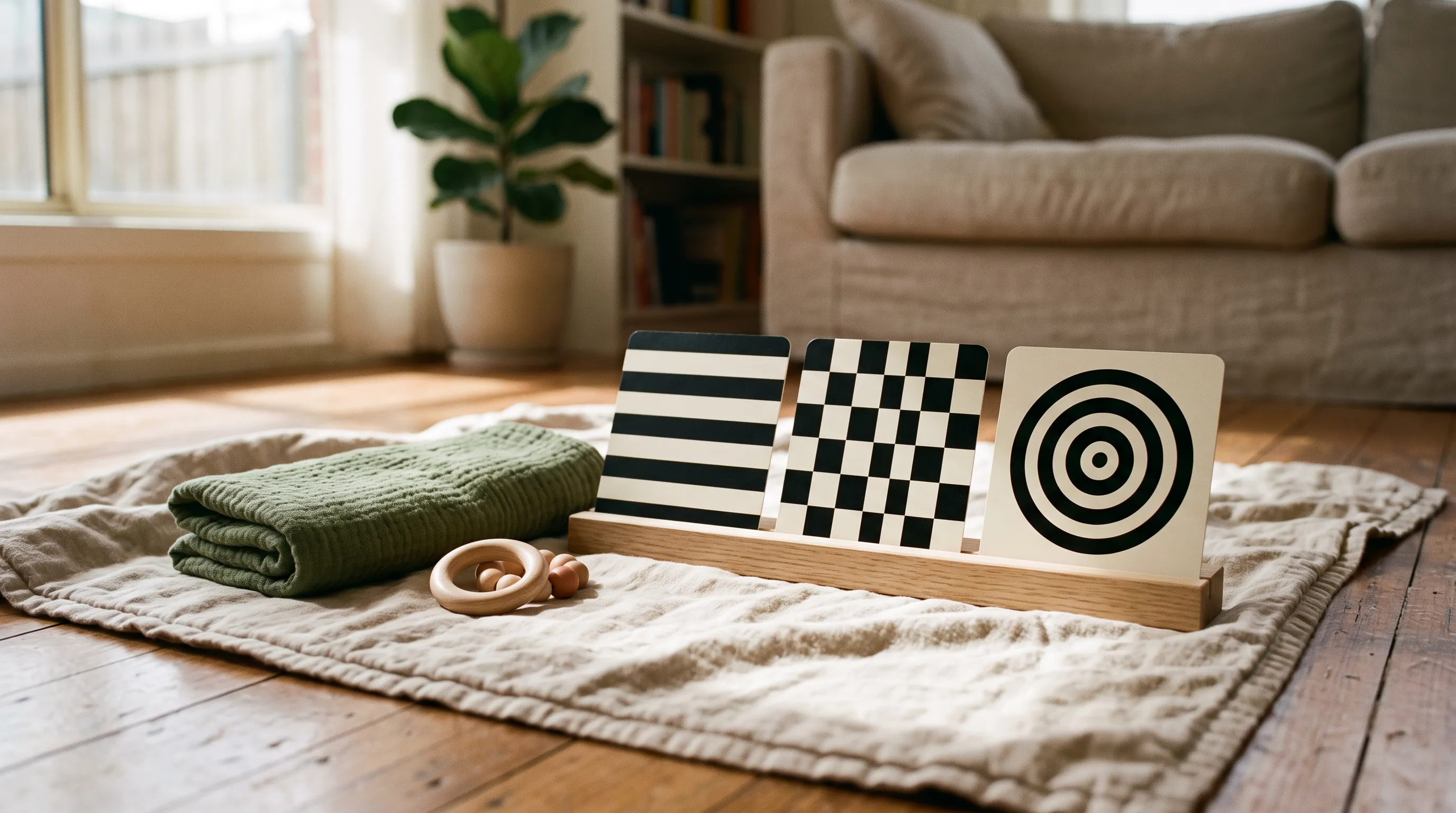
One month milestones, around 3 to 4 weeks, include a brief head lift during tummy time, studying a familiar face held close, turning towards your voice and startling at a loud noise. Movement is still mostly reflex, and crying is still the main way a 1 month old tells you what they need.
This page lines up what Australian health services list for the end of the first month: the 1 month page at Pregnancy, Birth and Baby(opens in a new window), Raising Children Network's 0 to 1 month tracker, and the 2 and 4 week visits in the NSW Blue Book and Victoria's maternal and child health program.
It follows the first two weeks in newborn development week by week and comes before 2 month milestones, inside the wider guide to baby milestones by age.
What can a 1 month old do?
A 1 month old moves mostly by reflex, looks at faces more than objects, knows your voice, and briefly lifts their head on their tummy by the end of the month. They communicate by crying and small throaty noises. Pregnancy, Birth and Baby(opens in a new window) sums up the month in one line.
Pregnancy, Birth and Baby · Your baby's growth and development, 1 month oldAt 1 month, cuddling, sleeping and feeding matter most to your baby.
The checklist below groups what the Australian sources describe by area. A 1 month old may be doing some of these and not others yet.
- Movement. Sucking and swallowing, turning the head when a cheek is touched, grasping a finger placed in the palm, and flinging out arms and legs at a sudden noise. Hands stay in tight fists most of the time. By the end of the month, a brief head lift and a turn to the side on the tummy.
- Seeing. A 1 month old sees you best within about 20 cm, prefers faces to objects, and can tell light from dark. A cross-eyed look is common at this age.
- Hearing. Your baby knows your voice and may turn towards it. Loud noises still bring a startle.
- Communicating. Crying is the main signal, plus throaty noises when your baby needs you. Some babies make eye contact to get your attention.
- Feeding and settling. Feeds come often, about 12 times a day in the first month. Some babies start to soothe themselves by sucking a dummy, finger or thumb.
The movement, seeing, hearing and settling points come from Pregnancy, Birth and Baby's 1 month page. The 20 cm distance, knowing your voice, the eye contact and the throaty noises come from Raising Children Network(opens in a new window). The feed count comes from the Sydney Children's Hospitals Network(opens in a new window).
Weeks 3 and 4: what changes?
Between 2 and 4 weeks, a baby's interest in faces sharpens from a first focus to watching a familiar face during feeds, and the first head lift appears on the tummy.
Each item sets the 2 week lists from the NSW Blue Book(opens in a new window) and Victoria's two week visit(opens in a new window) beside Victoria's four week visit(opens in a new window) and Pregnancy, Birth and Baby's 1 month page.
- Faces and eyes: Around 2 weeks, many babies start to focus on faces and look into your eyes. Around 4 weeks, many watch familiar faces during feeds or when you talk to them.
- Head and body: Around 2 weeks, many babies grasp your fingers when placed in their hand. Around 4 weeks, many lift the head briefly and turn it from side to side on the tummy.
- Light and sound: Around 2 weeks, many babies startle at loud noises. Around 4 weeks, many shut their eyes to bright light and respond to your voice.
- Sounds and signals: Around 2 weeks, many babies cry as the main signal, and spend lots of time sleeping and feeding. Around 4 weeks, many move their lips and tongue when you talk to them.
The same lists say when to ask the nurse:
- Around 2 weeks: If your baby is not reacting to loud noises, not feeding well, or not making any sounds.
- Around 4 weeks: If your baby is not making any sounds, not beginning to watch faces, not responding to bright light, or not moving both arms and legs.
None of the Australian health services checked here publishes a separate 3 week list. Week 3 sits between the two ages. A 3 week old may already show some of the 4 week skills, or none of them yet. Read each item as a direction of travel, not a deadline.
Is my baby watching faces and following things yet?
Most 1 month olds look at faces, especially a familiar face about 20 cm away, but following a moving object with their eyes is only just starting. Raising Children Network describes a baby who is fascinated by faces and might be able to follow your face with their eyes.
Toys in contrasting colours, such as red, black and white, or with faces and patterns, hold their attention too.
Vision is still blurry. Pregnancy, Birth and Baby notes that a 1 month old can tell light from dark and may look cross-eyed. The ACECQA developmental milestones(opens in a new window) place brief tracking of a slow-moving target somewhere in the birth to 4 months band, so it keeps improving over the next few months.
The smile that answers yours usually comes later. The Raising Children Network 1 to 2 month tracker(opens in a new window) puts the first smiles from about 6 weeks, and most babies smile back by about 8 weeks, so a 1 month old who does not smile back yet is on schedule. The first smile has its own page at 6 week milestones, and what follows is on the 2 month milestones page.
Head lifts and tummy time at 1 month
By the end of the first month, many babies lift their head briefly and turn it to the side when lying on their tummy. Pregnancy, Birth and Baby and Victoria's four week visit both list it. The lift lasts a moment, and it grows with practice rather than arriving on one day.
Tummy time builds the neck strength behind it. Pregnancy, Birth and Baby suggests short periods during the day, starting with a couple of minutes each time.
Raising Children Network suggests starting with 1 to 2 minutes and building up to 10 to 15 minutes several times a day as your baby grows. Victoria's four week visit suggests tummy time on your lap, your chest or a rolled-up towel.
Stay with your baby for every minute of tummy time, and always put them on their back to sleep. Our guide to tummy time by age shows how the minutes build from here.
Feeding, sleep and nappies at 1 month
A 1 month old usually feeds about 12 times a day and sleeps in short bursts around the clock. A breastfed baby has at least five heavy wet nappies a day. The three numbers below are the everyday checks a nurse asks about.
Feeding. The Sydney Children's Hospitals Network(opens in a new window) says newborns feed about 12 times a day in the first month, usually every 1.5 to 3 hours, dropping to about 8 feeds by around 2 months. Our guide to how much milk a baby drinks has the amounts by age.
Nappies. For a baby having only breastmilk, the Australian Breastfeeding Association(opens in a new window) looks for at least five heavy wet disposable nappies, or six very wet cloth ones, in 24 hours, with pale wee. Under 6 to 8 weeks, these babies usually have three or more runny yellow-mustard poos a day.
If your baby has formula, see the signs a formula-fed baby is getting enough. The wet nappies guide covers what a heavy nappy feels like.
Sleep. Newborns sleep in short bursts, may wake as often as every 40 minutes, and need feeding every 2 to 3 hours overnight, per the Sydney Children's Hospitals Network. Most do not sleep through the night yet. The newborn sleep guide covers settling and day-night confusion.
Growth. Most healthy babies are back to their birth weight within the first 2 weeks and then keep growing, per Pregnancy, Birth and Baby. Steady growth over time matters more than any single weigh-in.
Child health visits in the first month
NSW, Victoria and WA all book a child health visit in the first month: NSW at 1 to 4 weeks, usually at home; Victoria at a home visit after discharge, then at 2 and 4 weeks; and WA(opens in a new window) between 0 and 14 days. Our guide to baby health checks in Australia covers what the nurse checks and each state's schedule.
When to talk to your nurse or GP
Talk to your child health nurse or GP if your 1 month old isn't feeding well, doesn't react to loud sounds, or has crying or sleeping patterns that worry you. Those three come from Pregnancy, Birth and Baby(opens in a new window). Raising Children Network(opens in a new window), Victoria's four week visit and the ACECQA milestones add more signs worth raising. Your baby:
- isn't feeding well
- doesn't startle at loud sounds or turn towards sounds
- isn't responding to bright light, or isn't following your face with their eyes
- isn't making sounds such as gurgling
- isn't moving both arms and legs
- seems floppy or stiff
- seems very tired, or sleeps more than is typical for a newborn
- cries a lot and is hard to soothe, and this is worrying you
- has stopped doing something they had already learned
Raising Children Network's advice is to get help early if you feel something isn't quite right. healthdirect(opens in a new window) puts it plainly: most children learn skills in the same order, but not always at the same time.
You can also call Pregnancy, Birth and Baby on 1800 882 436 to speak with a maternal child health nurse, from 7am to midnight (AET), 7 days a week. Look after yourself too. Raising Children Network suggests seeing your nurse or GP if you have signs of postnatal anxiety or depression, whether or not you gave birth.
Keeping track
BabyLog's milestone checklist starts with the same ACECQA birth to 4 months band cited on this page, as a guide rather than a diagnosis.
Mark a skill as one to watch, then as observed with the date, so the first time your partner caught steady eye contact at about 20 cm still has its date when the nurse asks at the 6 to 8 week check. Milestone tracking is part of BabyLog Pro.
Enjoy the first month for what it is, and track your baby's development with BabyLog when you want the dates kept for you.
Common questions
Ready to start tracking?
BabyLog works on any device — iPhone, Android, tablet, or desktop. Setup takes two minutes.
Keep reading

Newborn Development Week by Week: Milestones From Birth to 8 Weeks
Newborn development week by week: reflexes in week 1, head lifts by 4 weeks, smiles and cooing by 8 weeks, plus the newborn and 6 to 8 week checks.

2 Month Milestones: What Most Babies Do at 8 Weeks in Australia
2 month milestones: the social smile, head lifting and cooing most babies show around 8 weeks, plus the 6 to 8 week check and the first immunisations.