
Newborn Sleep Guide for Parents in Australia
How much should your baby sleep? Wake windows and naps by age, safe sleep, day-night confusion, and what's behind sleep regressions — a practical guide based on Australian health guidelines.
Nobody tells you this before the baby arrives: newborns don't really have a sleep schedule. They have sleep chaos — tiny bursts of unconsciousness between feeds, nappy changes, and staring at the ceiling fan.
If you're reading this at 3am wondering whether your baby's sleep is normal, the short answer is probably yes. Here's the longer answer — how much sleep is usual, how long babies can stay awake, what naps look like as they grow, and what's really going on when sleep falls apart for a week.
How much sleep do babies actually need?
According to the Raising Children Network(opens in a new window) (Australia's national parenting resource), babies sleep a lot — but never when you want them to.
| Age | Total sleep (24 hours) | Longest stretch | Naps |
|---|---|---|---|
| 0–3 months | 14–17 hours | 2–4 hours | No pattern — sleeps between feeds |
| 3–6 months | 12–15 hours | 4–6 hours | 3–4 naps per day |
| 6–12 months | 12–14 hours | 6–10 hours | 2–3 naps per day |
These are averages. Your baby hasn't read this table.
In the newborn weeks, sleep fits between feeds that come around every 2 to 3 hours, day and night. Our newborn feeding schedule covers night feeds and when to wake a sleepy baby.
For the older end, the sleep-medicine bodies put a wider, looser band around it:
American Academy of Sleep MedicineInfants 4–12 months should sleep 12–16 hours per 24 hours, including naps — and individual sleep needs vary, so an hour or two either way can be perfectly normal.
The single most useful idea in all of this: the Raising Children Network notes a baby can be doing well on more or less sleep than another baby the same age. Your baby's own pattern matters more than any chart. The averages are a sanity check, not a target to chase.
One more thing every new parent learns the hard way: newborns can't tell the difference between day and night. Their body clock doesn't really develop until around 6–8 weeks. Until then, every hour is the same to them.
Safe sleep — the Australian guidelines
Red Nose Australia(opens in a new window) (formerly SIDS and Kids) provides the national safe sleeping guidelines. These are the ones your child health nurse will ask about, and they apply to every sleep — naps included:
- Sleep baby on their back — for every sleep, day and night
- Keep the face and head uncovered — no loose blankets, pillows, bumpers, or toys in the cot
- Keep baby smoke-free — before and after birth
- Safe sleeping environment — firm, flat mattress in a safe cot that meets Australian Standards (AS/NZS 2172)
- Sleep baby in their own safe space — in the same room as you for the first 6–12 months
- Breastfeed baby — if you can, breastfeeding reduces the risk of sudden infant death
These guidelines are based on decades of research and have significantly reduced SIDS rates in Australia. They're worth following even when your baby protests about sleeping on their back (and they will).
If there's a toddler in the house too, keep the baby's sleep space separate from theirs; our two under two guide covers safe sleep and moving a toddler out of the cot.
Reading your baby's sleep cues
Babies give signals when they're getting tired. The Raising Children Network(opens in a new window) is clear that tired signs, not the clock, are the best guide to when a baby is ready to sleep. The trick is catching them before the overtired meltdown:
Early cues (act now):
- Yawning
- Staring into space
- Jerky arm and leg movements
- Frowning or furrowing brows
- Clenching fists
Late cues (you've probably missed the window):
- Crying
- Arching back
- Difficult to settle
The window between "I'm tired" and "I'm so overtired I can't sleep" can be as short as 10 minutes for a newborn. Babies also cry for reasons other than tiredness — hunger, discomfort, illness, or just wanting a cuddle — so read the cues alongside the clock, not instead of your baby.
Wake windows by age: how long can a newborn stay awake?
A newborn can stay awake for around 1 to 2 hours before tired signs appear, and that includes the feed. Some babies are ready to sleep after 1 to 1.5 hours. Others stay content for 2 hours or more. The window stretches to 2 to 3 hours by 6 months and 3 to 4 hours by their first birthday.
| Age | Typical wake window | Typical naps |
|---|---|---|
| Birth to 6 weeks | 1 to 2 hours, feed included. Some newborns are tired after 1 to 1.5 hours | No pattern yet: 6 to 8 sleeps of 2 to 4 hours spread across day and night |
| 6 to 12 weeks | 1 to 2.5 hours | 3 to 4 naps of 1 to 3 hours |
| 3 to 5 months | 1.5 to 2 hours at 3 months, 2 to 3 hours by 5 months | 2 to 3 naps of up to 2 hours each |
| 6 to 8 months | 2 to 3 hours | 2 to 3 naps of 30 minutes to 2 hours |
| 9 to 12 months | 2.5 to 3.5 hours at 9 to 10 months, 3 to 4 hours at 11 to 12 months | 2 naps, the first 1 to 2 hours, the second 1 to 1.5 hours |
The ranges come from Tresillian's routine pages for newborns(opens in a new window), 3 to 5 months(opens in a new window), 6 to 8 months(opens in a new window) and 9 to 12 months(opens in a new window), and from the Raising Children Network's tired signs(opens in a new window), newborn sleep(opens in a new window) and baby sleep 2 to 12 months(opens in a new window) pages.
One thing worth knowing before you pin this table to the fridge. Australia's national parenting authorities do not prescribe wake windows. The Raising Children Network(opens in a new window) says a newborn might be tired 1 to 1.5 hours after waking, or happy for 2 hours or more, and that a 3 to 6 month old might be tired after 1.5 to 3 hours awake. Pregnancy Birth and Baby(opens in a new window) skips the numbers altogether: put bub down as soon as you notice tired signs. Both describe what tiredness looks like, not a clock to watch. The tidy chart format comes from sleep consultants and tracking apps. Tresillian, the one Australian early parenting service that publishes awake windows by age, calls them averages and still tells you to respond to your baby's tired cues at every sleep.
So treat the table as a rough guide, not a stopwatch. QEC(opens in a new window) (the Queen Elizabeth Centre, a Victorian early-parenting service) notes that babies aged 6–12 months might be tired after two to three hours of being awake, and lists tired signs like clinginess, grizzling, and fussiness with food. The advice at every age is the same: watch for those tired signs rather than rigidly counting minutes.
In practice a 2-week-old may be ready to sleep again an hour or so after waking. That hour includes the feed, the burp and the nappy change, so by the time you have finished all three it is nearly nap time again. Your baby's own usual window, read off a couple of weeks of sleep logs, predicts the next nap better than any row in the table.
Naps by age
Daytime sleep is its own puzzle. Per the Raising Children Network(opens in a new window), babies aged 6–12 months are often still having 2–3 daytime naps lasting anywhere from 30 minutes to 2 hours — a huge range that's all normal, and the number of naps gradually drops over the first year. QEC(opens in a new window) describes 6–12 month olds as starting to nap about twice a day for one to two hours, with most babies sleeping 10–14 hours across a full day.
A few things worth knowing so you don't worry unnecessarily:
- Short naps are normal, especially in the early months. A single 30-minute nap isn't a "failed" nap.
- Nap totals matter more than any one nap. A short morning nap often gets balanced out later in the day.
- The drop from 3 naps to 2, and later 2 to 1, is gradual and bumpy — expect a few rough weeks around each transition.
There's no universal nap schedule that fits every baby. The useful version is your baby's own pattern: roughly when they tend to nap, and how long their naps usually run.
Fixing day-night confusion
If your newborn sleeps all day and parties all night, that's normal — and temporary. You can help their body clock develop:
During the day:
- Open the curtains — let natural light in during awake time
- Keep things normally noisy (no need to tiptoe)
- Make feeds social — talk, make eye contact
- Go outside — even a short walk helps set their body clock
At night:
- Keep the room dark (a dim red/amber night light is fine for feeds)
- Keep things quiet and boring — no play, minimal eye contact during feeds
- Don't change the nappy unless it's dirty or very wet
- Put baby back in their cot as soon as the feed is done
Most babies start to figure out day vs night around 6–8 weeks. Some take longer. Consistency helps.
Once a longer first sleep appears, a late dream feed before your own bedtime can line that stretch up with yours for some babies.
A simple bedtime routine for a newborn
A newborn bedtime routine is short: a feed, a clean nappy, dim lights, a few minutes of quiet cuddling or patting, then into the cot on their back, in the same order each night. Australian guidance adds a bath and a story from about 3 to 6 months, when a fuller 20-minute routine starts to help.
The steps, drawn from Pregnancy Birth and Baby(opens in a new window) and the Raising Children Network(opens in a new window):
- Feed, then a clean nappy. Pregnancy Birth and Baby's check before any sleep: fed, changed, and not too hot or cold.
- Dim the lights and drop your voice. At night, lower the lights, keep talk to a minimum and skip the play, so bub learns that night is different from day.
- Wrap safely, if bub is not yet rolling. A swaddle can help a newborn settle. Swap to a safe infant sleeping bag once they start trying to roll, around 4 to 6 months.
- A few minutes of quiet comfort. A cuddle, gentle patting, a soft shh or a quiet song until they are calm or drowsy. Under 3 months, this hands-on settling is the routine.
- Into the cot on their back. Same cot, same room as you, every night, following the safe sleep guidelines above.
Start the routine on tired signs, not the clock. If bub is yawning and staring into space at 6:30, that is bedtime tonight, even if the plan said 7. Keep the steps in the same order and at around the same time each night. The order is what does the work: the Raising Children Network describes a bedtime routine as similar activities in roughly the same order, so a baby learns what comes next and feels safe.
A newborn does not need a bath and a book every night. Raising Children says you can start a gentle bedtime routine from about 3 months, and Pregnancy Birth and Baby puts the fuller version at 4 to 6 months(opens in a new window). From then, add a warm bath and a short story at the front, let the whole thing run for around 20 minutes, and keep screens out of it. Before that, the daytime version is the feed, play, sleep(opens in a new window) pattern: offer a feed on waking, change the nappy, a short play, then back down for sleep. If your baby falls asleep during a feed instead, that's fine too, as our guide to feeding to sleep explains.
The steps above say what a newborn bedtime looks like. Only your own log says when yours actually goes down, and that time drifts week to week. A few nights of tapping the sleep start in BabyLog shows the family's real bedtime, which is the time to build the routine around rather than the one on a chart.
Sleep changes, regressions and rough patches
Just when you think you've cracked it, sleep falls apart for a week. Parents often call this a "regression" — around 4 months especially — but it's usually a sign your baby's sleep is developing, not going backwards.
Lots of ordinary things disrupt sleep for a few days: a developmental leap, teething, illness, a vaccination day, travel, or a daycare change. The key is not to compare this week against last week's pattern and panic. The Raising Children Network(opens in a new window) reminds parents that baby sleep varies, and to seek help from a child health professional if you're worried.
Two things worth separating from "just a rough patch":
- Teething doesn't cause a fever. The Royal Children's Hospital(opens in a new window) is clear that teething may cause mild grizzliness but not a true fever (38°C or higher). If there's a fever, look for another cause — don't write it off as teeth.
- Night waking with other symptoms can mean illness. healthdirect(opens in a new window) notes that an ear infection can cause fever, irritability, night crying and appetite changes. Sudden night waking alongside those signs is worth a check, not a sleep-training plan.
A bad week of sleep is almost always temporary. Talk to your child health nurse or GP if your baby seems unwell, is very hard to settle for days on end, or you have any concern. A baby under 3 months with a fever (38°C or higher) needs to go to the nearest emergency department straight away, according to healthdirect(opens in a new window). This article is general information, not medical advice.
Why tracking sleep helps
In the fog of the first few months, every day blurs together. Did she sleep well yesterday? When did that 40-minute nap happen? How many hours total?
Tracking sleep lets you:
- See your baby's own rhythm — their usual wake window and typical nap length, which is far more useful than a generic age chart
- Share with your child health nurse — real data beats "I think she sleeps okay?", and our baby sleep diary guide shows what to record
- Coordinate with your partner — they can see the last sleep without asking
- Spot a genuine change early — when sleep shifts for a few days, you can see exactly when and how, instead of guessing
You don't need anything complicated. A simple log of when sleep starts and ends gives you more insight than you'd expect after a couple of weeks of data.
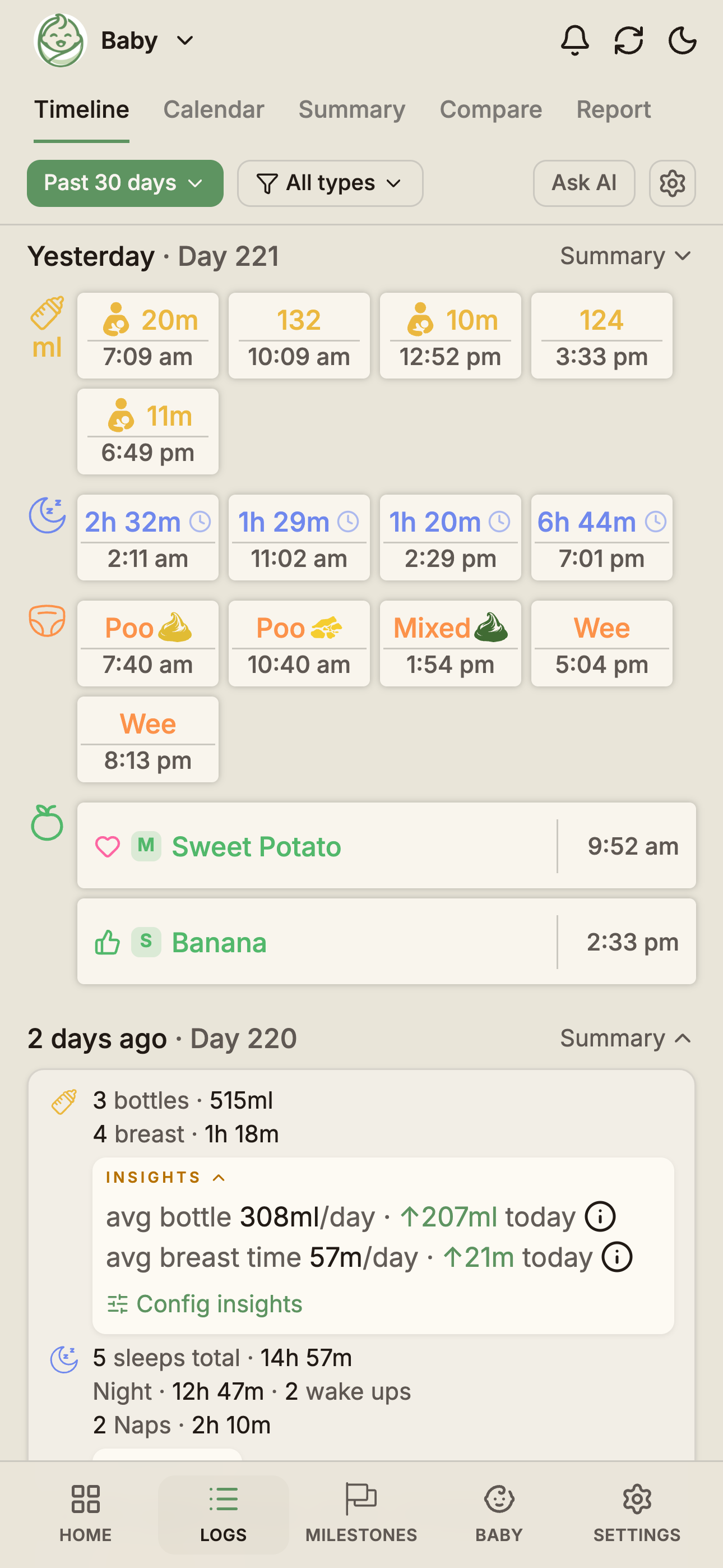
The sleep tracking page shows what a quick log looks like in practice, and the sharing guide covers how both parents can see the same sleep history without texting "when did she go down?"
When to talk to your child health nurse
Most newborn sleep "problems" are normal developmental stages. But talk to your child health nurse or GP if:
- Your baby is consistently sleeping much less than the broad ranges above for their age
- They're extremely difficult to wake for feeds (especially in the first few weeks)
- They seem very lethargic or floppy when awake
- Their breathing is noisy, laboured, or stops periodically during sleep
- A baby under 3 months has a fever (38°C or higher): go to the nearest emergency department straight away
- You're struggling with sleep deprivation yourself — your health matters too
Your local child and family health service(opens in a new window) can help. Every state has free services for parents of newborns.
If your baby is unwell, a sick-day record of temperatures, feeds, wet nappies and medicine times makes the GP's questions easier to answer.
It gets better
This is the part every sleep-deprived parent needs to hear: it does get better. Most babies start sleeping longer stretches around 3–4 months. By 6 months, many (not all) can do a solid 6-hour stretch at night.
Until then, take shifts with your partner if you can, accept help from anyone who offers, and know that every exhausting night is one night closer to the first full sleep.
If you want to start spotting your baby's sleep patterns, BabyLog logs naps and night sleep in one tap and syncs to every caregiver's device. See the sleep feature page, the Free vs Pro split on pricing, or just start tracking.
Common questions
Ready to start tracking?
BabyLog works on any device — iPhone, Android, tablet, or desktop. Setup takes two minutes.
Keep reading

Cluster Feeding & the Witching Hour: What's Normal
Why your newborn wants to feed non-stop in the evening, whether cluster feeding means low supply (it usually doesn't), and how to get through the witching hour. Based on Australian health guidance.

How Much Milk Should a Baby Drink? Amounts by Age (Australia)
Around 150 mL per kg a day to 6 months, about 100 mL per kg to 12 months. Feeds and mL by age from Australian guidance, and the signs of enough.