
Baby Poo Colour Chart: What's Normal and When to Worry
A practical guide to newborn and infant nappy colours — what each colour means, what's normal at each stage, and the one colour you should never ignore.
Nobody warns you about the sheer variety of colours you'll see in a baby's nappy. Within the first week alone, your baby's poo goes through more colour changes than a mood ring.
Most of these colours are completely normal. One isn't. Here's what you need to know.
The first few days: meconium
Your baby's first nappies contain meconium — a dark, sticky, tar-like substance that's been building up in their intestines since before birth. It's greenish-black and has the consistency of vegemite (sorry for the comparison, but it's accurate).
Meconium is completely normal and usually clears within 2–3 days. If your baby hasn't passed any meconium within 48 hours of birth, tell your midwife or doctor straight away.
The colour guide
After meconium clears, your baby's poo colour depends mainly on what they're eating.
Breastfed babies
| Colour | What it means |
|---|---|
| Mustard yellow | The classic breastfed poo. Seedy, runny texture. Completely normal. |
| Gold / bright yellow | Normal variation. Can look almost orange. |
| Green | Common when baby gets more foremilk, or during a growth spurt. Usually normal. |
| Light brown | Normal as baby gets older and feeds change. |
Breastfed poo is usually soft, runny, and can look like grainy mustard. It often doesn't smell strongly. Frequency varies wildly — some breastfed babies poo after every feed, others go several days between nappies (both are normal after the first 6 weeks).
Formula-fed babies
| Colour | What it means |
|---|---|
| Tan / light brown | Normal formula poo. Firmer than breastfed poo. |
| Dark brown | Normal. Formula poo is darker than breastfed poo. |
| Greenish-brown | Normal variation, especially with iron-fortified formula. |
| Dark green | Iron in formula. Normal. |
Formula poo tends to be firmer, darker, and smellier than breastfed poo. It's usually more consistent in colour — fewer surprises.
Once solids start (around 6 months)
Everything changes when food enters the picture. You'll see:
- Orange after sweet potato or carrots
- Green after peas, beans, or spinach
- Dark brown becomes the new normal
- Bits of undigested food — completely normal. Their digestive system is learning.
If you're new to introducing food, our starting solids guide walks through the Australian guidelines and what to expect.
Colours that need attention
Most colours are normal. These aren't:
Red
Red streaks could be:
- Swallowed blood from cracked nipples (breastfeeding) — not harmful to baby
- A small anal fissure (tiny tear from straining) — common, usually heals on its own
- An allergy or intolerance — especially if combined with mucus
If you see red, note when it happened and contact your child health nurse or GP. It's usually something minor, but it's worth checking.
Black (after the meconium stage)
Black poo after the first few days can indicate digested blood higher in the digestive tract. Contact your GP.
White, grey, or very pale
This one matters. Consistently pale, chalky, or white poo can indicate a problem with the liver or bile ducts. According to Pregnancy Birth Baby(opens in a new window) (an Australian Government resource), pale poo should always be checked by a doctor.
If your baby's poo is consistently the colour of chalk or clay — even once — see your GP. It may be nothing, but it needs to be ruled out.
What about consistency?
Colour gets all the attention, but consistency matters too:
- Runny / watery (breastfed): Normal for breastfed babies.
- Soft / pasty: Normal for both breast and formula.
- Formed / firm: Normal for formula-fed and older babies on solids.
- Very watery / explosive: Could be diarrhoea. Watch for dehydration signs.
- Hard pellets: Constipation. Talk to your child health nurse.
- Mucusy: Small amounts are normal. Mention large amounts, or mucus combined with blood, to your GP.
How often should they poo?
This varies more than any other topic:
- Newborn (0–6 weeks): Multiple times a day — sometimes every feed
- Breastfed (after 6 weeks): Anywhere from multiple times a day to once every 7–10 days (both normal, according to the Australian Breastfeeding Association(opens in a new window))
- Formula-fed: Usually every 1 to 2 days, according to Pregnancy, Birth and Baby(opens in a new window)
- On solids: 1–2 times per day
If your baby seems comfortable, is feeding well, and gaining weight, their poo frequency is probably fine — even if it seems irregular.
Breastfed baby not pooing: is it normal?
It depends on your baby's age. Under 6 weeks, a breastfed baby usually poos at least three times a day. Fewer than one poo a day can mean they need more milk. After 6 weeks, some breastfed babies go 7 to 10 days without a poo. That's fine if the poo is soft and plentiful when it comes.
The Australian Breastfeeding Association(opens in a new window) (ABA) draws the line at about 6 weeks. Before then, poos are one of the ways you can tell your baby is getting enough milk. The ABA's advice for a newborn with fewer than one poo a day is to feed more often.
After 6 to 8 weeks, a long gap between poos is no longer a sign of low milk on its own. What the poo looks like, and how much there is, matters more than how often it comes.
Australian Breastfeeding Association · Is my baby getting enough breastmilk?After 6 to 8 weeks, some babies start to poo less often, sometimes only once every 7 to 10 days. This is alright as long as the poos are soft or runny and there's a good amount.
How long can a breastfed baby go without pooing?
The answer changes at around 6 weeks. The list sets out the two rules, with formula-fed babies for comparison.
- Breastfed, under 6 weeks: At least 3 soft, runny poos a day, each about the size of your baby's palm. Get advice if your baby has fewer than one poo a day (feed more often and call your nurse), or fewer than five heavy wet disposables (six cloth) from day 5.
- Breastfed, after 6 weeks: Anywhere from a poo at every feed to one every 7 to 10 days. Get advice if the poo turns hard or dry, or your baby seems in pain or unwell.
- Formula-fed: Usually every 1 to 2 days. Get advice if the poo is hard and dry.
Sources for the list: the ABA's baby poo guide(opens in a new window) and signs of enough breastmilk(opens in a new window) for breastfed babies, and Pregnancy, Birth and Baby(opens in a new window) for formula-fed babies.
Take a breastfed baby of 7 weeks who went from several poos a day to none for four days. That fits the normal pattern, as long as they are feeding well, wetting at least five heavy nappies a day, and the next poo is soft.
Wet nappies are the steadier check at any age. Our wet nappy guide gives the count by age.
Constipated or just infrequent?
Constipation is judged by what the poo is like. Pregnancy, Birth and Baby describes constipation as hard, dry poo that is difficult to pass. A breastfed baby who goes several days without a poo, then passes a soft one, is not constipated. Constipation is more common in formula-fed babies than breastfed babies.
Pregnancy, Birth and Baby(opens in a new window) lists these signs of constipation in a baby:
- Hard, dry poo
- Straining to pass a hard poo
- Feeding less than usual
- Being fussy or unsettled
- Small tears around the bottom, which can leave streaks of blood
- A bloated or swollen tummy
Straining on its own isn't constipation. Healthy babies under 9 months sometimes strain and cry before passing a soft poo. Pregnancy, Birth and Baby calls this dyschezia. If the poo that follows is soft, it isn't constipation, and it settles on its own.
The Royal Children's Hospital Melbourne(opens in a new window) notes that a breastfed baby may poo after every feed or only once a week. If you think a baby under 12 months is constipated, the RCH advises seeing your GP or Maternal and Child Health nurse.
When to see the GP about a baby not pooing
See your GP or child health nurse if a breastfed baby under 6 weeks has fewer than one poo a day, or if a baby of any age has hard, bloody or pale poo, a swollen tummy or pain when pooing. A newborn who hasn't passed their first poo within 48 hours of birth needs to see a doctor. A long gap on its own, in an older breastfed baby who is otherwise well, is not a reason to worry.
- Go to the nearest emergency department or call 000: A baby under 3 months with a temperature above 38°C needs the nearest emergency department straight away, or call 000 for an ambulance.
- Take your baby to a doctor: If they have a fever, are vomiting, or are lethargic.
See your GP or child and family health nurse if your baby:
- hasn't passed their first poo (meconium) within 48 hours of birth
- is under 6 weeks and has fewer than one poo a day, or fewer wet nappies than usual
- has hard, dry, pebble-like, ribbon-like or pencil-thin poo
- has blood or mucus in their poo
- has white, grey or very pale poo, which can be a sign of a liver problem (see colours that need attention)
- has a swollen tummy, or seems in pain when pooing
- is feeding less, or isn't growing as expected
If your baby has fewer wet nappies as well as fewer poos, read the dehydration red flags too. For breastfeeding questions, the ABA's National Breastfeeding Helpline (1800 686 268, 24 hours) and your child health nurse can help you work out whether your baby is getting enough.
Why parents track nappies
In the first few weeks, your midwife or child health nurse will ask about nappy output — it's one of the simplest ways to check that your baby is feeding enough and staying hydrated.
Tracking nappies helps you:
- Answer your nurse's questions with data — "4 wet, 2 dirty today" beats "I think it was normal?"
- Spot changes early — a sudden shift in frequency or colour is easier to notice when you can look back at the last week
- Coordinate with your partner — whoever changes the nappy logs it, everyone sees the count
You don't need to photograph every nappy (though some parents do). A quick log of type, colour, and any notes is enough to spot patterns and share with your health professional.
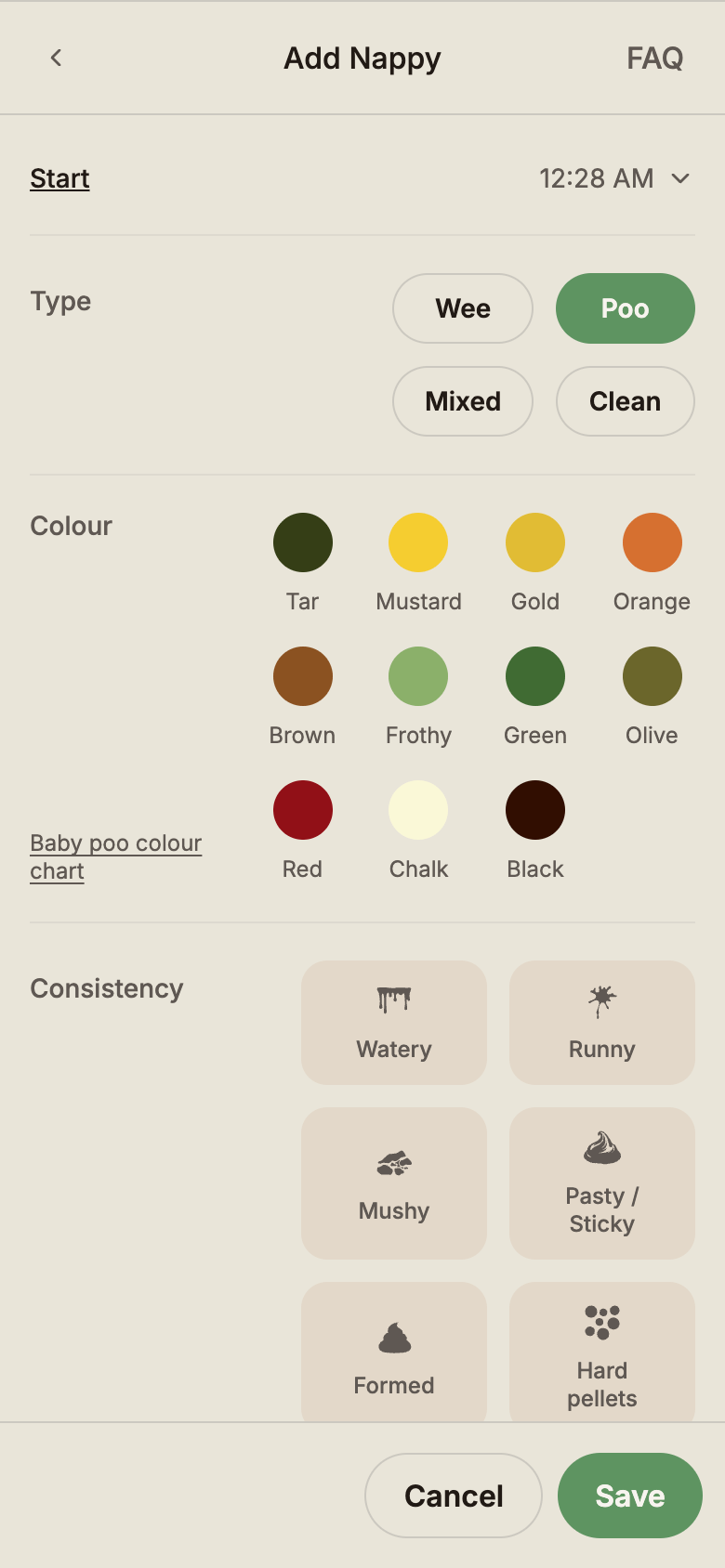
The nappy tracking page shows the full set of colour and consistency options, and the sharing guide covers how every caregiver in the household sees the same nappy log in real time. BabyLog is free to start — see what's included on the pricing page.
Common questions
Ready to start tracking?
BabyLog works on any device — iPhone, Android, tablet, or desktop. Setup takes two minutes.
Keep reading
Starting Solids in Australia: What the NHMRC Guidelines Actually Say
When to start solids, what to introduce first, and how to handle allergies — based on the Australian NHMRC guidelines, not internet opinions.

Newborn Sleep Guide for Parents in Australia
How much should your baby sleep? Wake windows and naps by age, safe sleep, day-night confusion, and what's behind sleep regressions — a practical guide based on Australian health guidelines.