
Cluster Feeding & the Witching Hour: What's Normal
Why your newborn wants to feed non-stop in the evening, whether cluster feeding means low supply (it usually doesn't), and how to get through the witching hour. Based on Australian health guidance.

It's 6pm. You've fed the baby, they've pulled off, fussed, and rooted to feed again — for the third time in an hour. You're touched out, the dishes are cold, and a small voice asks: is something wrong? Do I not have enough milk?
Almost certainly not. What you're describing has a name — cluster feeding — and for most newborns it's a normal, if exhausting, phase.
Witching hour vs cluster feeding: not the same thing
Cluster feeding is a feeding pattern; the witching hour is a fussy period. They turn up at the same time of day and often together, which is why the two names get used interchangeably — but they're different things, and telling them apart changes what helps.
| Cluster feeding | Witching hour | |
|---|---|---|
| What it is | Several short feeds bunched close together | A stretch of unsettled, hard-to-soothe crying |
| When | Often late afternoon and evening | Often late afternoon and evening |
| Does feeding help? | Yes — feeding is the point of it | Sometimes, but not always |
| Usually eases | As the feeding window ends, or as your baby matures | Most common in the first three months, easing as your baby matures |
In practice most evenings are both at once, and you don't have to work out which one you're in to respond — feeding an unsettled baby is rarely the wrong move. The distinction matters later, when you're trying to work out whether the evening is about hunger or about a baby who has had enough of the day.
What cluster feeding is
Cluster feeding is a run of short feeds close together over a few hours, often with fussing in between. The Australian Breastfeeding Association(opens in a new window) describes it as frequent feeds bunched into a window, common in the first few months — and most likely in the late afternoon or evening.
Pregnancy, Birth and BabyCluster feeding is lots of short feeds over a few hours, commonly late afternoon or early evening — and it is not usually a sign of low supply.
You'll often see short feeds with the baby pulling on and off, brief rests or catnaps between feeds, and general fussiness. It tends to be bounded — a busy window, then a longer settle or sleep — rather than non-stop feeding all day.
If the extra feeds run through the day and night for a few days, a growth spurt may be the reason. Our guide to newborn growth spurts covers the common ages and how long they last.
If the length of each feed is what worries you, our guide to how long a newborn breastfeed takes covers what's usual at each age.
The "witching hour"
The evening fussiness that goes with it is what many parents call the witching hour: a stretch of late-day unsettledness, often paired with wanting to feed constantly. It's most common in the first three months and usually eases as your baby matures.
Cluster feeding and the witching hour frequently arrive together — which is exactly why it can feel like your baby is "never satisfied" in the evening, even though the daytime felt fine.
With a toddler in the house, the witching hour lands on their dinner and bath time. Our two under two guide has a sample day that plans for it.
If your baby brings up milk after most feeds as well, our guide to posseting and reflux covers what's normal and when to see the GP.
Does it mean my supply is low?
This is the worry that sends parents to the formula aisle at 7pm. For most, it's the opposite of what's happening.
Milk supply works on demand — the more your baby feeds, the more milk you make. The World Health Organization(opens in a new window) recommends feeding on demand, as often as the baby wants, day and night, precisely because that's how supply is established and maintained. NSW Health(opens in a new window) likewise notes that cluster feeding is not a sign of low supply.
So a baby feeding often in the evening is usually doing their job — topping up and building your supply — not signalling that it's failing.
If your midwife or lactation consultant has already suggested formula top-ups, our guide to mixed feeding and top-ups covers how to protect your supply while you give them.
How often is "normal" anyway?
It helps to recalibrate what frequent looks like for a newborn. The Australian Breastfeeding Association(opens in a new window) notes babies in the early months commonly feed 8–14 times or more in 24 hours — tiny tummies and fast digestion make frequent feeding expected, and strict schedules can miss a baby's cues. There's wide variation from one baby to the next.
In other words: a newborn isn't on an adult's three-meals-a-day schedule, and a packed evening doesn't mean the rest of the day went wrong.
For how often a newborn feeds in each of the first 8 weeks, day and night, see our newborn feeding schedule.
Evening feeds often swap between breasts quickly. If you lose track mid-cluster, our guide to which side you breastfed on last has the rule for where to start next.
Getting through it
You can't "fix" cluster feeding — and you shouldn't try to space the feeds out. What you can do is make the window survivable. The ABA and Pregnancy, Birth and Baby(opens in a new window) suggest:
- Follow your baby's lead and feed when they want
- Get comfortable before it starts — water, snacks, phone, remote within reach
- Rest where you can — feeding is a reason to sit down
- Tag in support — hand the baby to your partner between feeds for a break, or agree a night shift plan for the evenings
- Lower the bar on everything else for the evening
If your baby falls asleep at the breast at the end of an evening cluster, that's normal too, as our guide to feeding to sleep explains. If you find yourself patting for a burp between every evening feed, our guide on how to wind a baby covers why a few minutes is usually enough.
It's a phase, not a forever. Most babies grow out of the worst of it within the first few months.
Once the evening feeds ease and your baby has a longer first sleep, some parents add a late dream feed before their own bedtime to line that stretch up with theirs.
Speak to your doctor, midwife, child health nurse or a lactation consultant if your baby isn't gaining weight, isn't having enough wet or dirty nappies, or isn't settling after feeds. Cluster feeding should be busy but bounded — feeding non-stop all day, alongside poor nappies or an unsettled, unwell baby, is worth checking. This article is general information, not medical advice.
Seeing the pattern in your logs
One of the quietest reassurances in those early weeks is seeing that the evening rush is a real, repeating pattern — not a sign things are unravelling.
When you log feeds, a run of short feeds close together shows up as exactly that: a cluster, in a bounded evening window, followed by a longer settle. Looking back over a few days, you start to recognise your baby's witching hour — and knowing it's coming makes it easier to set yourself up before it hits.
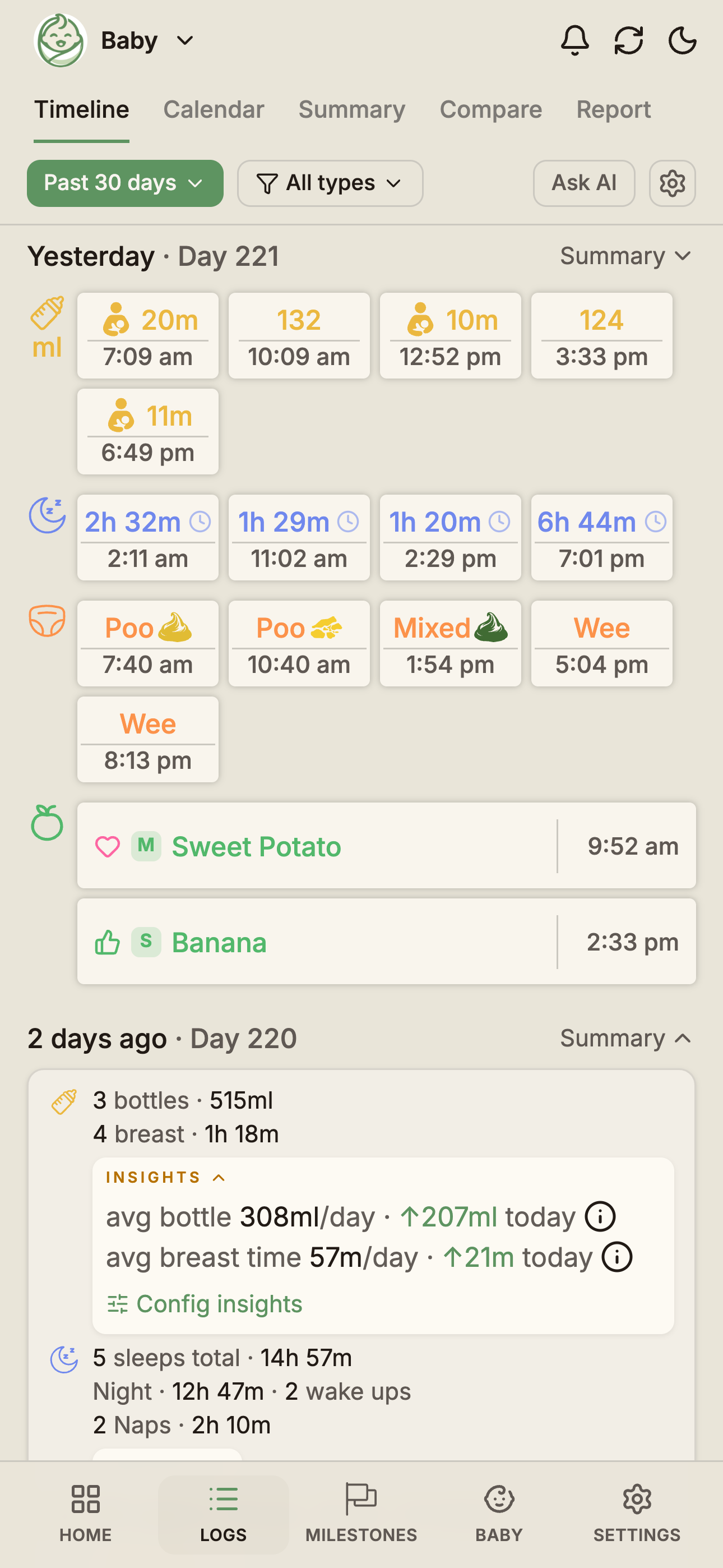
BabyLog logs breast and bottle feeds in a tap and syncs to every caregiver, so whoever's on the evening shift can see the run of feeds. See the feeding feature page, the sharing guide for tag-team evenings, or start tracking.
Common questions
Ready to start tracking?
BabyLog works on any device — iPhone, Android, tablet, or desktop. Setup takes two minutes.
Keep reading

How Much Milk Should a Baby Drink? Amounts by Age (Australia)
Around 150 mL per kg a day to 6 months, about 100 mL per kg to 12 months. Feeds and mL by age from Australian guidance, and the signs of enough.

Newborn Sleep Guide for Parents in Australia
How much should your baby sleep? Wake windows and naps by age, safe sleep, day-night confusion, and what's behind sleep regressions — a practical guide based on Australian health guidelines.