
Dream Feeding: What It Is, When to Try It, and How to Tell If It Helps
Dream feeding is a late-evening feed while your baby is still drowsy. When to try it, how to do it safely, what studies found, and a 7-night check.
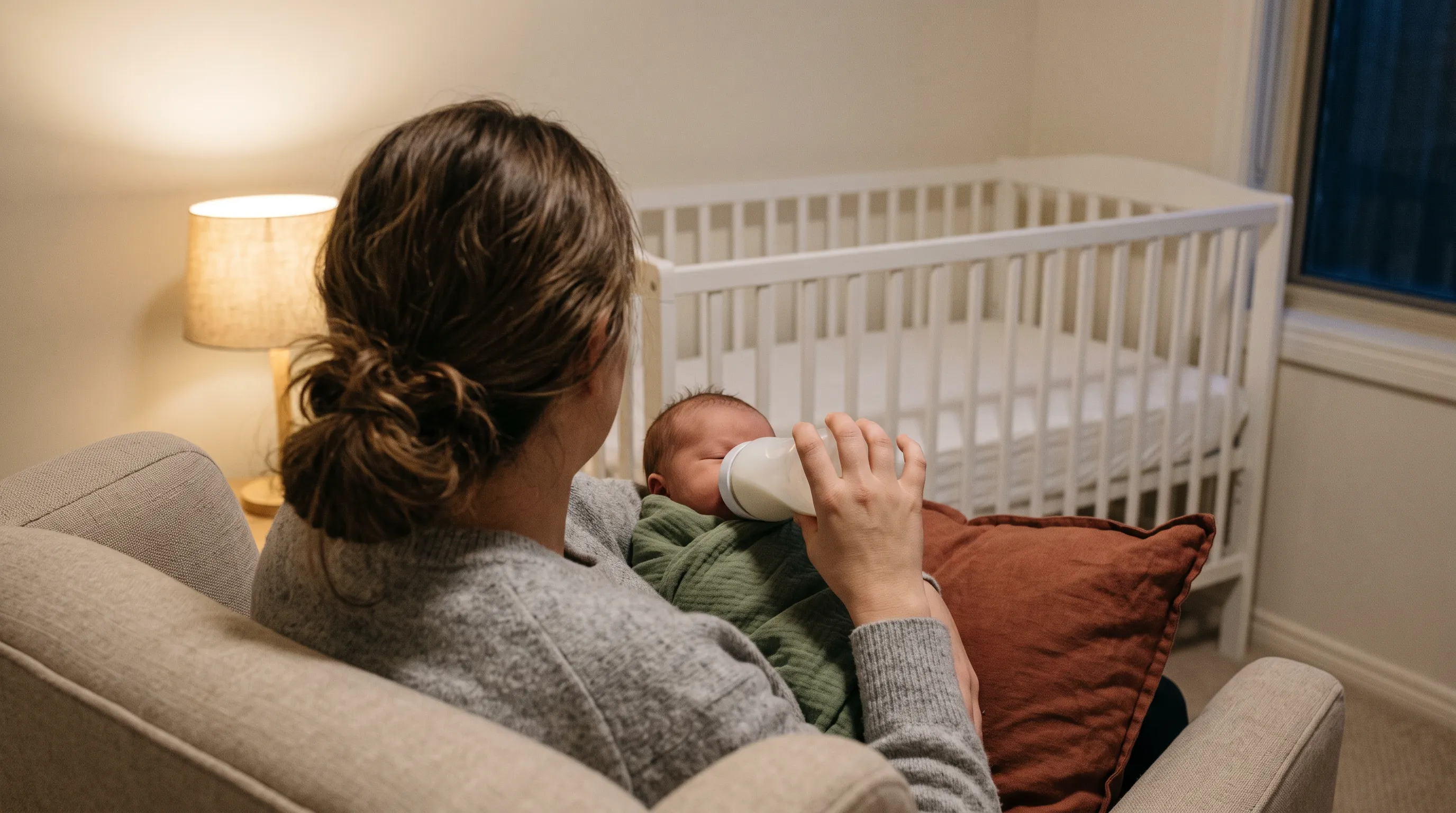
What is dream feeding? A dream feed is a late feed, usually between 10pm and midnight, that you give your baby just before you go to bed yourself. Your baby stays drowsy and goes straight back into their cot. The aim is to move their next hungry waking later, so your first long sleep lines up with theirs.
It helps some babies and does nothing for others. This guide covers when parents try a dream feed, how to give one at the breast or with a bottle, and what the studies found. It ends with a 7-night check you can run to see whether it helps your baby.
In Australia, the Raising Children Network is the one health source we found that describes dream feeds, which it also calls rollover feeds. Pregnancy, Birth and Baby and the Australian Breastfeeding Association cover night feeds and newborn sleep without naming the practice. The studies on dream feeding come from overseas, so this guide labels them as supporting evidence.
What is a dream feed?
A dream feed is a planned late feed, usually between 10pm and midnight, given while your baby is still drowsy from their first sleep. You gently rouse your baby, feed them before you go to bed, and put them straight back down.
The Raising Children Network(opens in a new window) describes it this way:
Raising Children Network · Baby sleep, 2 to 12 monthsA rollover feed or 'dream feed' is a late feed between 10 pm and midnight. Some parents find that rollover feeds help babies sleep longer towards morning.
Versions differ in how much the baby wakes. Some parents feed a baby who stays asleep the whole time. Others rouse the baby enough to feed well. Many end up with a baby who is drowsy, sucking and barely awake.
In the one small trial that measured intake, babies given a late feed drank about the same total over 24 hours as the others. So a dream feed mostly moves a feed rather than adding one, to a time that suits you.
At what age do parents try a dream feed?
No Australian health authority sets an age for starting a dream feed. Overseas trials started it in the first weeks, and one advised stopping after 4 months. Australian guidance says newborns feed often, day and night, so early on a late feed is one feed among many. Longer night sleeps may start from about 8 weeks.
- Birth to 4 weeks: At least 8 feeds in 24 hours, including overnight (ABA). Sleep comes in bursts of 2 to 3 hours (RCN). For a dream feed: a late feed is one of those feeds. Your baby will wake again soon, so it rarely buys a longer stretch yet.
- 4 to 8 weeks: A body clock starts to form around 4 to 6 weeks (PBB). Between 1 and 3 months, babies may wake less often at night (RCN). For a dream feed: the INSIGHT trial introduced its dream feed advice at 3 to 4 weeks. Some parents start here.
- 8 weeks to 4 months: Longer sleeps may start from about 8 weeks (PBB). Around 3 months, some babies have a 4 to 5 hour sleep at night (RCN). For a dream feed: the stretch a dream feed can move is now long enough to matter. The trials measured their results at 8 and 16 weeks.
- 4 months and over: RCN mentions dream feeds in its guidance on night feeding at 6 to 12 months. For a dream feed: the INSIGHT trial advised avoiding dream feeds after 4 months. RCN says if a rollover feed works for you and your baby, it's fine.
In the first weeks, feeding enough comes before any plan for longer sleep. The Australian Breastfeeding Association(opens in a new window) says a newborn who sleeps for long periods may need waking to fit enough feeds in, especially if weight gain is slow. Our newborn feeding schedule covers when to wake a sleepy newborn for a feed.
If your baby was born early or small, your paediatrician or child and family health nurse may give you a waking plan, and that plan comes first.
For how many night feeds are typical at each age, see night feeds by age.
How to do a dream feed with the breast or a bottle
To give a dream feed, pick a time before your own bedtime, keep the room dim and quiet, feed your baby while they are drowsy, then put them on their back in their own cot. Keep the whole feed calm and boring. Pregnancy, Birth and Baby(opens in a new window) says calm, stimulation-free feeds overnight can help babies resettle more quickly.
Dream feeding when you're breastfeeding
- Choose a time you can repeat. The Raising Children Network and the 1993 Pinilla and Birch trial both put the feed between 10pm and midnight.
- Keep the lights low. Lift your baby gently and hold them in your usual feeding position.
- Offer the breast. A drowsy baby will often latch and suck without fully waking. The ABA suggests hand expressing a little breastmilk near a sleepy baby's mouth to encourage them.
- Keep a sleepy baby feeding. The ABA suggests switching sides when sucking slows, and breast compressions to keep milk flowing. If you lose track of the side at 11pm, see which side did I breastfeed last.
- Skip the nappy change unless it's dirty or soaked. The ABA lists a nappy change as a way to wake a sleepy baby, which is the opposite of what you want here.
- Put your baby down on their back in their cot or bassinet once the feed is done.
Dream feeding with a bottle
A bottle dream feed of expressed breastmilk or formula is a feed a partner can take. Pregnancy, Birth and Baby suggests partners take turns with overnight bottle feeds. Our guide to splitting night feeds with a partner covers bottles when you're breastfeeding.
- Hold your baby fairly upright. Pregnancy, Birth and Baby recommends paced feeding, with your baby held more upright rather than lying down, to help prevent choking.
- Stay with your baby for the whole feed. Karitane(opens in a new window) says to always avoid propping the bottle or leaving your baby alone during a feed, because that raises the risk of choking and ear infections.
- Make the bottle as you would for any other feed. Our formula feeding guide covers safe preparation.
Does a dream feed work? What the evidence says
Three overseas studies suggest a planned late or bedtime feed can help some babies sleep longer at night. None tested a dream feed on its own: two trials bundled it with other changes, and the third only observed families. Treat the findings as supporting evidence, and your own baby's nights as the real test.
- Pinilla & Birch 1993: 26 first-time parents of breastfed babies, in a trial. A 10pm to midnight feed, combined with two other night changes, had all 13 babies in that group sleeping from midnight to 5am by 8 weeks. In the other group, 23% were. Total milk over 24 hours did not differ.
- INSIGHT 2016: 279 mothers and babies, in a trial. A package of sleep advice that included a dream feed from 3 to 4 weeks added about 35 minutes of night sleep at 8 weeks and 25 minutes at 16 weeks. There was no difference at 1 year.
- Quante 2022: 313 babies, observed. A bottle feed at bedtime at 1 month went with a longest night sleep about 62 minutes longer at 6 months.
What these numbers can and can't tell you:
- The trials changed several things at once. In Pinilla and Birch(opens in a new window), parents also stretched the gap between middle-of-the-night feeds and made days brighter and busier than nights. In INSIGHT(opens in a new window), the dream feed was one line in a long list of sleep advice. That list also included advice that differs from Australian guidance, such as moving babies to their own room by 3 months, so follow Red Nose's safe sleep advice rather than the trial's package.
- The first trial was small. It had 13 babies in each group, and parents recorded sleep in diaries.
- "Sleeping through" had a narrow meaning. In the 1993 trial it meant midnight to 5am.
- An association is not proof. The 2022 study(opens in a new window) found that babies with a bedtime bottle slept longer, and other differences between families could explain that.
Parenting Science(opens in a new window) reviews these studies in more depth. It also notes a dream feed may not suit babies who are underweight or have some medical conditions.
A dream feed mostly moves a feed your baby would have had anyway. Whether it moves their longest sleep is something only your baby's nights can show.
Dream feed pros and cons
The main benefit of a dream feed is that you choose when one night feed happens, so you can go to bed straight after it. The main drawback is that it doesn't work for every baby, and a baby who wakes fully can take a long time to resettle.
Pros
- You go to bed with a fed baby. The feed happens at 10.30pm on your timing, instead of at 1am on theirs.
- A partner can take it. With expressed breastmilk or formula, the late feed becomes a job someone else can own.
Cons
- It may change nothing. Some babies wake at their usual time anyway, and you've added a feed to the night.
- A sleepy baby may feed poorly. A few half-hearted sucks may not hold them any longer than no feed at all.
- Your baby may wake fully. A baby who is wide awake at 11pm can undo the stretch you were aiming for.
- Feeding can become part of settling. Pregnancy, Birth and Baby calls a baby who only settles with a feed a sleep association. It says this is only a problem if you'd prefer your baby learned other ways to settle.
If your baby has reflux, Parenting Science suggests keeping them upright for a while after the feed. Red Nose says to still put them down flat on their back, and never to tilt or raise the mattress.
A 7-night check: is the dream feed helping your baby?
To tell whether a dream feed helps, note when your baby first wakes hungry on 3 baseline nights, then on 7 nights with a dream feed at the same time each night, and compare the two.
If the first wake after the dream feed lands clearly later on most nights, keep going. If your baby wakes at the same time as before, you've added a feed and gained nothing, so drop it.
One good or bad night tells you very little. Babies have growth spurts, off nights and early wakes for no clear reason. The Raising Children Network suggests tracking a baby's sleep for 5 to 7 days to get a clear picture, and this check uses the same idea.
Before you start (3 nights, no dream feed): write down when the last evening feed ended and when your baby first woke hungry afterwards. The time between is your baseline first stretch.
The test (7 nights, dream feed at the same time each night): write down when the dream feed ended and when your baby next woke hungry. Also note how long they took to resettle after the dream feed.
| Night | Feed ended | First wake | First stretch |
|---|---|---|---|
| Example baseline | 7.30pm | 12.10am | 4 h 40 min |
| Example dream feed | 10.45pm | 3.20am | 4 h 35 min |
In the example, the stretch after the feed is about the same length, but it now starts at 10.45pm. A parent who goes to bed at 11pm gets about four hours of sleep before the first wake, instead of about one. That counts as the dream feed working, even though the baby slept no longer.
Read the results like this:
- Use the middle night of each set, not the best one. Sort the first wakes from earliest to latest and take the middle one. One great night can make any plan look good.
- It's working if your baby's first wake after the dream feed falls later than their baseline first wake on most nights, and they settle back to sleep quickly after the dream feed.
- It isn't working if your baby still wakes around the same time as before, or the dream feed wakes them fully on most nights. Stop, and try again in a few weeks if you like.
- Pause the check during a growth spurt, an illness or a big change in routine, and restart once things settle.
A notebook by the cot works for this, as long as everyone who does a night feed writes theirs down. If your nurse has asked for a feeding diary before a weight check, see what to record.
BabyLog's free feeding tracker and sleep log keep the same record on your phone, and a partner can log the dream feed from their own phone. Charted views go back 14 days on the free plan, which covers the 3 baseline nights and the test week, and you can start free tonight.
Safe sleep after a dream feed
After a dream feed, put your baby on their back in their own cot or bassinet, in your room, with their face and head uncovered. Red Nose Australia's safe sleep advice applies to every sleep, including the drowsy one after a late feed.
Red Nose Australia's six safe sleep recommendations(opens in a new window) are:
- Always place your baby on their back to sleep.
- Keep your baby's head and face uncovered.
- Keep your baby smoke free, before and after birth.
- Provide a safe sleeping environment, night and day: a safe cot, a firm flat mattress, and no pillows, bumpers, doonas or soft toys.
- Sleep your baby in their own safe sleep space in the same room as you for at least the first 6 months.
- Breastfeed your baby, if possible.
A late feed brings two extra risks for a tired parent:
- Falling asleep while feeding. Red Nose(opens in a new window) says never to sleep with your baby on a sofa, armchair or recliner, however tired you are. If you feel yourself getting drowsy, put your baby in their own safe sleep space first.
- A bottle left with your baby. Never prop a bottle or leave your baby to feed alone. Stay until the feed is finished.
Our newborn sleep guide covers safe sleep in more detail.
- Call 000 straight away: If you think your baby needs urgent medical help.
- Check with your doctor: If your baby is very sleepy or hard to wake for feeds, as the Australian Breastfeeding Association advises.
- Before starting a dream feed: Check with your GP or child and family health nurse if your baby was born early or small, is slow to gain weight, or has reflux or another health condition.
- Helplines: You can call Pregnancy, Birth and Baby on 1800 882 436 (7am to midnight AET, 7 days) to talk to a maternal child health nurse. The Australian Breastfeeding Association helpline is 1800 686 268. The Red Nose Safe Sleep Advice Line is 1300 998 698 (9am to 5pm weekdays).
If the evenings already feel like one long feed, that may be cluster feeding and the witching hour.
Common questions
Ready to start tracking?
BabyLog works on any device — iPhone, Android, tablet, or desktop. Setup takes two minutes.
Keep reading

Night Feeds by Age: How Many Are Typical and When Babies Drop Them
How many night feeds are typical from newborn to toddler, when babies naturally need fewer, and why it is a need rather than a habit to break.

Cluster Feeding & the Witching Hour: What's Normal
Why your newborn wants to feed non-stop in the evening, whether cluster feeding means low supply (it usually doesn't), and how to get through the witching hour. Based on Australian health guidance.