
Feeding and Pumping Reminders: When One Helps, and How to Set It Up
Do you need a feeding reminder app? When a feed or pumping reminder helps in the early weeks, how often feeds come, and what a good reminder does.
Do you need a feeding reminder app? For many babies, no: most early feeds follow your baby's hunger cues, so the next feed tells you when it's due. A reminder earns its place in three situations: a sleepy newborn you've been asked to wake for feeds, expressing for every feed, and nights shared between two people.
This guide sets out how often feeds and pumping sessions come in the early weeks, from Australian guidance, then what makes a feed or pumping reminder useful, and how reminders work in BabyLog.
Do you need a feeding or pumping reminder?
Often not for a breastfed baby who feeds on cues and is gaining weight. Often yes when you express for every feed, when a sleepy newborn needs waking for feeds, or when two people take turns through the night. In each of those, nothing in the room tells you the next feed or session is due, and the last one is hard to remember on broken sleep.
The Australian Breastfeeding Association (ABA) is clear that a strict timetable doesn't suit most young babies.
Australian Breastfeeding Association · Feeding patterns in the early monthsStrict schedules usually don't work well for most young babies. They can make you feel stressed and might mean missing your baby's signs that they need a feed or comfort.
So treat a reminder as a backstop for a tired memory. If your baby shows hunger cues before it goes off, feed your baby.
When a reminder helps
- A sleepy newborn. The ABA says little babies need to feed at least 8 times in 24 hours, including overnight, and a newborn who sleeps for long periods may need waking to get enough feeds. If your midwife or child health nurse has asked you to wake your baby for feeds, a reminder helps you keep to the gap they gave you.
- Expressing for every feed. A pump has no hunger cues. The ABA(opens in a new window) says most hospitals recommend expressing every 2 to 3 hours during the day and at least every 4 hours at night, and that leaving long gaps between sessions doesn't help you make more milk.
- Shared nights. Pregnancy, Birth and Baby(opens in a new window) suggests a partner can bring the baby for night feeds, then burp, change and settle the baby afterwards. When two people take turns, the one on next needs to know when the last feed started.
When you can leave it off
The ABA says it's okay not to have a routine in the early months. If your baby feeds often, is gaining weight and your breasts are comfortable, the ABA says it's probably okay to let them sleep a little longer. A reminder adds little there.
How often feeds and pumping sessions come in the early weeks
A newborn usually feeds 8 to 12 or more times in 24 hours, about every 2 to 3 hours, day and night. Expressing for every feed means at least 8 sessions in 24 hours, including overnight. These ranges come from Australian guidance, and your baby may sit anywhere inside them.
| Situation | How often | Source |
|---|---|---|
| Breastfed newborn | 8 to 12 or more feeds in 24 hours, about every 2 to 3 hours, day and night | ABA, Tresillian |
| Little babies, the floor | At least 8 feeds in 24 hours, including overnight | ABA |
| Formula-fed newborn | On demand when hunger cues show, with no set schedule | Pregnancy, Birth and Baby |
| Expressing for every feed | At least 8 sessions in 24 hours: every 2 to 3 hours in the day, at least every 4 hours at night | ABA |
| Building supply by expressing | Avoid gaps of more than 6 hours | ABA |
Reading the table:
- Feeds bunch up. The ABA says 8 to 14 or more feeds in 24 hours is common in the early months, and Tresillian(opens in a new window) says feeds can be anywhere from 2 to 5 hours apart.
- There's no need to time feeds. The ABA says so directly. A reminder counts the gap between feeds, never the length of one.
- Night sessions matter when you express. The ABA says they may be tiring, but they help build your milk supply. Its expressing basics(opens in a new window) page says to avoid gaps of more than 6 hours while you build supply.
The week-by-week detail is in our newborn feeding schedule, and amounts per session are in how much breast milk to pump. Pumping around a return to work has its own guide: a pumping schedule for working mums.
Your baby's hunger cues come first. A reminder is there for the feed or pumping session a tired memory might miss.
What makes a feeding or pumping reminder useful
A useful reminder counts from the last feed or session you logged, treats day and night separately, reaches whoever is on next, and stays quiet while a feed is already under way. A plain phone alarm does none of these.
- It counts from the last log. If your baby fed early, the next reminder moves with that feed. A fixed alarm keeps ringing on its own timetable.
- Day and night are separate. Many parents want daytime nudges and a different gap, or none, overnight.
- It follows your baby. A gap worked out from your own baby's logged feeds fits your baby better than a number from a chart.
- It reaches the right person. On a shared night, the reminder is most useful on the phone of whoever is doing the next feed.
- It stays quiet mid-feed. A reminder that goes off while you're already feeding or pumping is noise.
- It's easy to turn off. Once feeds settle into your baby's own rhythm, you may not need it at all.
Feed and pumping reminders in BabyLog
In BabyLog, feed and pumping reminders are part of Pro, and they arrive on the iPhone app or on the web app added to your home screen. Logging every feed, pumping session and nappy stays free on every plan. Reminders are one of the features of BabyLog Pro.
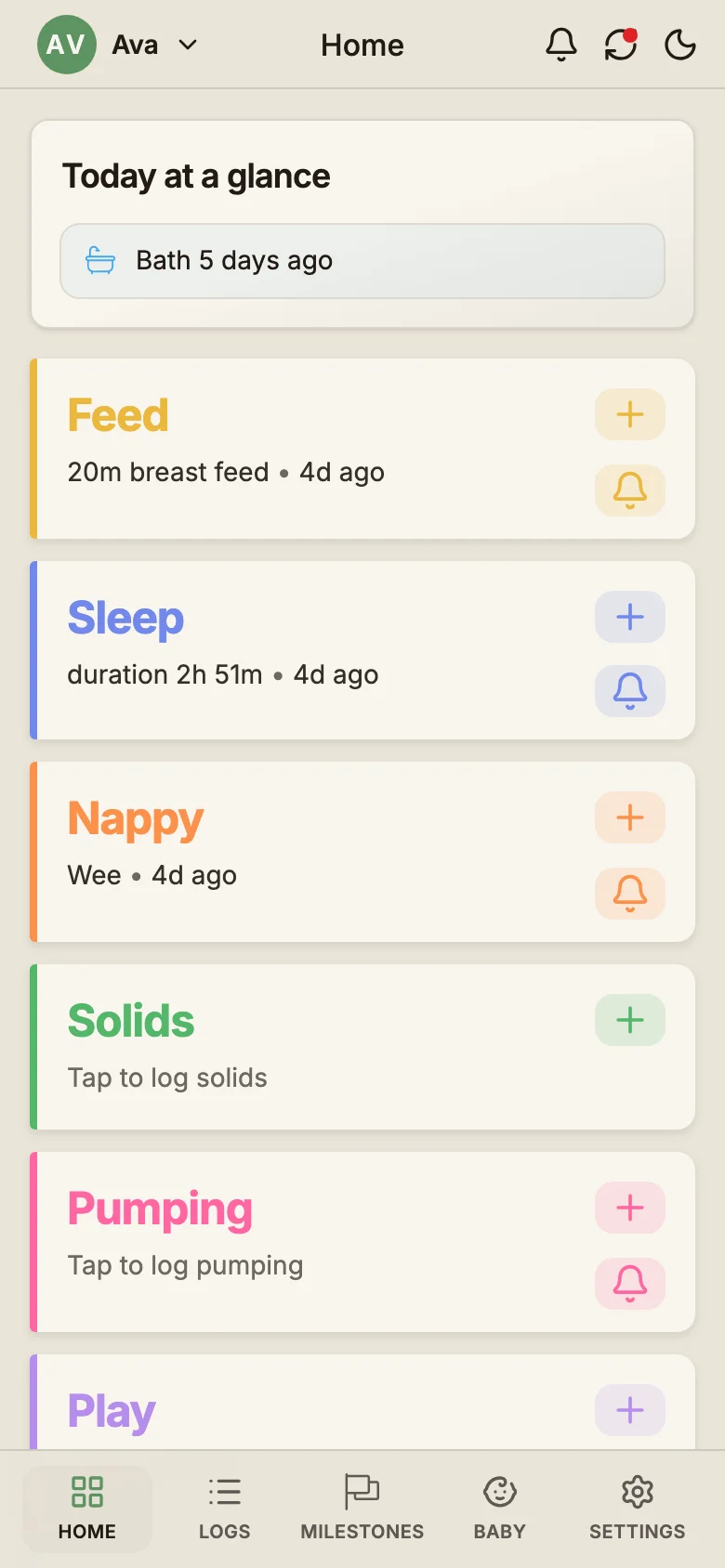
You set a reminder from the bell on the Feed or Pumping tile on the home screen. Sleep and Nappy have their own bells.
How the settings work:
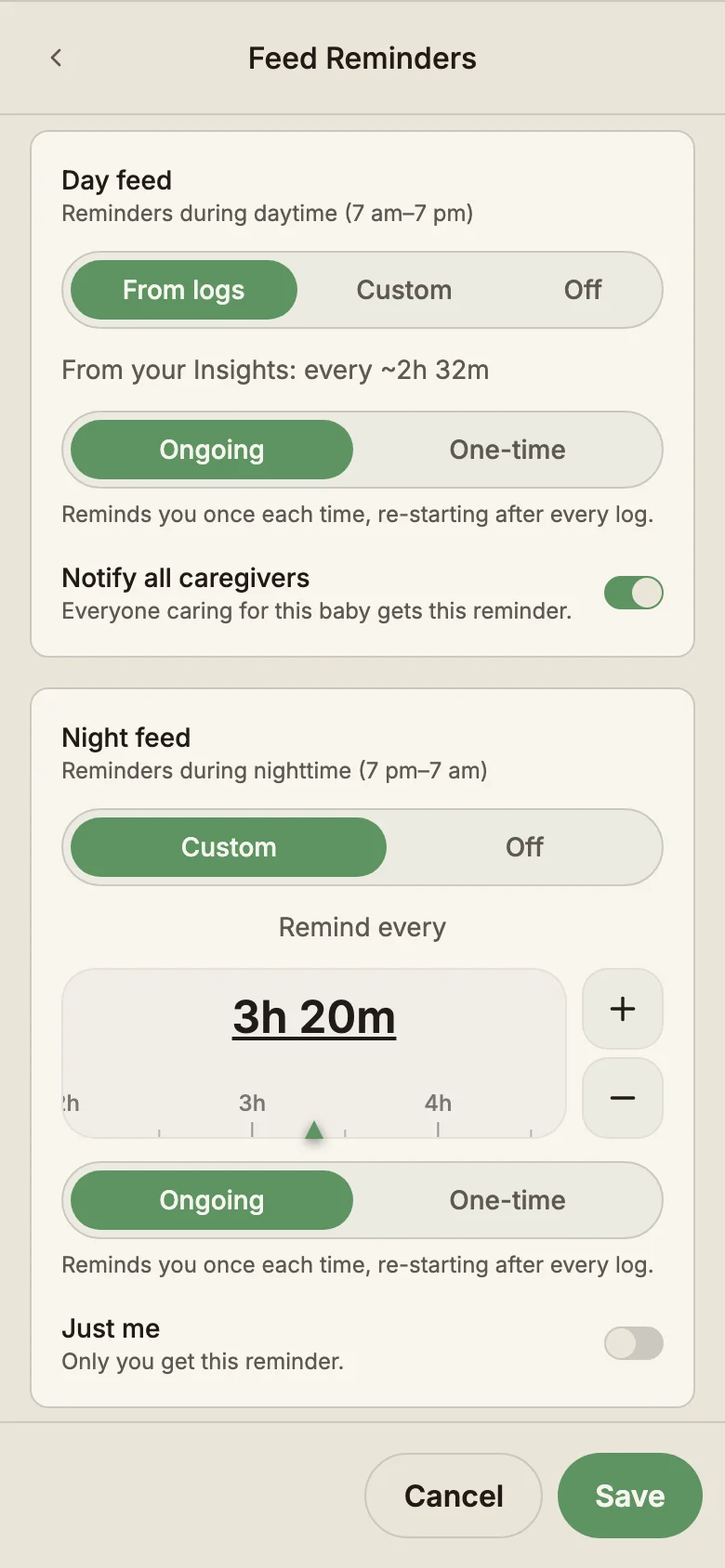
- Day and night are separate cards. The day and night hours follow the day and night times set for your baby in BabyLog.
- During the day, pick From logs, Custom or Off. From logs works out the gap from your baby's own logged feeds or pumping sessions, with a starting interval until there are enough logs. Custom uses the gap you set.
- At night, pick Custom or Off. For night feeds, the suggested gap comes from your baby's own night feeds, and you can change it.
- Ongoing or One-time. Ongoing reminds you once after each feed or session and starts again after the next log. One-time reminds you once, then switches off.
- Just me or Notify all caregivers. The person who sets a reminder can send it to every caregiver on the baby. Each caregiver can turn shared reminders off for themselves in Settings.
- Quiet while a timer runs. A running feed timer holds the feed reminder, and a running pumping timer holds the pumping reminder. From logs feed reminders also wait while a logged sleep is still going, then come once if the feed is still due.
- From day 5 for From logs feed reminders. BabyLog's From logs feed reminders start once your baby is 5 days old. Before then, a Custom reminder works from day one, set to the gap your midwife or nurse gave you.
Reminders need the app installed. A browser tab can't receive them reliably, so BabyLog asks you to install it first. Here's how to add BabyLog to your home screen.
A reminder never replaces watching your baby. The ABA says to check with your doctor or child health nurse if you're unsure, or if your baby is very sleepy or hard to wake. Feeding help is on the ABA Breastfeeding Helpline, 1800 686 268, free, 24 hours a day.
Getting started
A reminder can only count from a feed it knows about, so the log comes first. Logging feeds, pumping sessions and nappies is free on every plan: you can start free today, see whether the log alone does the job, and add reminders later if it doesn't.
If you share the nights, each of you can start logging free on the same baby, so whoever is up next can see when the last feed started.
Common questions
Ready to start tracking?
BabyLog works on any device — iPhone, Android, tablet, or desktop. Setup takes two minutes.
Keep reading

How Often Should a Newborn Feed? A Week-by-Week Feeding Schedule for the First 8 Weeks
A newborn feeding schedule, week by week: 8 to 12 or more feeds a day and night. When to wake a sleepy baby, and when to call your nurse.

How Much Breast Milk Should You Pump for a Newborn? Amounts by Day, How Often and How Long
How much breast milk should you pump? Drops at first, 50 to 70 mL a session by day 5, 500 to 800 mL a day by 2 weeks, plus how often and how long.