
How to Keep a Baby Sleep Diary for Your Child Health Nurse or Sleep School
What to write in a baby sleep diary, the RCH 24-hour grid, a filled example day, how long to keep it and what your nurse looks for.

A baby sleep diary records every sleep across complete 24-hour days: when your baby fell asleep, when they woke, where they slept and how they settled, with the feeds and night wakes in between. Your child health nurse, GP or a sleep and settling service reads it to see your baby's real pattern, not the one you remember at 4am.
You might have been asked for one at a check, or you're on a waitlist for a day stay or a residential stay and want to arrive prepared. This guide covers what to write down, the 24-hour grid the Royal Children's Hospital uses, a filled example day, how long to keep it, and what your nurse looks for.
What goes in a baby sleep diary?
A useful baby sleep diary has one line for every sleep, each with the time your baby fell asleep and the time they woke, plus where they slept and how they got there. Add feeds, night wakes and long spells of crying, so your nurse can see what happens between the sleeps.
Here is what to capture:
- Asleep and awake times. The clock time your baby fell asleep, not the time you started settling, and the time they woke.
- Put down and picked up. The Royal Children's Hospital (RCH) diary marks the time a baby goes into the cot and the time they come out, separately from the time asleep. The gap shows how long settling takes.
- Where. Cot, bassinet, pram, carrier, car seat or in someone's arms.
- How your baby settled. Fed to sleep, rocked, patted, wrapped, a dummy, a walk in the pram.
- Feeds. The time of each feed, day and night. If the nurse wants feed detail too, our baby feeding diary guide covers sides, minutes and mL.
- Night wakes. What woke your baby, if you could tell, and what got them back to sleep.
- Crying. Roughly when and for how long. The RCH sheet shades crying in red.
- Anything unusual. An immunisation, a cold, visitors, a big outing or a night away from home.
Record how your baby settled, because Pregnancy, Birth and Baby(opens in a new window) notes that a baby who is always fed, nursed or rocked to sleep may find it harder to get back to sleep at night without the same help. Your nurse can only spot that pattern if the diary records it.
A free 24-hour sleep grid to print
The simplest baby sleep diary is a grid: one row for each day, 24 columns from midnight to midnight, and a pencil. The RCH sleep diary sheet(opens in a new window) is a free one-page grid laid out this way, covering one week from Monday to Sunday.
The sheet's instructions are short:
- Shade the time your baby is asleep in black.
- Shade any crying in red.
- Draw a down arrow when your baby is put to bed, and an up arrow when they get up in the morning or come out of bed at other times.
The sheet also has a notes box. Use it for anything that might explain a day, such as a cold or a change in routine.
Each column is one hour, so a half-hour nap fills half a square. After a few days the shading shows the shape of your baby's sleep at a glance: where the long stretch falls, how broken the night is, and whether the crying bunches at one time of day.
Can't print? Rule the same grid in a notebook. Keep it wherever the night feeds happen, with a pencil tied to it.
What one filled day looks like
A grid shows the shape. A list shows the detail behind it. You can keep both: the grid for the week, and a line per sleep for the "where" and "how settled" notes.
This example is for an imaginary 7 week old, breastfed, on one ordinary day from 7am. The numbers show the layout, not a target for your baby. Each line gives when your baby fell asleep and woke, the length, where they slept, how they settled and any notes.
- 7:45 am to 9:10 am (1 h 25 min): Bassinet; fed, then patted.
- 10:30 am to 11:10 am (40 min): Carrier; walk outside. Woke at the end of one cycle.
- 12:20 pm to 2:30 pm (2 h 10 min): Bassinet; fed, rocked.
- 3:50 pm to 4:30 pm (40 min): Pram; rocked in the pram. Cried on and off 4:30 to 5:30 pm.
- 5:30 pm to 6:00 pm (30 min): In arms; fed to sleep. Evening cluster feeds.
- 7:30 pm to 11:40 pm (4 h 10 min): Bassinet; fed, wrapped, patted. Longest stretch.
- 12:05 am to 2:50 am (2 h 45 min): Bassinet; fed back to sleep. Night wake 1: feed.
- 3:15 am to 6:30 am (3 h 15 min): Bassinet; fed, partner resettled. Night wake 2: feed and nappy.
- Total: 15 h 35 min. 5 day sleeps, 3 night sleeps, 2 night wakes (both feeds).
Every sleep has a start and an end, so the lengths, the longest stretch and the daily total all follow. Where and how sit on the same line, so your nurse can see the carrier and pram sleeps were short and every night sleep started with a feed. Feeding to sleep like this is normal in the newborn months, as our guide to feeding to sleep explains.
Feeds that didn't lead into a sleep, such as a feed on waking at 6:30 am, go on their own line or in a feed column.
The run of short sleeps and feeds in the early evening is common. Our guide to cluster feeding and the witching hour explains why it happens.
How long should you keep a sleep diary?
Keep the sleep diary for as long as your nurse, GP or sleep service asks. None of the Australian service pages we checked sets a number of days. If nobody said, keep one full week, because the RCH sheet covers seven days and a week shows the good days alongside the rough ones.
Complete days matter more than the number of days. A diary with the nights missing looks nothing like your baby's real pattern, because so much of a newborn's sleep and waking happens after dark.
Two habits make a week manageable:
- Fill in the night first thing each morning, before it blurs into the next one.
- Let whoever does the night shift write it down. A partner who did the 2am resettle knows the times. You don't.
If you're on a waitlist, keep going until the appointment in the same layout, so each week can be compared with the last.
Who asks for a sleep diary: your nurse, GP and sleep services
Your child health nurse, GP or midwife may ask for a sleep diary. Pregnancy, Birth and Baby says a health professional you see about your baby's sleep will ask about sleep habits and routines, and may ask you to keep one:
Pregnancy, Birth and Baby · Sleep patterns for babiesYour health professional will ask you questions about their sleep habits and routines. They may also ask you to keep a sleep diary to track your baby's sleep patterns.
Sleep also comes up at every routine check, including the 6 to 8 week check, so a diary answers questions you'd be asked anyway.
Early parenting services, often called sleep schools, work differently. We checked what two NSW services, Tresillian and Karitane, ask families to do before a stay:
- Tresillian residential: Getting in: referral from your GP or child and family health nurse, or the Book a Visit form. Stay: 4 nights, 5 days; birth to 24 or 36 months, by site. Bring: Blue Book, medicines, Medicare card, a completed family information form (Nepean parent guide). Diary asked for: not on the pages we checked.
- Karitane residential: Getting in: NSW families; self-refer with the online Get Help form. Stay: most families 2 to 4 nights; birth to 5 years. Bring: clothing, toiletries, feeding equipment, comfort items. Diary asked for: not on the pages we checked.
Checked September 2026, on Tresillian's residential, booking and Nepean parent-guide pages and Karitane's residential and referral pages. A service can still ask for a diary at intake, so check with them.
A diary still helps when nobody asks for one. After you book with Tresillian, a nurse calls to complete the referral. A week of written times lets you answer that call with facts, not a guess made on no sleep.
Each service also runs a phone line with nurses:
- Tresillian Parent Help Line: 1300 272 736, 7am to 11pm, 7 days.
- Karitane Careline: 1300 227 464.
- Ngala Parenting Line (WA): (08) 9368 9368, 8am to 8pm every day.
- Pregnancy, Birth and Baby: 1800 882 436 for a maternal child health nurse, 7am to midnight (AET), 7 days.
In Victoria, your maternal and child health nurse is the first stop, and the RCH lists the state's early parenting centres as specialist support for children up to 4 years.
What will the nurse look for in the diary?
Expect your nurse to look at your baby's total sleep in 24 hours, the split between day and night, the longest stretch, the night wakes and whether each is a feed, how your baby settles, and when the crying happens.
The diary sits beside how your baby is feeding and growing, so no single number in it decides anything.
The normal range for young babies is wide. Here is what Australian sources say for the first three months:
- Sleep in 24 hours: 14 to 17 hours (Raising Children Network); 11 to 19 hours from birth to 3 months (Pregnancy, Birth and Baby).
- Length of each sleep: Short bursts of 2 to 3 hours, some up to 4 (Raising Children Network).
- Sleep cycles: About 40 minutes (Raising Children Network); 45 to 60 minutes (Pregnancy, Birth and Baby).
- Day and night: Sleep follows hunger, not light, at first; a body clock starts to develop at around 4 to 6 weeks (Pregnancy, Birth and Baby).
- Night wakes: Several a night for feeds (Raising Children Network).
- Longer sleep stretches: May start at about 8 weeks (Pregnancy, Birth and Baby); around 4 to 5 hours at night by about 3 months, still waking at least once (Raising Children Network).
- Crying: Rises for the first 6 to 8 weeks, eases after 4 months, often late afternoon or evening (RCH).
The ranges are wide, and the two sources don't agree on the total. What matters is your baby's pattern over a week, not how one day compares with a chart. For sleep ranges at older ages, see our newborn sleep guide.
If crying is the main worry, the diary's red shading helps. Our guide to why a 2 month old cries so much covers the crying peak.
Why schedules don't apply under about 3 months
A sleep diary is a record of what happened. It is not a test of whether your baby kept to a timetable. Australian guidance is clear that young babies don't run to one:
- Raising Children Network(opens in a new window) suggests a simple, flexible feed, play and sleep pattern for newborns, and says this isn't the time to worry about any kind of strict routine or schedule.
- Pregnancy, Birth and Baby(opens in a new window) says a newborn's sleep is driven by hunger, not by light or darkness.
- The RCH(opens in a new window) says there is no evidence that behavioural sleep interventions help babies under six months, and suggests responding to your baby's cues when they wake at night.
So leave the diary's times as they happened. The nurse needs the real pattern, rough days included.
Safe sleep while you're keeping the diary
The "where" column shows every place your baby slept, so it doubles as a check on safe sleep. Red Nose(opens in a new window) recommends six steps for every sleep, from birth to 1 year:
- Always place your baby on their back to sleep.
- Keep your baby's head and face uncovered.
- Keep your baby smoke free, before and after birth.
- Provide a safe sleeping environment, night and day: a safe cot, a firm flat mattress, and no soft items such as pillows, bumpers, doonas or soft toys.
- Sleep your baby in their own safe sleep space, in the same room as a parent or caregiver, for at least the first 6 months.
- Breastfeed, if possible.
Naps on the go need the same care. Red Nose(opens in a new window) says letting a baby sleep in a car seat or capsule when you're not travelling is a risk. When you get home, move your sleeping baby onto a firm, flat, safe sleep surface.
In a sling or carrier, you should always be able to see your baby's face when you glance down. Red Nose(opens in a new window) also says their chin should never rest on their chest, because that can restrict their breathing.
Two more points come from Pregnancy, Birth and Baby(opens in a new window). It warns against sleep in an inclined or sitting position, such as in a bouncinette, because a baby's head can fall forward and block their airway.
It also says not to share a bed with your baby when you are overly tired, and most parents keeping a sleep diary are.
Check with your doctor or child health nurse if your baby is very sleepy or hard to wake (Australian Breastfeeding Association).
Get urgent medical care if your baby is floppy, has a weak cry or is less responsive to things around them (healthdirect).
Speak to a doctor if your baby snores, seems to pause when they breathe, or has trouble breathing during sleep (RCH).
See a doctor if your baby is crying a lot and having trouble sleeping (Pregnancy, Birth and Baby). Go to hospital if you can't settle your baby and you're worried they're unwell (RCH).
Talk to your doctor or child health nurse if you feel you can't cope, or the crying is affecting your mood. PANDA's helpline is 1300 726 306.
Call 000 if your baby is very unwell, or if you're worried you might harm yourself or your baby (RCH).
Keeping the diary on your phone
Paper works. A printed RCH sheet on the fridge does the job, as long as whoever does the 2am resettle shades it in. The weak spots are the night nobody wrote down and adding up the lengths by hand.
If you'd rather use an app, a plain tracker is the right kind for this job. A sleep coach app that predicts naps is a different product, and our guide to choosing a baby sleep app explains the difference.
BabyLog's free sleep log has a timer you start when your baby falls asleep and stop when they wake, with a note for where they slept and how they settled.
The Calendar view shows each day as a column of coloured blocks, the phone version of the shaded grid, and charted views go back 14 days on Free, which covers a one or two week diary.
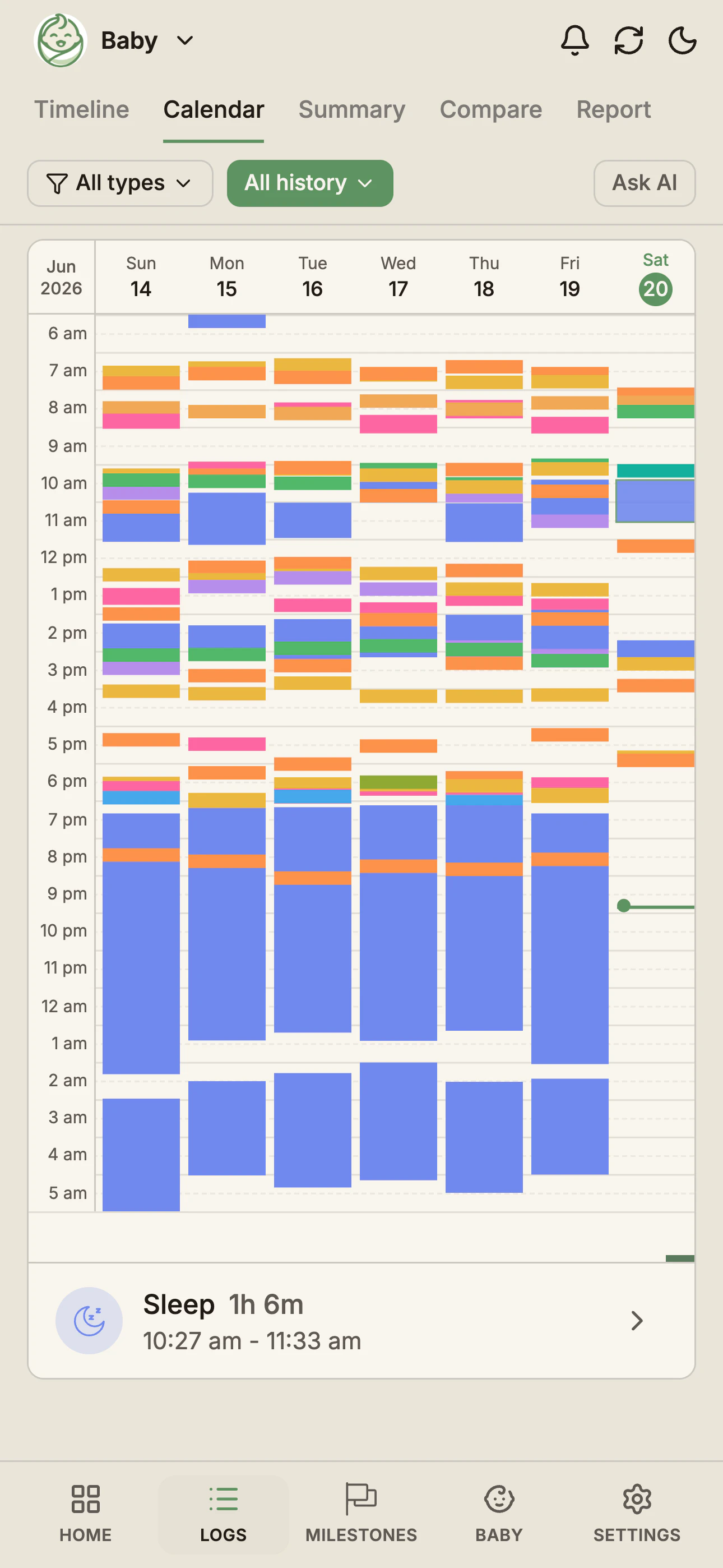
Once you invite your partner, they can log the 2am feed and the next sleep on their own phone, so it lands in the same diary.
If that would save the pencil hunt at 3am, you can start free in the browser on your phone.
If the nurse wants to see change over a longer stretch, such as before and after a residential stay, BabyLog Pro keeps the Calendar and Summary across your full history and lets Compare set any two periods side by side.
Common questions
Ready to start tracking?
BabyLog works on any device — iPhone, Android, tablet, or desktop. Setup takes two minutes.
Keep reading
Newborn Sleep Guide for Parents in Australia
How much should your baby sleep? Wake windows and naps by age, safe sleep, day-night confusion, and what's behind sleep regressions — a practical guide based on Australian health guidelines.
Baby Health Checks in Australia: The Schedule by State and What Happens at Each Visit
Baby health checks Australia: the free child health nurse visits in the first two years, state by state, what each visit covers and what to bring.