
BabyLog vs Feed Baby: A Long-Running Tracker or a Modern Australian Build?
A fair side-by-side comparison of BabyLog and Feed Baby — daily logging effort, reviewing the day, caregiver sharing, offline use, data export and multilingual support — for parenting in Australia, picking between them.

Feed Baby has been familiar to parents in Australia for years — feature-rich, functional, and one of the names that comes up when people search for a tracker. BabyLog is a newer tracker made in Australia, built around typeless, low-effort daily logging. The right answer depends on whether you value long-running depth or modern lower-effort flow.
This is a fair overview, not a takedown. Where we couldn't verify a Feed Baby claim with confidence, we've left it out or softened the wording.
At a glance
| Feed Baby | BabyLog | |
|---|---|---|
| Best for | Long-running detailed tracker familiar to parents in Australia | Low-effort everyday logging, made in Australia |
| Daily logging style | Feature-rich, functional, somewhat form-heavy | Routine logs often save in two taps; sensible defaults handle time and amount |
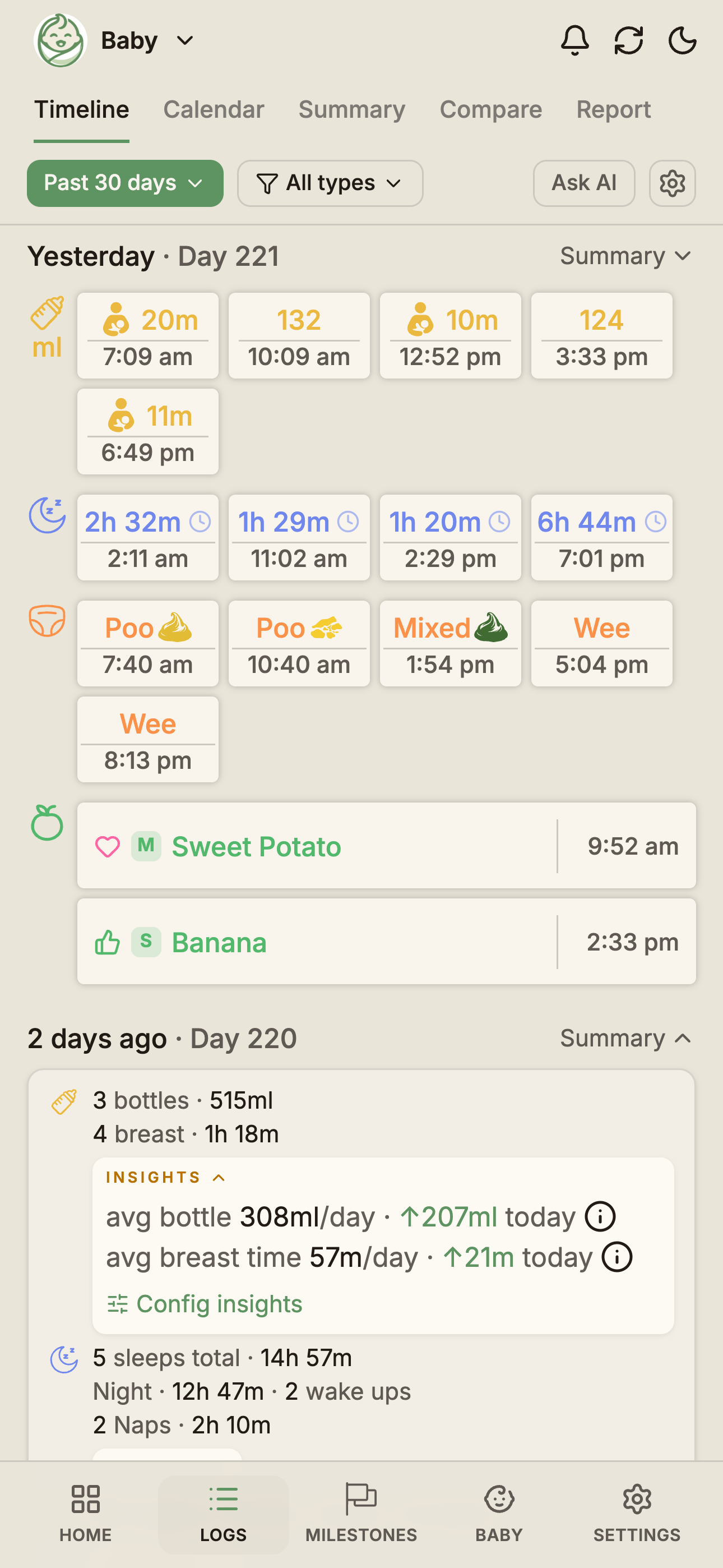
| Reviewing the day | Detailed history with export | Colour-coded timeline, calendar with type filters, summaries and compare views |
| Sharing | Cloud-account sharing | Owner / Editor / Viewer roles, locale-aware caregiver invite links |
| Offline use | Some basic offline behaviour | Local-first — logs save on device, sync when connected |
| Data export | CSV export available | Free CSV import and export |
| Languages | Primarily English | Six languages; RTL-aware layout for Arabic in supported areas |
| Australian feel | Familiar to parents in Australia | Made in Australia — wording, pricing and positioning to match |
What Feed Baby is best for
Feed Baby has been a default recommendation in Australian parent forums for years. It covers feeds, nappies, sleep, growth and more in detail, supports CSV export, and is a sensible pick if you want a long-running, functional tracker.
The most common trade-off is the interface — some users find it dated compared with newer apps, and the data-entry style is more form-heavy than newer designs.
What BabyLog is best for
BabyLog is built around typeless, low-effort logging and scannable review.
Routine logs often save in two taps because the app starts with sensible defaults — current time, a recent typical amount, optional notes — and only asks for changes when reality is different. Fast by default, adjustable when needed.
Each activity has its own colour, so feeds, sleep, nappies and solids are easy to scan in the timeline and calendar without reading every entry. The free tier covers all 12 everyday log types, including CSV import/export and caregiver sharing — so you keep ownership of your log history without paying for it.
Daily logging effort
- Feed Baby: functional and feature-rich, with a more form-style entry pattern.
- BabyLog: all 12 everyday log types start from sensible defaults; left-hand and right-hand modes keep important controls close to your thumb for one-handed logging.
Reviewing the day
- Feed Baby: detailed history; CSV export gives you data for spreadsheets.
- BabyLog: colour-coded timeline, calendar with type filters, daily/weekly summaries and a compare page so you can see patterns without exporting first.
Sharing with partners and caregivers
Both apps support sharing.
BabyLog uses three roles — Owner, Editor, Viewer — and you can send a locale-aware caregiver invite link so a non-English-speaking grandparent or carer can use the whole app in their language. See sharing baby tracking with your partner for the practical flow.
Offline use and data ownership
- Feed Baby: some basic offline behaviour; CSV export is supported.
- BabyLog: local-first — logs save on device first and sync when connected. CSV import and export is part of the free product.
Multilingual support
BabyLog is available in English, Simplified Chinese, Traditional Chinese, Vietnamese, Hindi and Arabic, with RTL-aware layout for Arabic in supported areas — useful in multicultural Australian households.
Pricing and plans
- Feed Baby: free with ads historically, with a paid version to remove them; check current model.
- BabyLog: free tier covers all 12 everyday log types, caregiver sharing, offline-capable logging, summaries, growth charts (WHO percentiles), CSV import/export and Ask AI context sharing. Pro is A$8/month or A$64/year and adds full-history summaries and calendar, milestones, period comparisons, push reminders, multiple editable babies and future premium features.
Who should pick which?
- Pick Feed Baby if you want a long-running, detail-rich tracker familiar to parents in Australia and you're comfortable with its interface style.
- Pick BabyLog if you want a more modern, lower-effort daily flow, colour-coded review, caregiver sharing with role control, offline-capable use, free CSV export and multilingual support. Start with BabyLog or check the pricing page.
A note on safety
Baby tracking apps can help families record routines and notice patterns, but they do not replace advice from a GP, child and family health nurse, paediatrician, lactation consultant, or emergency service. If you are worried about your baby's health, seek professional care. In Australia, for emergencies call triple zero (000).
A note on bias
We built BabyLog, so we are not impartial. We've tried to be fair to Feed Baby: where we couldn't verify a claim with confidence, we've left it out or softened the wording. If Feed Baby suits your family better, use it.
Ready to start tracking?
BabyLog works on any device — iPhone, Android, tablet, or desktop. Setup takes two minutes.
Keep reading

BabyLog vs Baby Daybook: Mainstream Tracker vs Low-Effort, Made in Australia
A fair side-by-side comparison of BabyLog and Baby Daybook — daily logging effort, reviewing the day, caregiver sharing, offline use, data export and multilingual support — for parenting in Australia, picking between them.

BabyLog vs BabyConnect: Detailed Records vs Low-Effort Daily Logs
A fair side-by-side comparison of BabyLog and BabyConnect — daily logging effort, structured records, reviewing the day, sharing, offline use, data export and pricing — for parenting in Australia, deciding between them.