
BabyLog vs Huckleberry: Which Baby Tracker Suits Parents in Australia?
A fair side-by-side comparison of BabyLog and Huckleberry — sleep support, daily logging effort, reviewing the day, caregiver sharing, offline use, data export and pricing — for families parenting in Australia, deciding between them.

Huckleberry is one of the best-known baby tracker brands, especially for sleep. BabyLog is a tracker made in Australia, built around low-effort daily logging. They sit in slightly different lanes, and the right answer depends on which job you most want the app to do.
This is a fair overview, not a takedown. Where we couldn't verify a Huckleberry claim with confidence, we've left it out or softened the wording.
At a glance
| Huckleberry | BabyLog | |
|---|---|---|
| Best for | Sleep prediction and sleep support | Low-effort everyday logging, made in Australia |
| Daily logging style | Solid general logging with strong sleep workflow | Routine logs often save in two taps; sensible defaults handle time and amount |
| Reviewing the day | Sleep-focused insights and timing | Colour-coded timeline, calendar views and daily/weekly summaries |
| Sharing | Partner sharing supported | Owner / Editor / Viewer roles, locale-aware caregiver invite links |
| Offline use | Generally needs a connection for full sync | Local-first — logs save on device, sync when connected |
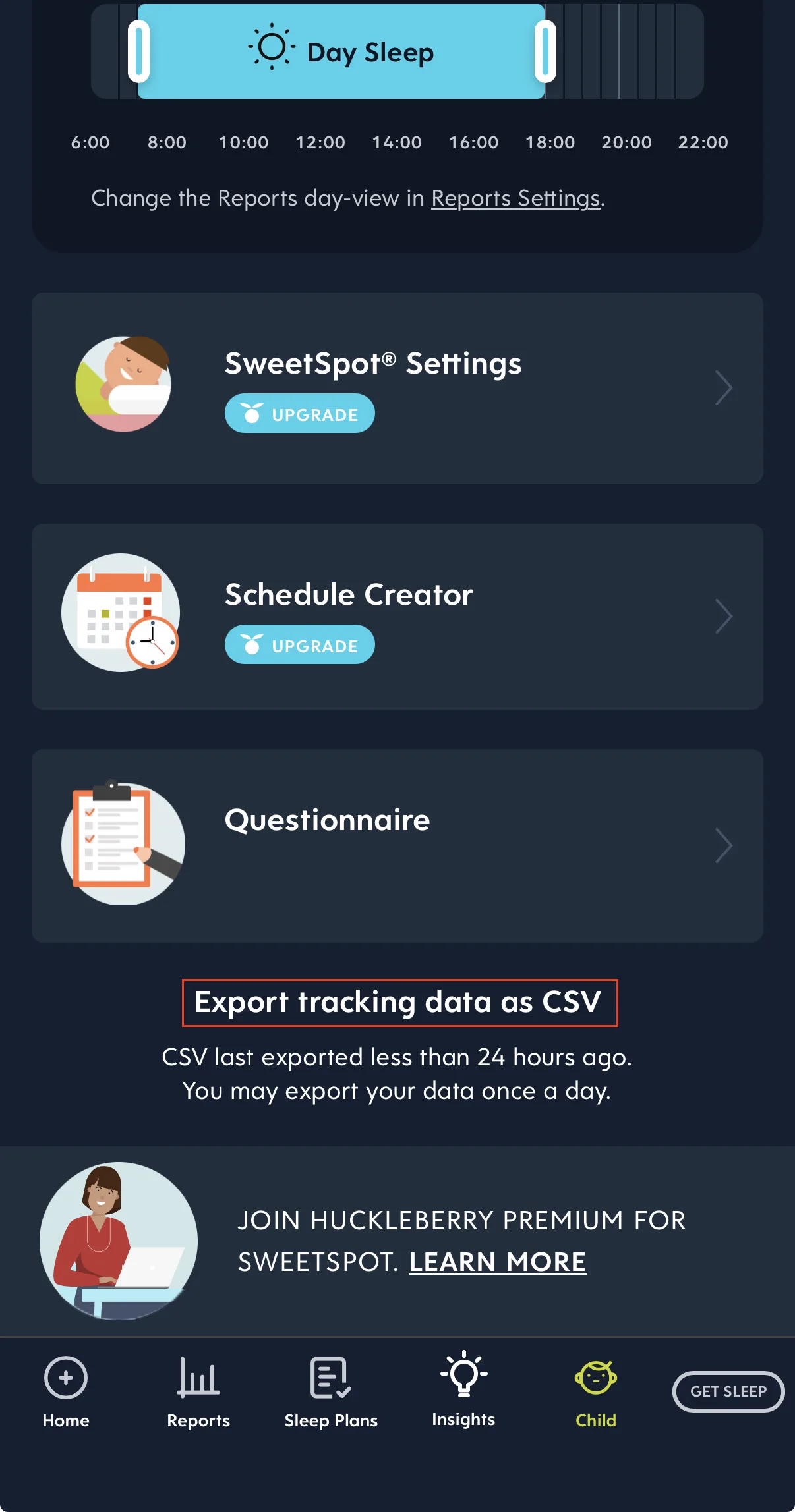
| Data export | Limited / depending on plan and version | Free CSV import and export |
| Languages | Primarily English | Six languages; RTL-aware layout for Arabic in supported areas |
| Australian feel | Global product | Made in Australia — wording, pricing and positioning to match |
Pricing and feature scope can change. Check the current app store listing before subscribing.
What Huckleberry is best for
Huckleberry's strongest feature is its sleep guidance. SweetSpot-style nap timing has earned a lot of trust with parents who feel out of their depth on sleep, and the brand has years of reviews and social proof behind it.
If your single biggest worry right now is sleep — when to nap, how long the wake window is, why bedtime is going sideways — Huckleberry deserves to be on your shortlist. We are not going to claim BabyLog beats Huckleberry on sleep prediction; its sleep support is among the strongest of any mainstream tracker.
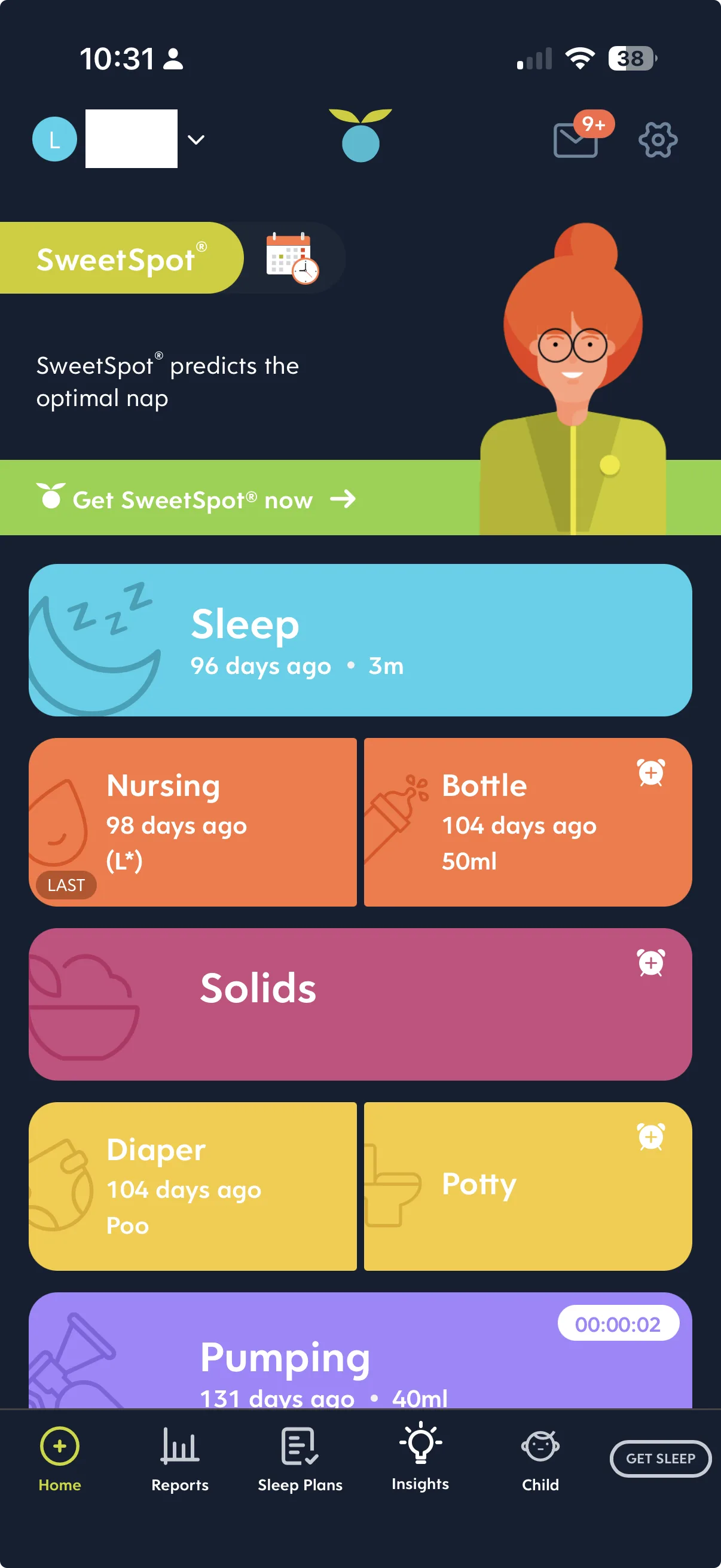
It's also a genuinely polished app to use day to day: the home screen is colourful and glanceable — each activity shows the time since its last entry — and the free tier covers the everyday tracking, with the deeper sleep tooling being what the paid plan is mainly for.
What BabyLog is best for
BabyLog is built around typeless, low-effort logging. The product principle is: fast by default, adjustable when needed.
A routine bottle log can often be saved in two taps — open the feed screen, tap Save — because the app starts with sensible defaults: current time, a recent typical amount (currently the median of recent entries), and optional notes. You only adjust if reality is different. The time control is built for mobile hands: scroll back to yesterday, tap or type if you prefer, or long-press the plus/minus buttons to move faster, with a gentle nudge instead of a harsh error if you stray into the future.

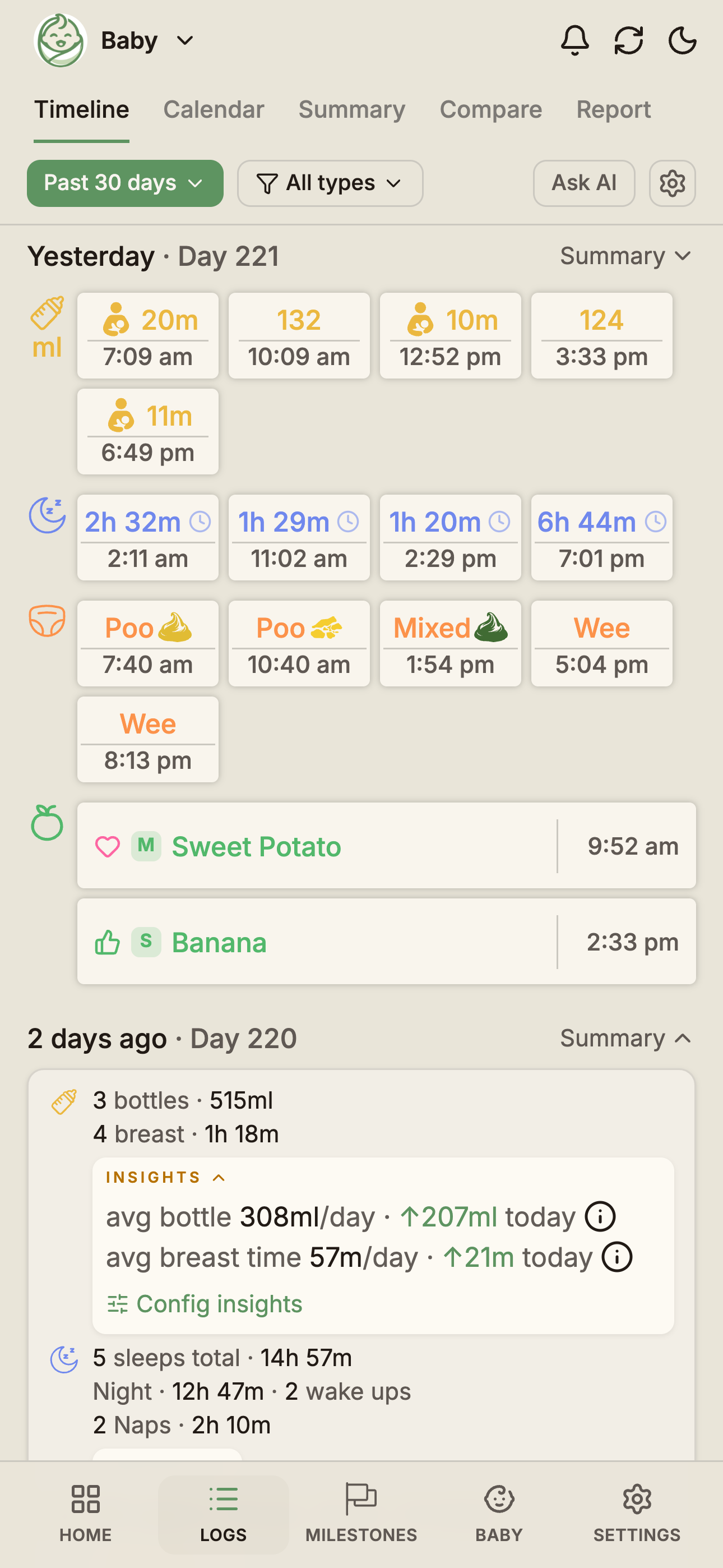
Reviewing the day matters too. Each activity has its own colour, so feeds, sleep, nappies and solids are easy to spot in the timeline and calendar without reading every entry.
Daily logging effort
Baby logging is a repeated micro-action — 6–10 feeds a day, several sleeps, lots of nappies — often at 3am, one-handed, while holding a baby. The difference between a 2-tap flow and a form-heavy flow adds up.
- Huckleberry: strong, sleep-aware logging; sleep is the standout workflow.
- BabyLog: routine logs across all 12 everyday types (feeds, sleep, nappies, solids, pumping, bath, growth, play, temperature, medication, symptoms, notes) are designed to start from sensible defaults so you rarely need to type. Left-hand and right-hand modes keep important controls close to your thumb.
Reviewing the day
- Huckleberry: strongest review experience is around sleep — patterns, windows, timing.
- BabyLog: colour-coded timeline groups logs by day and activity. The calendar view shows each day as a vertical column; you can filter to one type (sleep only) or several (feed + sleep) to see the rhythm without spreadsheets.
Sharing with partners and caregivers
Both apps support sharing.
BabyLog uses three roles — Owner, Editor, Viewer — and you can send a locale-aware invite link so a Mandarin-speaking grandparent or a Vietnamese-speaking carer can use the whole app in their own language from the first tap. See sharing baby tracking with your partner for how this plays out day-to-day.
Offline use and data ownership
- Huckleberry: generally needs a connection for full functionality; check current behaviour.
- BabyLog: local-first — logs save to your device first and sync when connected. Full CSV import and export is part of the free product.
Multilingual support
BabyLog is available in English, Simplified Chinese, Traditional Chinese, Vietnamese, Hindi and Arabic, with RTL-aware layout for Arabic in supported areas. That matters in multicultural Australian households where a nai nai or a ba ngoại might be helping for the afternoon.
Pricing and plans
- Huckleberry: free tier plus a paid plan for full sleep features. Check current pricing on the app store.
- BabyLog: free tier covers all 12 everyday log types, caregiver sharing, offline-capable logging, summaries, growth charts (WHO percentiles), CSV import/export and Ask AI context sharing. Pro is A$8/month or A$64/year and adds full-history summaries and calendar, milestones, period comparisons, push reminders, multiple editable babies and future premium features.
Who should pick which?
- Pick Huckleberry if sleep prediction and sleep coaching are your top priority and you're happy with a global product.
- Pick BabyLog if you want low-effort everyday logging across all activities, free CSV export, caregiver sharing with role control, offline-capable use, multilingual support, and wording and pricing built for parenting in Australia. Start with BabyLog, or skim the pricing page and the feeding and sleep pages.
You can also use both — some families lean on Huckleberry for sleep guidance and BabyLog for everyday logging across the rest.
A note on safety
Baby tracking apps can help families record routines and notice patterns, but they do not replace advice from a GP, child and family health nurse, paediatrician, lactation consultant, or emergency service. If you are worried about your baby's health, seek professional care. In Australia, for emergencies call triple zero (000).
A note on bias
We built BabyLog, so we are not impartial. We've tried to be fair to Huckleberry: where we couldn't verify a claim with confidence, we've left it out or softened the wording rather than overstate it. If Huckleberry suits your family better, use it. The important thing is finding a tracker your household can keep using.
Ready to start tracking?
BabyLog works on any device — iPhone, Android, tablet, or desktop. Setup takes two minutes.
Keep reading

BabyLog vs Baby Daybook: Mainstream Tracker vs Low-Effort, Made in Australia
A fair side-by-side comparison of BabyLog and Baby Daybook — daily logging effort, reviewing the day, caregiver sharing, offline use, data export and multilingual support — for parenting in Australia, picking between them.

BabyLog vs BabyConnect: Detailed Records vs Low-Effort Daily Logs
A fair side-by-side comparison of BabyLog and BabyConnect — daily logging effort, structured records, reviewing the day, sharing, offline use, data export and pricing — for parenting in Australia, deciding between them.