
Printable Newborn Feeding and Nappy Chart for the First Week (A4 PDF)
A printable newborn feeding chart and nappy log for week one: an A4 PDF with each day's minimums marked, a filled example and when to get help.
A baby feeding and nappy log printable for the first week records every feed, wet nappy and poo, day by day, so you and your midwife can see how feeding is going. The A4 chart below works as a newborn log book: each day's minimum feeds and nappies are printed in bold, and a second page holds a 24-hour log.
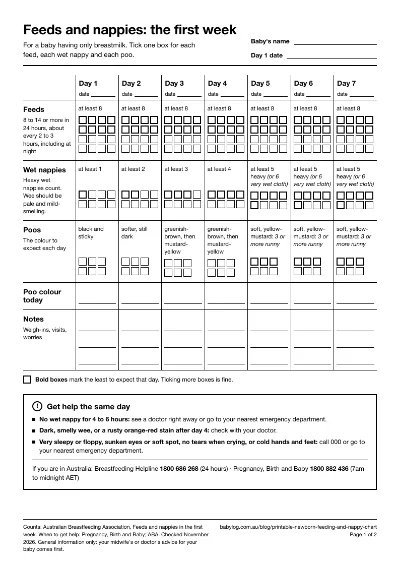
Newborn first-week feed and nappy chart
Two A4 pages: the first week at a glance with each day's minimums marked, and a 24-hour log to print for each day.
The chart prints in black ink only, so it copies cleanly, and it stands on its own: the numbers, the signs to act on and the helpline numbers are all on page 1.
What should a first-week chart record?
A first-week chart records each feed, each wet nappy and each poo with its colour, for every day from birth to day 7. Those three counts are the signs you can check at home that a breastfed newborn is getting enough milk.
- Feeds. One tick per feed on page 1. On page 2, the time, the minutes on each side, and any top-up or expressing session with its mL.
- Wet nappies. One tick per wet nappy. A heavy wet nappy counts; note it if the wee looks dark or smells strong.
- Poos. One tick per dirty nappy, and the colour, which changes quickly in the first days.
- Notes. Weigh-ins, a midwife visit, a feed that went badly, anything you want to ask about.
Your midwife or child health nurse asks for these counts because you can't see how much milk a baby takes at the breast. The Australian Breastfeeding Association(opens in a new window) (ABA) uses wet nappies, poos and pale wee as the reliable signs in the first week.
If you have been asked for a longer feeding diary before a weigh-in, our guide to a baby feeding diary for a weight check covers what the reader looks for.
How to fill in the chart
Tick one box each time something happens, and add up page 2 at the end of each 24 hours. Page 1 shows the whole week at a glance; page 2 is the detail for one day, and you print one sheet per day.
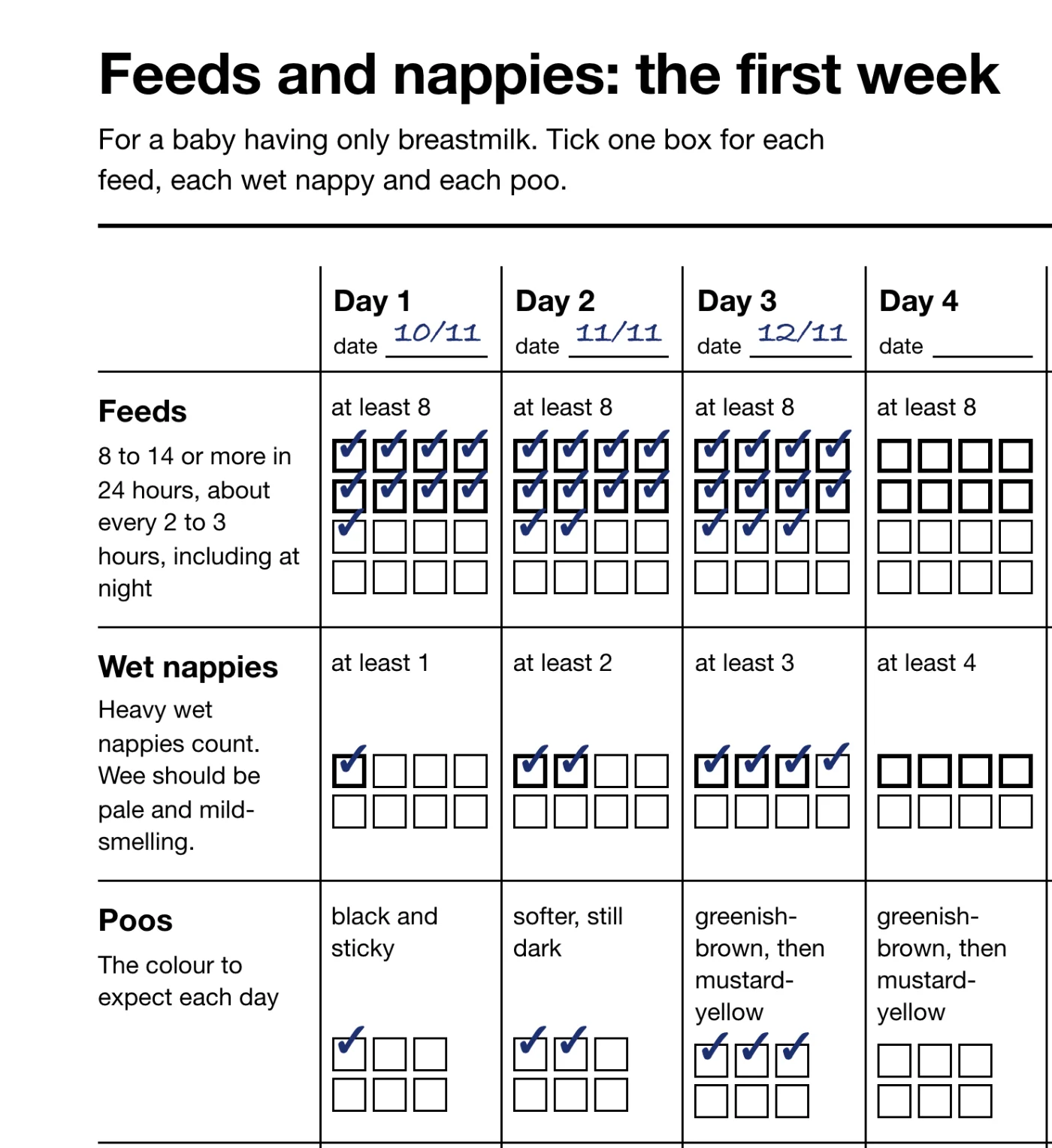
On page 1, each day has a column. The bold boxes are the least to expect that day: 8 feeds every day, then wet nappies rising from 1 on day 1 to 5 from day 5, and 3 poos from day 5. Ticking more boxes than the bold ones is fine. Write the colour you saw in Poo colour today, and anything else in Notes.
Here is a worked day 3 for the same imaginary baby, who is breastfed and has one small top-up of expressed milk on a midwife's plan.
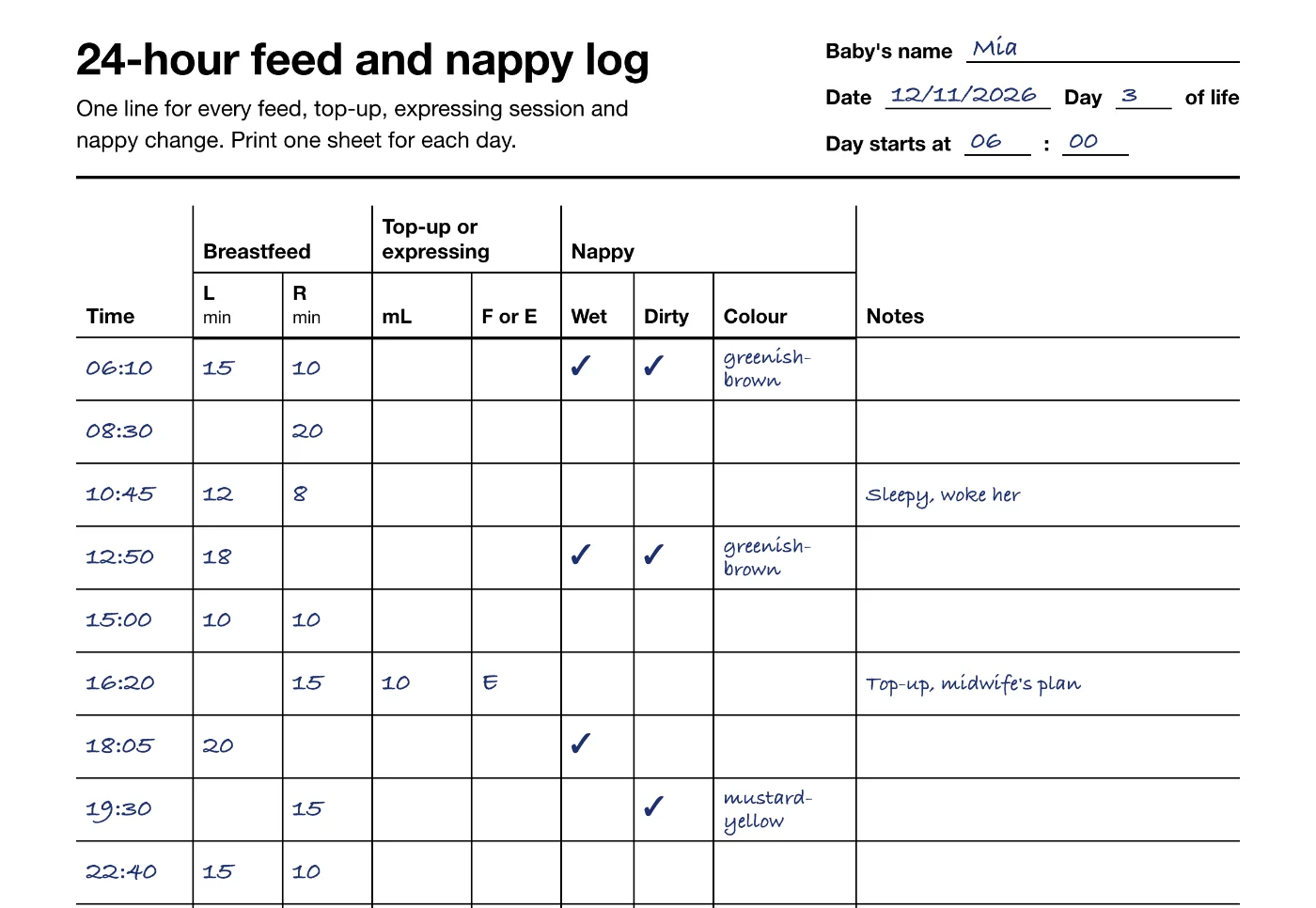
Each printed label means one thing:
- Day starts at. The clock time your 24 hours begins, here 06:00. Use the same time each day so the totals cover a full 24 hours.
- Breastfeed L and R. The minutes on each side. The 06:10 feed was 15 minutes left and 10 minutes right.
- Top-up or expressing, mL and F or E. The mL of a bottle, cup or syringe top-up, or of an expressing session. Write F for formula or E for expressed breastmilk. The 16:20 line shows a 10 mL top-up of expressed milk.
- Wet and Dirty. Tick each one. A nappy that is both gets two ticks on the same line.
- Colour. The poo colour in your own words, such as greenish-brown or mustard-yellow.
- Notes. Anything the reader should know, such as a sleepy feed you had to wake her for.
By 06:00 the next morning this baby had 11 feeds, 4 wet nappies and 3 dirty nappies, with 10 mL of top-up. Those totals go in the bottom row of page 2 and as ticks in the day 3 column on page 1.
How many feeds and nappies to expect in the first week
Most newborns feed 8 to 14 or more times in 24 hours, about every 2 to 3 hours including at night, and wet at least one more nappy each day until day 5. These are the ABA's counts for a baby having only breastmilk.
| Day | Wet nappies in 24 hours | Poo |
|---|---|---|
| Day 1 | At least 1 | Black and sticky |
| Day 2 | At least 2 | Softer, still dark |
| Day 3 | At least 3 | Greenish-brown, then mustard-yellow |
| Day 4 | At least 4 | Greenish-brown, then mustard-yellow |
| Day 5 onwards | At least 5 heavy disposables (or 6 very wet cloth) | Soft, yellow-mustard; 3 or more runny poos a day |
The ABA gives no poo count for days 1 to 4, so the chart has no bold poo boxes on those days. From day 5, wee should be pale and mild-smelling.
If your baby has formula, the counts differ: see the signs a formula-fed baby is getting enough. The counts for each stage after the first week are in our guide to how many wet nappies a day, and the colours in the baby poo colour chart.
When to get help the same day
A falling nappy count or dark wee is worth acting on the same day, and some signs need urgent care. The chart prints these in a box on page 1, so they are on the fridge when you need them.
- No wet nappy for 4 to 6 hours: see a doctor right away or go to your nearest emergency department, says Pregnancy, Birth and Baby(opens in a new window).
- Dark, smelly wee, or a rusty orange-red stain in the nappy after day 4: check with your doctor, says the ABA. The stain is normal in the first few days.
- Very sleepy or floppy, sunken eyes or soft spot, no tears when crying, or cold hands and feet: call 000 or go to your nearest emergency department.
If you are in Australia, the National Breastfeeding Helpline on 1800 686 268 answers 24 hours a day, and the Pregnancy, Birth and Baby helpline on 1800 882 436 connects you to a maternal child health nurse from 7am to midnight (AET).
When paper stops working
Paper works well while one person does most feeds and the chart stays in one place. It gets harder once more people help.
- Two people take turns. A partner or grandparent does the 3am feed and the sheet is in the other room, so the tick never lands.
- The tally at 3am. Adding up feeds, minutes and nappies at the end of a long day is where mistakes creep in.
- The nurse asks for two weeks. Fourteen sheets of page 2 are a lot to carry and a lot to read.
That is when a phone log helps. In BabyLog each person logs on their own phone, a feed or nappy takes a tap, and running daily totals of feeds, wet nappies and dirty nappies are ready for the next check-up. Our guide to moving from notes to a feeding and nappy log compares the two. If that sounds easier, you can start a log on your phone and keep the paper chart for the days you prefer it.
Moving from paper to an app without retyping
You can turn a filled sheet into BabyLog entries with Import with AI instead of retyping it. Import with AI gives you a prompt, already filled in with your baby's name and birth date, for the AI chat you already use, such as ChatGPT or Claude.
- In BabyLog, open your baby's data page, go to the Import with AI tab and copy the prompt.
- Paste the prompt into your AI chat, then add a photo of each filled sheet. Taking the photo flat and in good light helps the AI read the handwriting.
- The AI may ask a question first, such as which calendar date day 3 is, then gives you a CSV.
- On the Import & Export tab, paste the CSV and tap Preview & Import. You see every entry before anything is saved.
We tried it with the filled day 3 sheet above, and with a blurred, tilted photo of it: following the prompt, every feed, top-up and nappy came through the preview with the right time, minutes and mL. Read the preview before you import, because handwriting varies and an AI can misread a number.
Import and export are free on every plan, and the import and export guide covers the steps in detail. When you are ready, create your BabyLog account and bring the first week with you.
Common questions
Ready to start tracking?
BabyLog works on any device — iPhone, Android, tablet, or desktop. Setup takes two minutes.
Keep reading

Keeping a Baby Feeding Diary for a Weigh-In or Lactation Consultant: What to Record, and for How Long
What to write in a baby feeding diary before a weigh-in or lactation visit, a filled 24-hour example, how many days to keep it and what to bring.
How Many Wet Nappies a Day? A By-Age Guide for Parenting in Australia
At least five heavy wet nappies a day once feeding is established. The by-age counts, what a heavy nappy feels like, and the dehydration red flags.