
Your First Week With a Newborn: Feeds, Nappies, Weight and Checks, Day by Day
Your first week with a newborn, day by day: 8 to 14 or more feeds a day, wet nappies climbing to 5, poo turning yellow, the weight dip and the checks.
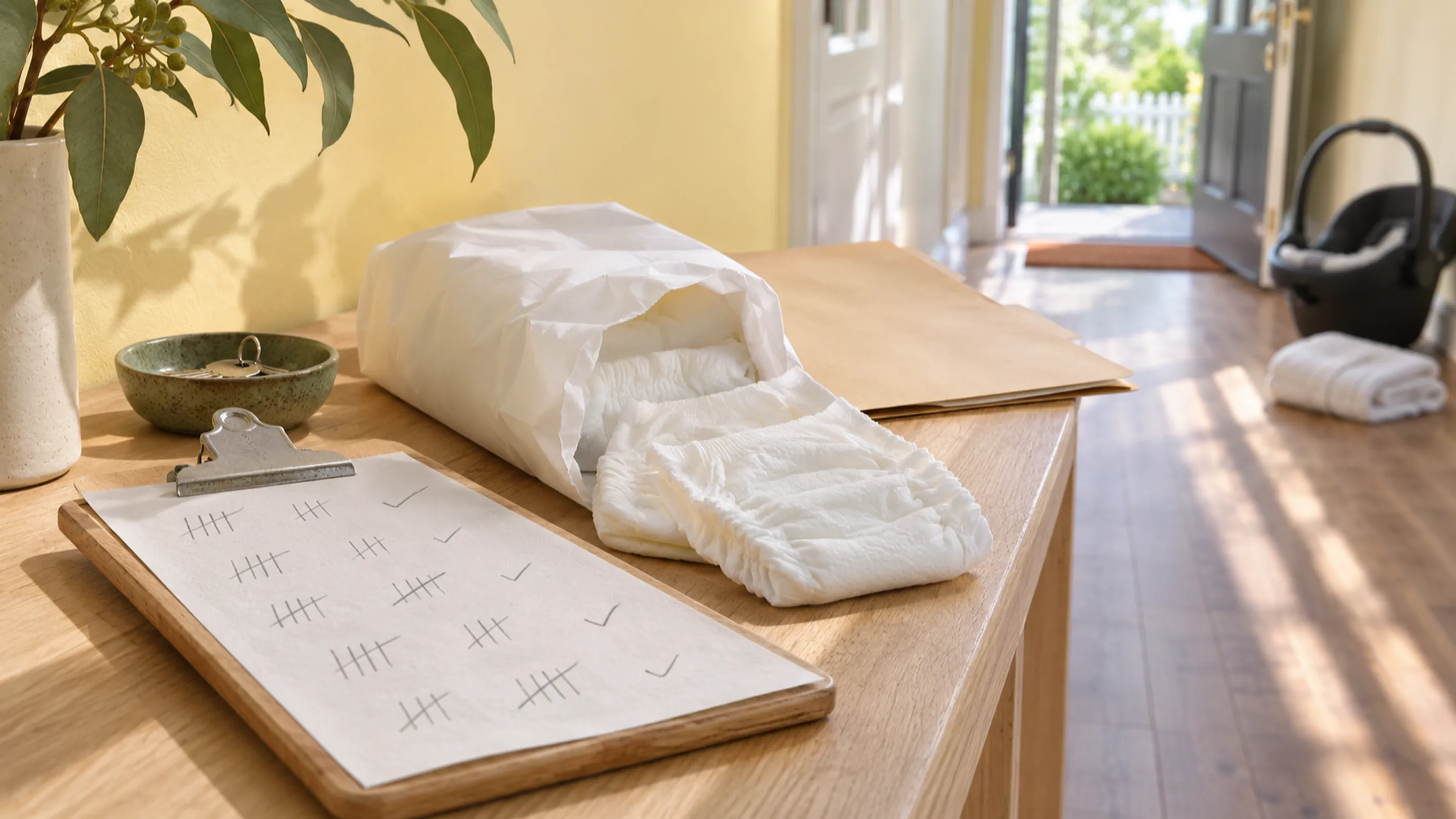
In the first week with a newborn, expect 8 to 14 or more feeds every 24 hours, including overnight. The minimum wet-nappy count rises by one a day, to five heavy ones from day 5, and poo turns from black to mustard-yellow. Your baby loses a little weight before gaining it back, and a midwife usually visits.
Below, the week is broken into days: what usually happens, the checks your baby has, and the signs that mean you call someone today.
The figures come from the Australian Breastfeeding Association (ABA), Pregnancy, Birth and Baby and healthdirect. Where a full table already lives on another page, this guide links to it.
A newborn first week schedule, day by day
Every day this week your baby needs 8 to 14 or more feeds, and the minimum number of wet nappies rises by one a day until day 5. Feed times vary from baby to baby, so this schedule tracks what changes each day.
| Day | Nappies | What's happening |
|---|---|---|
| Day 1 | 1+ wet; black, sticky poo | Colostrum feeds; vitamin K and first hepatitis B dose offered |
| Day 2 | 2+ wet; softer, dark poo | Hearing screen, usually done by now |
| Day 3 | 3+ wet; greenish-brown poo | Heel prick test (48 to 72 hours); jaundice can show, so get it checked |
| Day 4 | 4+ wet; poo turning yellow | Milk coming in (any time from day 2 to 5) |
| Day 5 | 5+ heavy wet; yellow poo | Weigh-in often around now |
| Days 6 and 7 | 5+ heavy wet; yellow poo | Weight should start climbing back |
The nappy counts are the ABA's minimums(opens in a new window) for a baby having only breastmilk. Our printable first-week feed and nappy chart puts the same counts on an A4 page, with a box to tick for each feed and nappy.
The checks and timings come from Pregnancy, Birth and Baby(opens in a new window). Every baby runs a little differently, so treat the "what's happening" column as a guide to the order of things.
Mild jaundice shows up in about 1 in 2 full-term newborns, often 2 to 4 days after birth, says Pregnancy, Birth and Baby(opens in a new window). Ask your midwife or doctor to check any yellow colour. Our guide to newborn jaundice at home covers how often to feed and which wees and poos to watch.
Your first day home with a newborn
If you went home early, day 1 or 2 at home is mostly feeding, changing and sleeping in short bursts. healthdirect(opens in a new window) says a midwife usually visits in the first week, and may come as soon as 24 hours after birth. You can arrange the visit with your midwife before you leave hospital.
Before that visit, it helps to know three things: roughly how many feeds there have been, how many wet and dirty nappies, and what colour the poo was. You don't need perfect numbers. A tally on the back of an envelope does the job.
Feeds in the first few days with a newborn
Newborns feed 8 to 14 or more times in 24 hours, and night feeds count. Both the ABA(opens in a new window) and Pregnancy, Birth and Baby(opens in a new window) give that range.
For the first couple of days your baby drinks colostrum, the first milk, in small amounts. Between days 2 and 5 it slowly changes into regular breastmilk, which is what people mean by milk "coming in". Our guide to when your milk comes in covers what that feels like and what helps.
Some newborns are so sleepy they snooze through feeds. The ABA says that if your baby is extra sleepy, you may need to wake them to make sure they get the milk they need.
Wondering how many millilitres that adds up to? The volumes for colostrum and each day after are in our guide to newborn feeding amounts. If your baby has formula, see the signs a formula-fed baby is getting enough.
Wees and poos: what changes each day
Wet nappies rise from at least one on day 1 to at least five heavy ones from day 5, and poo goes from black and sticky to soft and mustard-yellow. The ABA gives these counts for a breastfed baby.
The first poo is meconium, black and tar-like. By day 2 it's softer but still dark. Over the next few days it turns greenish-brown, then mustard-yellow, and there's more of it. Our baby poo colour chart shows each colour and the few that need a doctor.
Wee should be pale. The ABA says dark, smelly wee is a sign your baby isn't taking in enough milk. A rusty, orange-red stain is normal in the first few days, but check with your doctor if you see it after day 4.
The ABA(opens in a new window) says a heavy wet nappy holds about 60g of wee, roughly the weight of a large egg. Our guide to how many wet nappies a day covers how the count holds after the first week.
The weight dip and the turn
Healthy babies can lose up to 10% of their birth weight in the first week, then most are back to birth weight by around 10 to 14 days. Pregnancy, Birth and Baby(opens in a new window) gives both figures, and notes some babies take 2 to 3 weeks.
So a lighter baby at the day 5 weigh-in is expected. Pregnancy, Birth and Baby says early weigh-ins are often around 5 and 10 days of age. The ABA(opens in a new window) puts it simply: it's usual to lose a little weight after birth, but your baby should start gaining again.
What happens after the turn, week by week, is in our guide to newborn weight gain per week.
Visits and checks in week one
In week one your baby has a hearing screen and a heel prick test, and a midwife usually visits at home. The first child health nurse visit, usually at home, comes after that, at a time that depends on your state.
- Vitamin K and hepatitis B. You'll be offered the vitamin K injection and the first hepatitis B vaccine dose while you're in hospital (Pregnancy, Birth and Baby(opens in a new window)).
- Heel prick test. The newborn bloodspot screen is usually done between 48 and 72 hours of age.
- Hearing screen. It's usually done in hospital within 2 days of birth. If you're home before then, it can be done as an outpatient or at a home visit (Pregnancy, Birth and Baby(opens in a new window)).
- Newborn Child Declaration. Your doctor or midwife signs this form before you leave hospital (healthdirect(opens in a new window)).
- Midwife visit. A midwife usually visits during the first week, sometimes as soon as 24 hours after birth.
- Child health nurse. The first visit is usually at your home. The hospital usually tells your local child health service about your baby, and healthdirect suggests checking with your midwife how to book or confirm it.
Our guide to baby health checks in Australia lists each state's schedule and what the nurse checks.
Sleeping safely from the first night
Put your baby on their back for every sleep, day and night, from the very first one. Red Nose Australia(opens in a new window) sets out six recommendations:
- Always place your baby on their back to sleep.
- Keep their head and face uncovered.
- Keep your baby smoke-free, before and after birth.
- Provide a safe sleeping environment, night and day.
- Sleep your baby in their own safe sleep space, in the same room as an adult, for at least the first 6 months.
- Breastfeed, if possible.
Home from special care
If your baby was born early or spent time in special care, the hospital's plan for feeds, weigh-ins and follow-up comes first, and some days in this guide may not match. Our guide to bringing a premature baby home covers those first weeks.
When to get help straight away
Some first-week signs can't wait for the next visit. Trust your gut. You know your baby better than anyone.
- Yellow in the first 24 hours: jaundice that starts in the first day needs care straight away. Pregnancy, Birth and Baby says call 000 or go to your nearest hospital.
- Any yellow skin or eyes: Pregnancy, Birth and Baby(opens in a new window) says any newborn with signs of jaundice should be checked by a midwife or doctor. Jaundice that starts in the first 48 hours, or spreads down the body, needs checking straight away by a midwife or child health nurse.
- Jaundice with pale poo or dark wee: seek emergency care, says Pregnancy, Birth and Baby.
- Jaundice and sleepy: a yellow baby who is sleepy and needs waking for feeds, or whose yellow spreads down the body, needs prompt help (Sydney Children's Hospitals Network(opens in a new window)).
- Too few wet nappies: fewer wet nappies than the day's minimum in the table, or dark, smelly wee, can mean your baby isn't getting enough milk (ABA(opens in a new window)). Pregnancy, Birth and Baby says to see your doctor if you think a baby under 6 months is dehydrated (source(opens in a new window)).
- Fever above 38°C under 3 months: take your baby to the nearest emergency department immediately, says healthdirect(opens in a new window).
- Fast, noisy or hard breathing: go to the nearest emergency department or call 000.
- Other emergencies: call 000 for a seizure, vomiting blood or green fluid, or a fever with floppiness, pale skin or a purple rash.
- Blood in the poo: see your doctor (healthdirect(opens in a new window)).
Not sure how serious it is? Call healthdirect on 1800 022 222 to speak with a registered nurse at any hour. The Pregnancy, Birth and Baby line on 1800 882 436 (7am to midnight AET) and the National Breastfeeding Helpline on 1800 686 268 (24 hours) can help too.
Keeping the week's record
By day 4 the nights blur, and few people can say whether the 2am nappy was wet. The printable chart works if it stays by the change table and everyone ticks it.
When the midwife asks how many wet nappies since yesterday, BabyLog has the list on your phone: the feed log times each breastfeed with left and right minutes or records a bottle in mL, and the nappy log records a wee, a poo or both, with the poo's colour and whether a wet one was very wet.
Logging a weight shows its percentile. You can share your baby with your partner for free, so whoever does the 3am change logs it, and it reaches the other phone when BabyLog next opens.
If that would help this week, you can start free in your phone's browser, with no app store needed.
Common questions
Ready to start tracking?
BabyLog works on any device — iPhone, Android, tablet, or desktop. Setup takes two minutes.
Keep reading
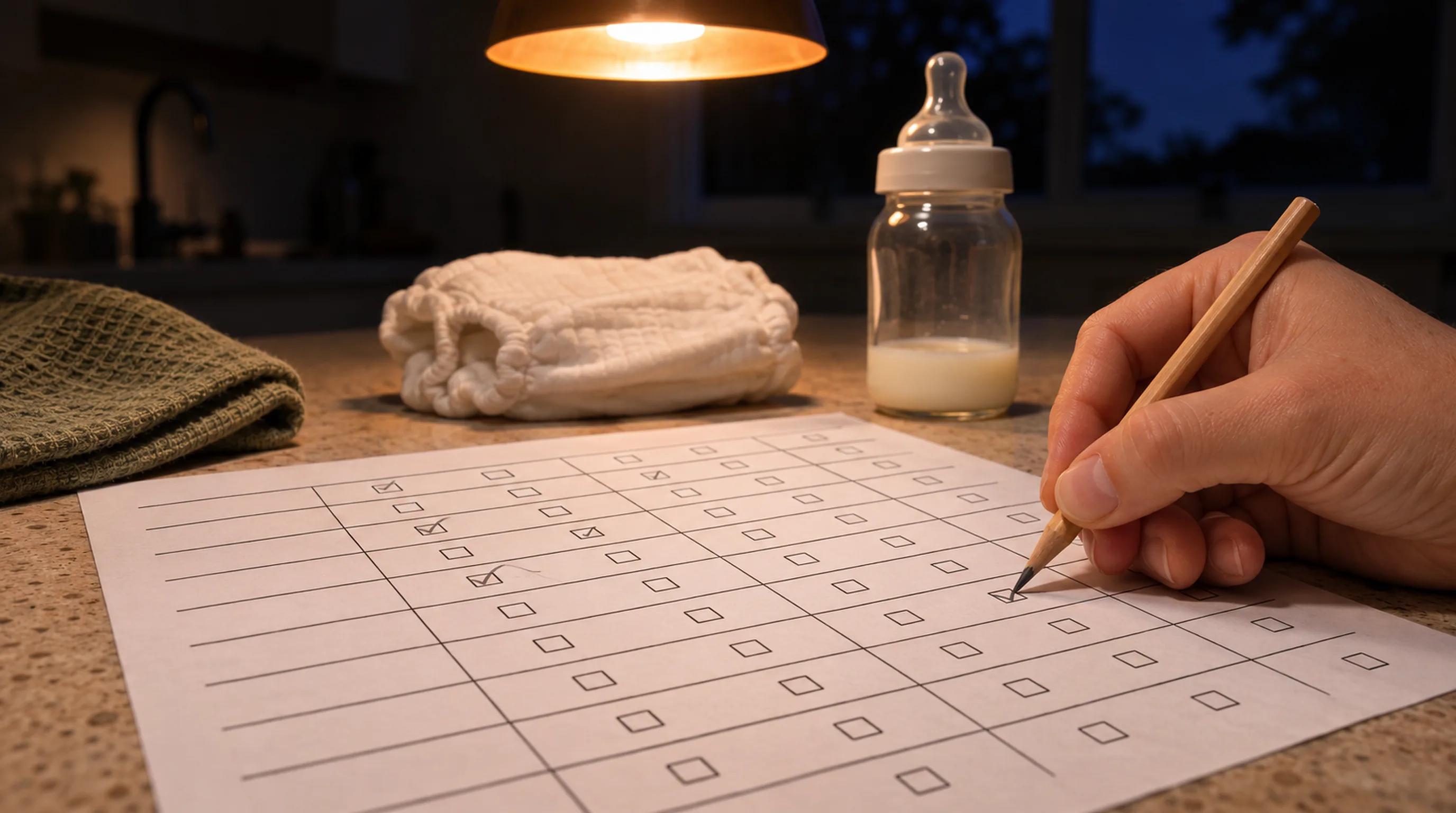
Printable Newborn Feeding and Nappy Chart for the First Week (A4 PDF)
A printable newborn feeding chart and nappy log for week one: an A4 PDF with each day's minimums marked, a filled example and when to get help.
Baby Health Checks in Australia: The Schedule by State and What Happens at Each Visit
Baby health checks Australia: the free child health nurse visits in the first two years, state by state, what each visit covers and what to bring.