
How Much Milk Does a Newborn Need? mL per Feed by Day and Week for the First 4 Weeks
Newborn feeding amounts by day and week: tiny feeds in days 1 to 4, then about 150 mL per kg a day, worked mL examples and how to tell it is enough.
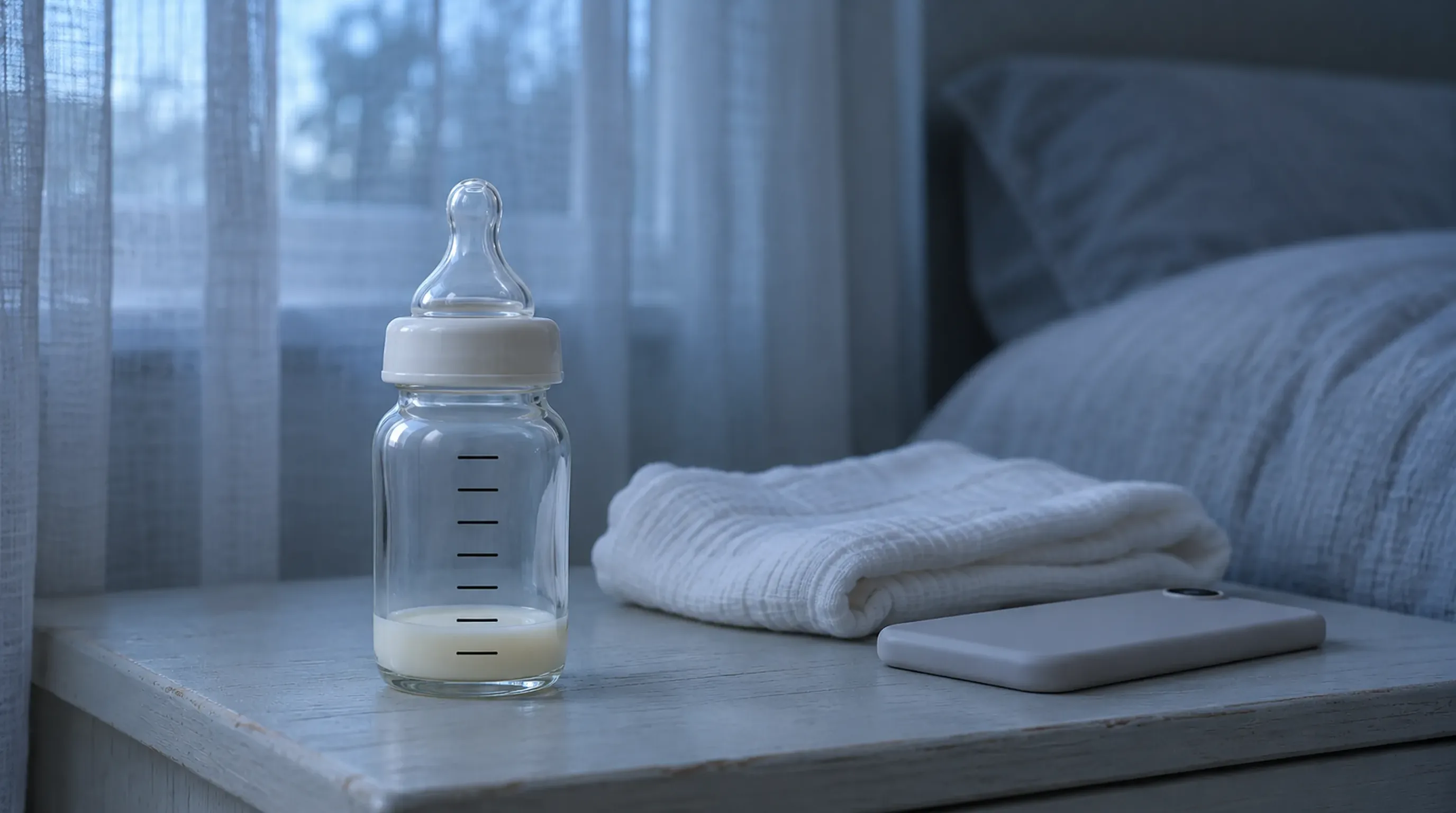
Newborn feeding amounts climb fast. Australia's NHMRC guidelines start formula at 30 to 60 mL per kg a day on day 1, rising to about 150 mL per kg a day from day 5. At an example weight of 3.5 kg, that's about 525 mL a day, or 45 to 65 mL a feed over 8 to 12 feeds.
If you're breastfeeding, there's no mL figure to check, because nobody can measure what your baby takes at the breast. Wet nappies, poos and weight gain do that job.
The per-kg figures come from the NHMRC Infant Feeding Guidelines(opens in a new window), and the breastfed amounts from the Australian Breastfeeding Association(opens in a new window) (ABA). Every formula mL figure below is worked out at a stated example weight. Treat it as a guide for the day. Your baby may take more or less and still be doing well.
Newborn feeding amounts by day in the first week
In the first four days a breastfed newborn takes a few millilitres a feed, rising to about 30 to 60 mL a feed by day 4. Your baby's tummy is very small at first, and the ABA says the colostrum your breasts make in the first few days is just the right amount.
| Day | Breastfed, per feed (ABA) | Formula, per day (NHMRC) |
|---|---|---|
| Day 1 | 2 to 10 mL | Start at 30 to 60 mL per kg (105 to 210 mL at 3.5 kg) |
| Day 2 | 5 to 15 mL | Rising each day |
| Day 3 | 15 to 30 mL | Rising each day |
| Day 4 | 30 to 60 mL | Rising each day |
| Days 5 to 7 | No per-feed figure | 150 mL per kg (about 525 mL at 3.5 kg) |
Reading the table:
- The ABA's own labels are 1 day old, 1 to 2 days old, 2 to 3 days old and 3 to 4 days old, for healthy, full-term breastfed babies.
- The NHMRC gives no figure for days 2 to 4. It says to start at 30 to 60 mL per kg a day and increase over the next few days, reaching 150 mL per kg from day 5.
- Feeds are frequent. The NHMRC says breastfed babies typically establish 8 to 12 feeds in 24 hours in the first week, and the ABA says 8 to 14 or more is common.
Between 2 and 5 days after birth, colostrum slowly changes into regular breastmilk, which the ABA calls your milk "coming in". Our guide to when your milk comes in covers that change, and your first week with a newborn covers the rest of days 1 to 7.
Weeks 2 to 4: how much per feed and per day
From day 5 to 3 months, the NHMRC guide for formula is about 150 mL per kg of body weight a day, spread across the day's feeds.
NHMRC · Infant Feeding Guidelines, section 8.4.3Bottle-fed infants up to 6 months require about 150 ml/kg body weight each day to meet their nutrient needs. Some will require more (up to 200 ml/kg), others less.
Here is that figure worked out at three example weights. As your baby grows, the NHMRC says the amount of formula goes up, and the strength always stays the same.
| Example weight | About per day | About per feed (8 to 12 feeds) |
|---|---|---|
| 3.5 kg | 525 mL | 45 to 65 mL |
| 4 kg | 600 mL | 50 to 75 mL |
| 4.5 kg | 675 mL | 55 to 85 mL |
The NHMRC adds that some babies, especially those born preterm, need up to 180 to 200 mL per kg a day. If your baby came early, their hospital team or child health nurse will set the amount.
Why the amount per feed changes
The daily total is the anchor. The size of each bottle depends on how many feeds your baby has that day. Pregnancy, Birth and Baby says bottle-fed newborns generally have 6 to 8 feeds(opens in a new window) in 24 hours, so at 4 kg and 6 feeds, each bottle works out at about 100 mL.
Fewer feeds mean bigger bottles. More feeds mean smaller ones. Both can add up to the same day. For how often a newborn feeds, see our newborn feeding schedule.
The breastfeeding side lines up with these numbers. The ABA says milk supply climbs to 500 to 700 mL a day by about the second week, close to the NHMRC formula figure at 3.5 to 4.5 kg (525 to 675 mL).
Breastfed newborns: why there is no mL number, and what to check instead
You can't measure how much your baby takes at the breast, so breastfed newborns have no mL figure to hit. Not having a number to check can feel unsettling in the first nights, so the checks below are the ones the ABA and NHMRC give instead. The ABA says it plainly:
Australian Breastfeeding Association · Feeds and nappies in the first weekWe can't measure how much a baby takes when they breastfeed.
What you can check, day by day:
- Wet nappies: at least 1 on day one, 2 on day two, 3 on day three and 4 on day four, then at least 5 heavy disposables (or 6 very wet cloth nappies) every 24 hours from day 5 (ABA). Our wet nappy guide sets out how many wet nappies a newborn should have.
- Poo: black and sticky at first, softer but still dark by day 2, then greenish-brown and mustard-yellow. From day 5, the ABA expects plenty of soft, yellow-mustard poos.
- Weight: the NHMRC says losing up to 10% of birth weight in the first week is common. Babies start to regain weight at 4 to 6 days and should be back to birth weight by 2 weeks. More in our guide to newborn weight gain each week.
- Between feeds: the ABA looks for good skin colour, alertness when awake and periods of calm between feeds.
Formula-fed babies get a similar check. The NHMRC lists plenty of wet nappies (six or more a day), steady weight gain and a thriving, active baby as signs all is well. The full list for both is in signs your baby is getting enough.
How much expressed milk to put in a bottle
For expressed breastmilk, use the breastfed amounts as your guide and let your baby decide when the bottle is done. In days 1 to 4, that means the ABA per-feed amounts in the first table. By about the second week, it means a share of roughly 500 to 700 mL a day.
To turn a daily amount into one bottle, the ABA's method is to divide by the number of feeds. At 600 mL a day and 10 feeds, that is about 60 mL a bottle. From 1 to 6 months, the ABA gives an average of 750 mL a day, so the bottles grow slowly.
The ABA suggests paced bottle-feeding, which lets your baby control how much and how fast they drink:
- Hold your baby upright and use a slow-flow teat.
- Keep the bottle mostly horizontal, tipped just enough to fill the teat.
- Pause every few minutes so your baby doesn't drink too much, too fast.
- Let them finish when ready. The ABA says they may not need all the milk in the bottle, and that's okay.
Make up small amounts to cut waste. Pregnancy, Birth and Baby says to throw away leftover milk at the end of a feed, or after one hour. If you're starting bottles alongside the breast, our guide to introducing a bottle to a breastfed baby walks through it.
Let hunger and fullness cues set each feed
Feed when your baby shows hunger cues, and stop when they show they're full, even if there's milk left. Pregnancy, Birth and Baby says to feed your baby based on their needs, and that responding to hunger cues helps make sure they get enough.
The Pregnancy, Birth and Baby hunger cues guide(opens in a new window) sorts them like this:
- Early cues: opening the mouth, moving the tongue, rooting, bringing hands to the mouth, becoming more alert and restless.
- Mid cues: more restless, more hand-to-mouth movements, sucking on lips or hands.
- Late cue: crying. Settle your baby first, then feed.
- Full: turning the head away, spitting out milk, clamping the mouth shut. On a bottle, sucking slows, pauses get longer and your baby pulls away from the teat.
When your baby shows they're full, you don't need to encourage more. Pregnancy, Birth and Baby is blunt about bottles: never force your baby to finish a bottle.
The mL figure describes a whole day. Your baby's cues decide each feed.
When to call the midwife, child health nurse or GP
Pregnancy, Birth and Baby says to check with your child health nurse if you're unsure how much formula to offer. These signs need more than a phone question:
- Have your baby checked promptly: if they are unusually sleepy or hard to wake, or feed poorly. The Royal Children's Hospital's guide for clinicians lists these among the signs of an unwell newborn, and describes poor feeding as less than half the usual amount over 24 hours.
- Fewer wet nappies than the counts above: in days 1 to 4, fewer than the day-by-day minimums; from day 5, fewer than 5 heavy disposables in 24 hours. The ABA says dark, smelly wee means your baby isn't taking in enough milk. Call your midwife or child health nurse.
- Yellow and sleepy: some jaundiced babies are drowsy and have trouble feeding. Take your baby to be checked immediately if they have jaundice and aren't gaining enough weight, are very unsettled or are vomiting (Pregnancy, Birth and Baby). Our guide to newborn jaundice and feeding has more.
- Jaundice in the first 24 hours, or jaundice with a fever: call 000 for an ambulance or go to your nearest hospital.
- After the first 4 days, no wet nappy for 4 to 6 hours: see a doctor right away or go to the nearest emergency department.
- Signs of severe dehydration: less active than usual, pale skin, sunken eyes or a sunken fontanelle (the soft spot), no tears or faster breathing. Call 000 or go to your nearest emergency department.
The ABA's Breastfeeding Helpline is on 1800 686 268, 24/7. Pregnancy, Birth and Baby's maternal child health nurses are on 1800 882 436, 7am to midnight (AET), 7 days a week. The healthdirect helpline is on 1800 022 222, with a registered nurse 24 hours a day (NURSE-ON-CALL in Victoria).
Checking today's total
The per-kg figure covers a whole day. By the 3am bottle, it's hard to remember whether the 11pm feed was 60 mL or 90. A note on the fridge works, as long as everyone who gives a bottle writes it down.
BabyLog's free bottle log records the mL in each bottle, and Today at a glance on the home screen adds up today's bottles and mL from 6am. For a breastfed baby, the same card counts today's nappies, wees and poos. If that would help, you can start free in your phone's browser, with no app store needed.
After the first month, our formula feeding guide carries the amounts on to 12 months. If you think your baby's formula isn't suiting them, read about changing baby formula before you swap.
Common questions
Ready to start tracking?
BabyLog works on any device — iPhone, Android, tablet, or desktop. Setup takes two minutes.
Keep reading

How Often Should a Newborn Feed? A Week-by-Week Feeding Schedule for the First 8 Weeks
A newborn feeding schedule, week by week: 8 to 12 or more feeds a day and night. When to wake a sleepy baby, and when to call your nurse.
How Many Wet Nappies a Day? A By-Age Guide for Parenting in Australia
At least five heavy wet nappies a day once feeding is established. The by-age counts, what a heavy nappy feels like, and the dehydration red flags.