
Introducing a Bottle to a Breastfed Baby: When to Start, Who Gives It, and Keeping Your Supply Up
Australian services advise no bottles in the first 4 weeks. How to introduce a bottle to a breastfed baby, pace the feed and keep your supply up.
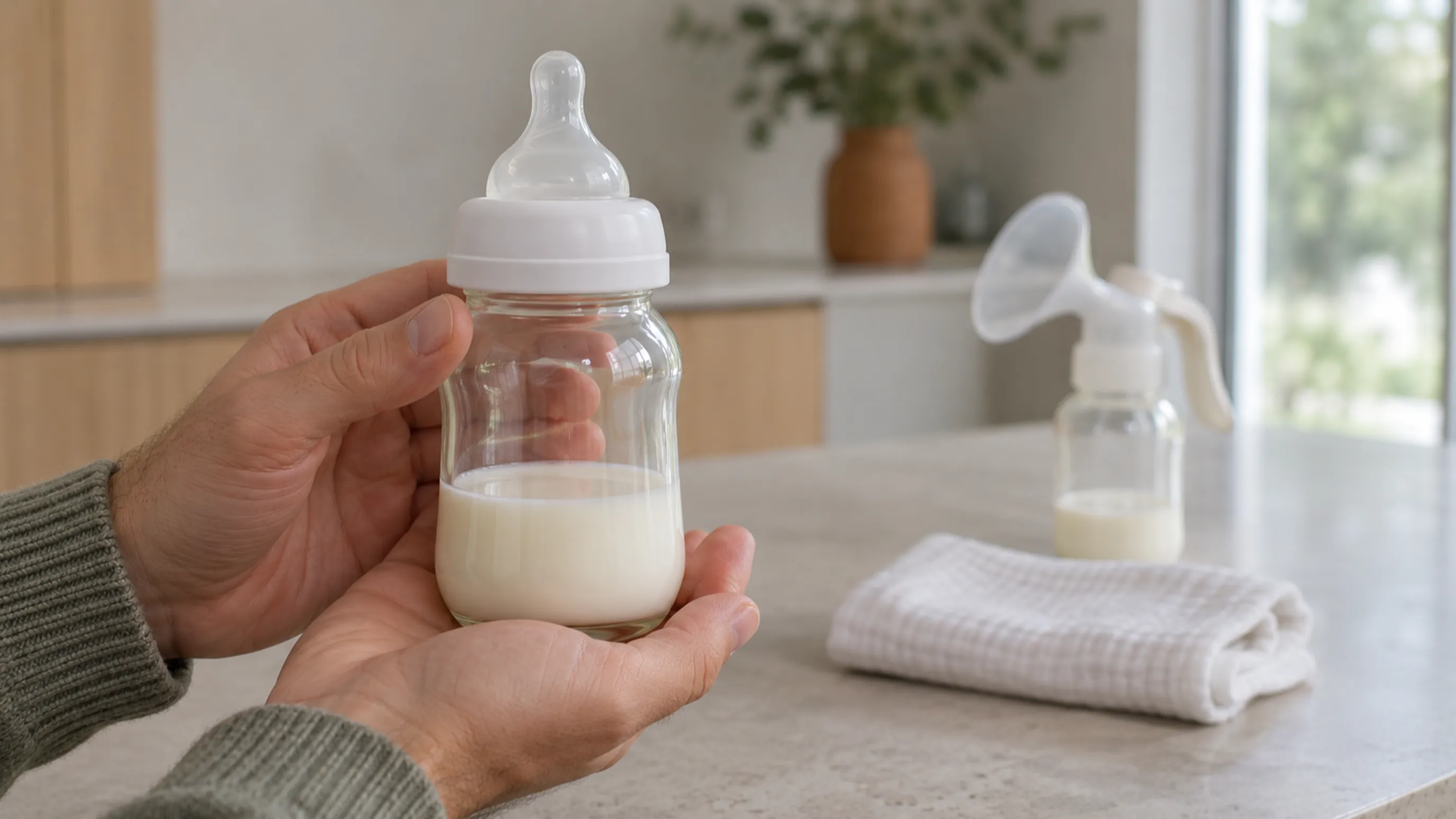
To introduce a bottle to a breastfed baby, wait until breastfeeding is going well. Australian health services advise no bottles in the first 4 weeks. Then have someone else offer a small amount of expressed milk through a slow-flow teat, pace the feed, and express at about the time of the breastfeed your baby misses.
Maybe your partner wants to take a feed, a grandparent is offering to babysit, or the return-to-work date is creeping closer on the calendar. Whatever the reason, a first bottle can feel like a big step when breastfeeding has taken this much work to get going.
No Australian source names an exact week to start. This guide lines up what they do say, then covers the practical parts: what to put in the bottle, how to pace it, who gives it, what to do when your baby refuses, and how to protect your supply.
When to introduce a bottle to a breastfed baby
Australian guidance keeps bottles out of the first 4 weeks, then leaves the timing to how breastfeeding is going. The early weeks are when frequent feeding at the breast builds your supply.
The NHMRC Infant Feeding Guidelines(opens in a new window) say early use of bottles can interfere with establishing breastfeeding. The Australian Breastfeeding Association(opens in a new window) (ABA) says bottles, even of expressed breastmilk, can sometimes interrupt that process.
Here is how the sources line up:
| Source | Advice on bottles | Timing |
|---|---|---|
| NHMRC Infant Feeding Guidelines | Early bottles can interfere with breastfeeding | While breastfeeding is establishing |
| Australian Breastfeeding Association | Bottles can sometimes interrupt supply-building | No fixed week |
| Healthy WA (WA Health) | Avoid bottles, teats and dummies | First 4 weeks |
| SESLHD (NSW Health) | No bottles or dummies | First month |
| NHS (UK, supporting) | Establish breastfeeding first | No fixed week |
The UK row is overseas guidance, included because it explains why timing matters: the NHS(opens in a new window) says missed breastfeeds signal your body to make less milk, especially in the first 6 to 8 weeks.
How do you know breastfeeding is going well?
The South Eastern Sydney Local Health District(opens in a new window) (SESLHD) leaflet describes a baby who is feeding well:
- Wet nappies: five or more heavy wet disposables, or six to eight pale wet cloth nappies, every 24 hours. Our guide to how many wet nappies a day has the full count.
- Poos: regular soft bowel motions.
- Weight: steady weight gain, which your child health nurse can check.
If those boxes are ticked and feeds no longer feel like a battle, you are in a good position to try a bottle. If you're unsure, a child health nurse or ABA counsellor can look at your situation.
If your baby needs a bottle sooner
Sometimes a bottle comes earlier because a midwife or doctor has asked for top-ups. Follow that plan. Expressed milk can also be given by cup or spoon. The NHMRC Infant Feeding Guidelines(opens in a new window) list bottle, cup and spoon as ways to feed it. Our guide to mixed feeding and top-ups covers giving a top-up while protecting your supply.
Expressed milk or formula in the first bottle
Expressed breastmilk is the usual choice for a breastfed baby's bottle. The NHMRC guidelines ask health workers to encourage mums to give expressed milk when they're away from their baby, and to breastfeed when they're together.
Start small. The SESLHD leaflet suggests only small amounts at first, and the ABA suggests preparing a little at a time to cut waste. For how much a baby takes at each feed, see our guide to newborn feeding amounts. The ABA's expressing basics(opens in a new window) show how to work out a per-feed amount from a 24-hour total.
A few handling points:
- Leftovers: throw away any expressed milk left at the end of the feed, or after one hour, Pregnancy, Birth and Baby(opens in a new window) says.
- Storage: our breast milk storage guide has the room, fridge and freezer times.
- Formula: if the bottle holds formula, the ABA's mixed feeding advice(opens in a new window) is to be consistent with the feed you replace and the amount you offer. Our formula feeding guide covers preparation.
Paced bottle feeding, step by step
Paced bottle feeding slows the flow so your baby controls the feed, much as they do at the breast. Raising Children Network(opens in a new window) notes that breastfed babies might find it hard to pace themselves when bottle-feeding. The ABA's steps for paced bottle-feeding(opens in a new window) go like this:
- Offer the bottle when your baby shows signs of hunger.
- Hold your baby upright, supporting their head and neck with your hand.
- Use a slow-flow teat, so your baby can control the flow.
- Gently brush the teat down the middle of your baby's lips, especially the bottom lip, and let them open wide and take it. Don't push it in.
- Keep the bottle almost flat, tipped just enough to fill the teat with milk. Your baby leans back gradually as the feed goes on.
- Let your baby rest every few minutes, so they don't drink too much, too fast.
- Let your baby finish when they're ready, even if milk is left.
Pregnancy, Birth and Baby(opens in a new window) adds that a baby who fusses or turns their head away may need a break, may be full, or may need a burp. Never force your baby to finish a bottle.
Paced feeding means an upright baby, a nearly flat bottle, a slow-flow teat and a pause every few minutes.
If pacing feels awkward, Raising Children Network suggests getting help from your child and family health nurse or a lactation consultant.
Who should give the first bottle?
Someone other than the breastfeeding parent usually has the best chance with the first bottle. Raising Children Network suggests asking your partner or another family member, which helps when you usually breastfeed. The ABA says a baby may accept the bottle more easily when mum is out of sight, because they expect to feed at the breast.
That makes the first bottle a natural job for your partner, and a nice one. A few ways to set it up:
- Leave the room, or even the house, so your baby isn't expecting the breast.
- Pick a calm moment. The ABA suggests offering milk at early feeding cues, before your baby gets upset. The UK's NHS adds that babies are less likely to take to something new when they're tired or hungry.
- Keep it to one person at first. The ABA's guide for carers(opens in a new window) notes that when one person offers the bottle, the baby often learns to accept it more easily.
A grandparent or carer who will give bottles later should meet your baby a few times beforehand, including at a feed time, the ABA says.
If your breastfed baby refuses the bottle
Some breastfed babies need time to get used to a teat, so a refusal on the first few tries is no cause for alarm. Try again later, when your baby is more settled. These ideas come from the ABA(opens in a new window), Raising Children Network and the SESLHD leaflet:
- Try a different time of day, such as after a sleep or between regular feeds.
- Squeeze the teat gently at first so a little milk reaches your baby's mouth.
- Change the position: more upright, or with gentle rocking or walking.
- Change the place: try another room, as the SESLHD leaflet suggests.
- Warm the teat if it feels cold.
- Check the flow. Younger babies often prefer a slower flow and older babies may manage a faster one, the ABA says, so try a different teat.
- Use something that smells of you, like a worn top, during the feed.
- Try a small cup or spoon, sitting your baby up and offering small sips.
It can be stressful to head out with a baby who won't take a bottle. The SESLHD leaflet notes some babies take only small amounts while you're away and wait for a bigger feed when you return. That can be normal at first, as long as their wet and dirty nappies stay regular.
Keeping your supply up when your baby has a bottle
Express at about the time your baby has the bottle, so your breasts still get the signal to make that feed. The ABA's rule is that the more milk removed from your breasts, the more milk you'll make. The SESLHD leaflet advises expressing around the same times your baby would be feeding.
Four more points from the ABA:
- Stretching out feeds can lower supply, because your baby removes less milk, the ABA explains(opens in a new window).
- Replace the same feed each time. The ABA's mixed feeding advice is to be consistent with the feed you replace, and to offer more breastfeeds if your baby seems hungry at other times.
- If you're expressing to replace feeds, the ABA suggests avoiding gaps of more than 6 hours between expressing sessions while you build supply.
- Pump output is a poor gauge of supply. The ABA says babies are usually better at getting milk than pumps, so a small amount from the pump doesn't mean you're running low.
Our guide to how much breast milk to pump has session counts and timing. If the plan is a night bottle so you can sleep, our guide to splitting night feeds with your partner covers how that affects your supply and your sleep.
Starting a bottle before you go back to work
Introduce a bottle or cup 2 or 3 weeks before your first day back, the SESLHD leaflet advises. That gives your baby time to practise and you time to build a small stash. If your baby is over 6 months, a cup is another option.
The same leaflet suggests expressing once a day to build a freezer supply, and many mums find it easiest after a morning feed. You're also entitled to reasonable lactation breaks at work under federal law, the ABA notes(opens in a new window). Our pumping schedule for working mums covers building a small supply before your first day.
When to get help
These signs mean it's time to talk to a professional:
- Regular refusal: if your baby keeps refusing the bottle, talk to your child and family health nurse, Raising Children Network advises.
- Refusing because unwell: if you think illness is behind the refusal, see your GP.
- No wet nappy for 4 to 6 hours, or no drinks for a few hours: Pregnancy, Birth and Baby(opens in a new window) says to see a doctor right away or go to the nearest emergency department.
- Signs of severe dehydration: being less active than usual or unusually sleepy, sunken eyes, no tears, or cold hands and feet. Call 000.
- Supply worries or sore breasts: call the ABA Breastfeeding Helpline on 1800 686 268, any time of day.
- Feeding questions: call Pregnancy, Birth and Baby on 1800 882 436 to talk to a maternal child health nurse.
One record for two feeders
Once two people feed your baby, the one holding the bottle needs to know when the last breastfeed was, and you need to know how much went down so you can express to match. A notebook on the fridge does the job, as long as both of you write in it.
BabyLog keeps that record free for both of you: your partner logs the bottle in mL, you log the pump session, and the home screen shows how long ago your baby last fed and who logged it. Each phone picks up the other's entries when BabyLog opens.
If you start logging a week or so before the first bottle, the free Compare view can later set the last 7 days against the 7 before, including feeds a day, the share that were breastfeeds, and wet nappies a day.
If a shared log would help, you can start free and invite whoever gives the bottle.
Common questions
Ready to start tracking?
BabyLog works on any device — iPhone, Android, tablet, or desktop. Setup takes two minutes.
Keep reading

How to Split Night Feeds With Your Partner: Three Shift Plans for the Newborn Weeks, Even If You're Breastfeeding
How to split night feeds with your partner: three shift plans for bottle-fed and breastfed newborns, and how to protect your milk supply.
Pumping Schedule for Working Mums: How Many Sessions You Need, With Sample Days by Age
A pumping schedule for working mums: one session per missed feed under 6 months, one or two from 6 months, plus sample days, storage and your rights.